


Global coal markets in 2025 are being shaped by a mix of weather patterns, fuel prices, policy decisions and regional energy transitions. While coal demand has stopped its rapid growth, it remains near record levels, with contrasting trends across major economies, according to IEA report. Here are key facts explaining where global coal demand stands today and where it is heading.
Global coal demand remains near record highs in 2025
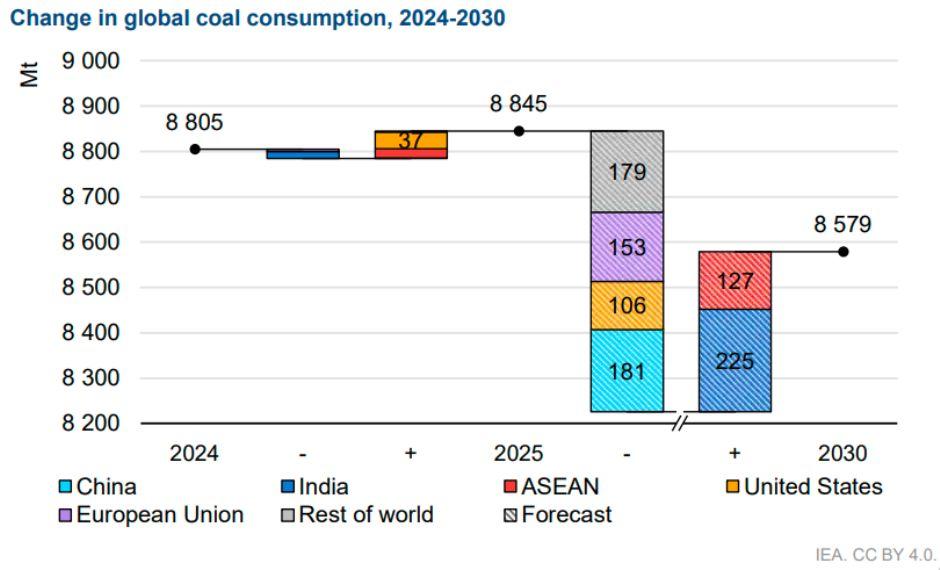
Worldwide coal consumption in 2025 is expected to rise marginally by around 0.5 percent to about 8.85 billion tonnes, keeping demand close to its 2024 level and marking a new record. This outcome broadly aligns with forecasts made a year earlier, despite significant regional variations.
India sees a rare decline in coal power generation
India, a long-time driver of coal demand growth, experienced an early and strong monsoon in 2025. Higher hydropower output and lower electricity demand reduced coal-fired generation, putting the country on track for only the third year-on-year decline in coal power generation in the past 50 years.
United States coal demand rebounds against long-term decline
After averaging a 6 percent annual decline over the past 15 years, US coal consumption is set to increase by around 8 percent in 2025. Higher natural gas prices and slower coal plant retirements, supported by federal policy measures, have temporarily lifted demand.
European Union coal demand falls more slowly
In the European Union, weaker hydropower and wind generation in the first half of 2025 increased coal-fired power output. As a result, coal demand is expected to decline by only about 2 percent in 2025, far less than the double-digit drops recorded in 2023 and 2024.
China keeps global coal demand stable
China consumes more coal than the rest of the world combined and remains the dominant force in global coal markets. In 2025, Chinese coal demand is expected to stay close to its 2024 level, helping keep global consumption broadly flat despite declines in several advanced economies.

Global coal demand is nearing a plateau toward 2030
Looking ahead, global coal consumption is forecast to plateau and then decline gradually through 2030. By the end of the decade, demand is expected to be about 3 percent lower than in 2025 and below its 2023 level, with coal-fired power generation falling under its 2021 level.
Industry coal use declines slowly, offset by gasification
Coal substitution in industrial processes remains slow. Industrial coal use is projected to decline by less than 1 percent per year through 2030, with much of this reduction offset by growth in coal gasification projects, particularly in China.
India and Southeast Asia drive future coal demand growth
Between now and 2030, India is expected to record the largest absolute increase in coal consumption, with demand rising by an average of 3 percent per year and adding more than 200 million tonnes. Southeast Asia is forecast to see the fastest growth, with coal demand increasing by over 4 percent annually.
Global coal production peaks and begins to ease
Global coal production in 2025 is set to remain close to the all-time high reached in 2024. China’s output is expected to rise modestly, while production growth in India has stalled and Indonesia is seeing its first decline since the Covid-19 period. Over the longer term, global coal output is forecast to edge lower through 2030.
Coal imports decline as domestic supply strengthens
After hitting a record in 2024, global coal imports are projected to fall by around 5 percent in 2025. Lower demand and strong domestic production in China and India are key factors. Over the next five years, imports are expected to decline further, with China reducing thermal coal imports and India increasing metallurgical coal imports to support steel production.
Thermal coal prices have retreated from the record highs seen during the 2022 energy crisis triggered by Russia’s invasion of Ukraine. In 2025, prices were about 10 percent lower in Europe and around 20 percent lower in Asia compared with 2024, although trends varied by region.
Prices in China fell in the first half of the year before rebounding as production tightened and demand picked up. Europe experienced a brief price increase early in the year due to weaker hydropower and wind generation, while Australian prices dropped below European levels in April before recovering through August, reflecting shifts in Japanese and Korean demand. Overall, thermal coal prices are moving closer to supply costs, leading to shrinking producer margins.
Together, these trends show a coal market at a turning point. While demand remains high in the near term, intensifying competition from renewables, nuclear power and liquefied natural gas, along with policy and technology shifts, is expected to gradually reshape global coal consumption by the end of the decade.
Baburajan Kizhakedath