


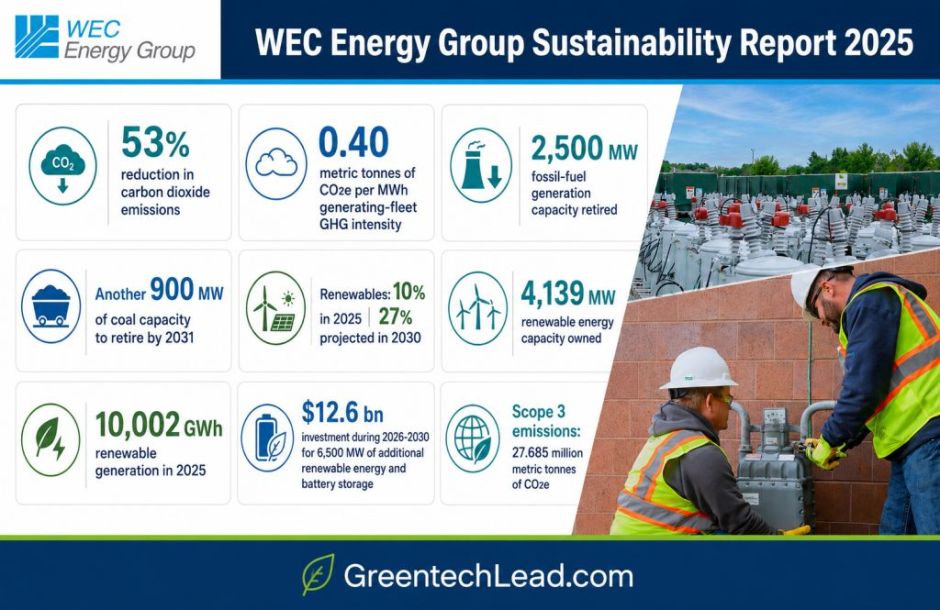
WEC Energy Group is accelerating its sustainability strategy with a 53 percent reduction in carbon dioxide emissions, a planned exit from coal, $12.6 billion of renewable energy and battery investment, clean-energy technology pilots and expanded customer and community programs.
The utility company aims to achieve net carbon-neutral electric generation by 2050, including the potential use of carbon offsets. The goal aligns with global emissions pathways designed to limit warming to 1.5 degrees Celsius.
WEC Energy Group sustainability report 2025 indicated that its transition combines renewable energy, battery storage, lower-carbon generation, hydrogen research, renewable natural gas, energy efficiency and community investment. However, its latest data also shows that Scope 3 emissions increased in 2025, highlighting the challenges associated with decarbonising the wider energy value chain.
WEC Energy Group cuts carbon dioxide emissions by 53 percent
WEC Energy Group reduced carbon dioxide emissions from its electric generation fleet by 53 percent at the end of 2025, compared with its 2005 baseline.
Greenhouse gas emissions intensity across its generating fleet declined from 0.78 metric tonnes of CO2e per MWh in 2005 to 0.40 metric tonnes in 2025. The company plans to reduce generating-fleet emissions intensity to net zero by 2050, including projected carbon offsets.
The changing electricity mix has been a major contributor to the reduction. Coal’s share of electricity supplied dropped from 73 percent in 2005 to 33 percent in 2025 and is expected to fall to just 1 percent in 2030.
Renewable energy’s share increased from 3 percent in 2005 to 10 percent in 2025 and is projected to reach 27 percent in 2030.
Natural gas represented 7 percent of electricity supply in 2005 and 36 percent in 2025. Its share is forecast to increase to 55 percent in 2030 as WEC Energy Group uses flexible gas-fired generation to support the expansion of intermittent renewable resources.
Nuclear energy accounted for 17 percent of the electricity mix in 2005, increased to 21 percent in 2025 and is expected to represent 17 percent in 2030.
WEC Energy Group targets complete coal exit by 2032
WEC Energy Group expects to use coal only as a backup fuel by the end of 2030 and plans to eliminate coal as an energy source by the end of 2032.
The company has retired approximately 2,500 MW of fossil-fuel generation capacity since the beginning of 2018. Retired assets include Pleasant Prairie, Presque Isle, Pulliam, Oak Creek Units 5 and 6, and part of Edgewater Unit 4.
WEC Energy Group expects to retire another 900 MW of coal-fired generation by the end of 2031. The company is also preparing to convert existing coal-fired units at Oak Creek and Weston Unit 4 to natural gas as part of its transition.
The coal phase-out is central to its effort to achieve net carbon-neutral electric generation by 2050 while maintaining electricity reliability and affordability.
Renewable energy capacity reaches 4,139 MW
WEC Energy Group owned 4,139 MW of renewable energy capacity at the end of 2025 across its regulated utility and nonutility businesses.
Its portfolio included 30 hydroelectric plants with 96 MW, one biomass plant with 44 MW, six wind facilities with 585 MW and solar facilities representing 773 MW.
The company also operated 11 majority-owned nonutility renewable generation facilities with 2,654 MW of capacity.
Renewable capacity serving its utility businesses increased from 1,018 MW in 2023 to 1,268 MW in 2024 and 1,487 MW in 2025.
Renewable capacity owned through WEC Infrastructure expanded from 1,845 MW in 2023 to 2,404 MW in 2024 and 2,654 MW in 2025.
Solar generation more than doubles in 2025
WEC Energy Group’s total renewable electricity generation increased from 8,502 GWh in 2023 to 9,055 GWh in 2024 and 10,002 GWh in 2025.
Solar generation recorded the strongest expansion, rising from 717 GWh in 2023 to 887 GWh in 2024 and 2,081 GWh in 2025.
Wind generation reached 6,258 GWh in 2025, compared with 6,466 GWh in 2024 and 5,956 GWh in 2023.
Hydroelectric facilities produced 1,224 GWh during 2025, while biofuel generation totalled 439 GWh.
Total zero-carbon electricity generation increased from 17,470 GWh in 2023 to 18,058 GWh in 2024 and 18,980 GWh in 2025.
$12.6 billion investment to add 6,500 MW of renewable energy and storage
WEC Energy Group plans to invest $12.6 billion between 2026 and 2030 to build and own approximately 6,500 MW of additional renewable energy and battery-storage capacity for its regulated utilities in Wisconsin.
Battery storage will give the company greater flexibility to manage variations in wind and solar output. Storage resources can absorb surplus renewable electricity and supply it when renewable generation falls or electricity demand increases.
Green bonds issued in connection with We Energies and Wisconsin Public Service renewable projects supported $940 million in construction expenditure through 2025.
Projects associated with the green financing include Red Barn Wind Park, Two Creeks Solar Park, Badger Hollow I and II solar parks and Paris Solar-Battery Park.
Solar projects support biodiversity and habitat restoration
WEC Energy Group had 40 operating solar-generation facilities in 2025, ranging from 1 acre to more than 2,000 acres.
Its renewable energy project sites collectively covered nearly 14,000 acres. More than 78 percent of this land had been restored to native grassland, while nearly 1,300 acres were specifically managed as pollinator habitat.
The company uses vegetation management and habitat-restoration programs at renewable project sites to improve biodiversity, protect water resources, reduce soil erosion and provide suitable environments for pollinating insects.
Long-duration battery pilot targets up to 10 hours of storage
WEC Energy Group is preparing a pilot of CMBlu Energy’s Organic SolidFlow battery at the Valley Power Plant in Milwaukee.
The long-duration battery is designed to provide between five and 10 hours of discharge. Unlike conventional lithium-ion batteries, the technology does not depend on lithium or rare metals.
The pilot will assess whether the system can provide longer-duration energy supply, strengthen grid flexibility and support greater integration of renewable generation.
Hydrogen pilots explore lower-carbon generation
Hydrogen forms another part of WEC Energy Group’s clean-energy technology research.
A utility-scale pilot successfully blended 25 percent hydrogen by volume with natural gas in a grid-connected reciprocating internal combustion engine. The trial evaluated engine efficiency, carbon dioxide reductions, methane emissions and the safe operation of hydrogen-blended fuel.
A separate testing program found that monitoring equipment could identify leaks and measure hydrogen content in natural gas systems using blends containing up to 20 percent hydrogen.
The company is examining hydrogen as a potential clean fuel for dispatchable generation and as a lower-carbon component of its natural gas distribution network.
Renewable natural gas contracts cover 2.1 billion cubic feet
WEC Energy Group is also using renewable natural gas to reduce methane emissions from its gas distribution operations.
The company has contracts covering 2.1 billion cubic feet of renewable natural gas, primarily produced from local dairy farms. The renewable gas replaces higher-emission conventional methane that would otherwise enter the distribution system.
Renewable natural gas, hydrogen, infrastructure upgrades and energy-efficient heating technologies form part of the company’s broader effort to reduce emissions associated with natural gas consumption.
Scope 3 emissions rise to 27.685 million tonnes
WEC Energy Group reported Scope 3 greenhouse gas emissions of 27.685 million metric tonnes of CO2e in 2025, compared with 24.228 million tonnes in 2024 and 25.739 million tonnes in 2023.
The use of sold products was the largest contributor, generating 19.690 million tonnes of CO2e in 2025.
Fuel- and energy-related activities accounted for 6.291 million tonnes, while purchased goods and services generated 680,000 tonnes.
Upstream transportation and distribution produced 628,000 tonnes, and investments accounted for another 396,000 tonnes of CO2e.
The year-over-year increase in Scope 3 emissions demonstrates that WEC Energy Group’s progress in reducing power-generation emissions has not yet been replicated across its entire value chain. Reducing emissions from sold energy products, fuel supply, procurement, transportation and investments will therefore be essential to strengthening its long-term climate performance.
$7.4 billion investment supports energy reliability
WEC Energy Group plans to invest $7.4 billion between 2026 and 2030 in modern natural gas generation and liquefied natural gas storage infrastructure.
Of the total, $6.1 billion will support more than 3,600 MW of additional natural gas generation capacity. These flexible resources are expected to maintain electricity reliability when wind and solar output is low.
The investment program includes $1.2 billion for 1,100 MW of simple-cycle combustion turbines at the Oak Creek Power Plant site.
WEC Energy Group also expects to invest $300 million in 128 MW of reciprocating internal combustion engine generation near the Paris Generating Station. An additional $200 million is planned for a 33-mile natural gas lateral pipeline.
Although these investments support reliability, their impact on long-term greenhouse gas emissions will be an important consideration as the company moves towards its 2050 carbon-neutral electricity target.
Energy-efficiency programs benefit more than 275,000 customers
More than 275,000 customers participated in WEC Energy Group’s energy-efficiency and conservation programs.
Participants received nearly $66 million in rebates and incentives designed to reduce the upfront cost of efficiency improvements.
Lower energy consumption can reduce customer bills, limit peak electricity demand and complement renewable energy investment by reducing the amount of generation required across the system.
WEC Energy Group invests $24 million in communities and customers
WEC Energy Group contributed $19 million through corporate charitable-giving programs and company foundations.
The company provided another $5 million through low-income customer-assistance programs, taking the combined community and customer-support contribution to $24 million.
These programs support energy affordability and community development while adding a social component to the company’s environmental sustainability strategy.
WEC Energy Group sustainability outlook
WEC Energy Group’s 2025 sustainability performance shows substantial progress in reducing emissions from electricity generation and expanding renewable energy.
The 53 percent carbon dioxide reduction, growth in renewable capacity to 4,139 MW and increase in zero-carbon generation to 18,980 GWh provide measurable evidence of its energy transition.
Its planned $12.6 billion investment in approximately 6,500 MW of renewable energy and battery storage could significantly expand the clean-energy portfolio between 2026 and 2030. The planned coal exit by 2032 and net carbon-neutral electric generation goal for 2050 provide further direction.
However, Scope 3 emissions rising to 27.685 million tonnes of CO2e shows that wider value-chain decarbonisation remains a challenge. WEC Energy Group’s long-term sustainability performance will depend on whether it can combine renewable growth, coal retirement, energy efficiency, storage and emerging technologies with meaningful reductions in indirect emissions.
SHAFANA FAZAL