


Walmart’s FY2025 Sustainability Report highlights significant progress toward its long-term environmental, social, and governance (ESG) strategy, with renewable energy adoption, emissions reduction, circular economy initiatives, and supplier decarbonization emerging as key priorities. The retail giant is integrating sustainability into core business operations to improve supply chain resilience, reduce costs, and create long-term value across its global footprint.
Walmart Advances Toward Net Zero by 2040
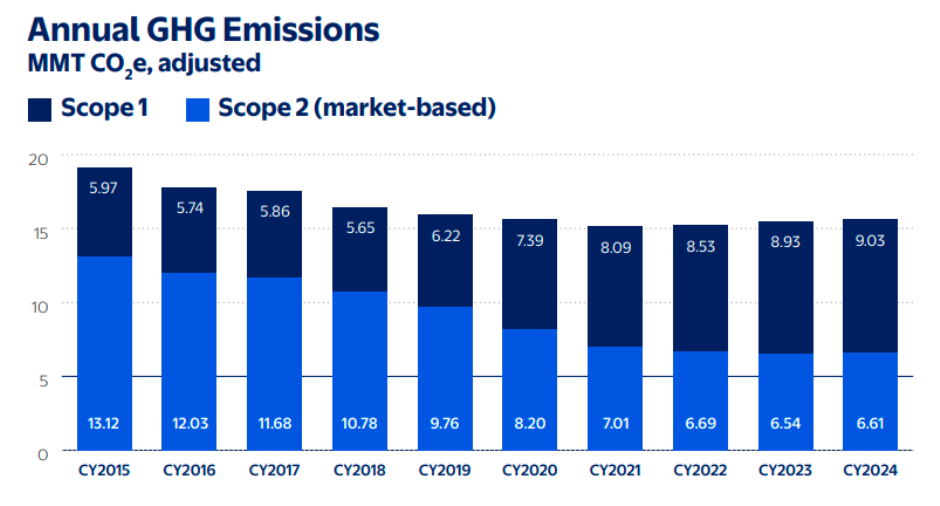
Walmart has reaffirmed its goal of achieving net zero emissions across global Scope 1 and Scope 2 operations by 2040. As part of its climate roadmap, the company aims to reduce absolute Scope 1 and Scope 2 greenhouse gas emissions by 35 percent by 2025 and 65 percent by 2030, compared with its 2015 baseline.
Walmart’s FY2025 Sustainability Report, which was published in September 2025, indicated that it also plans to power 50 percent of its global operations with renewable electricity by 2025 and 100 percent by 2035.
Renewable Energy Continues to Expand
Renewable electricity supplied 48.5 percent of Walmart’s global electricity requirements in 2024, up from 47.6 percent in 2023 and 46.6 percent in 2022. Renewable electricity procured through dedicated renewable energy contracts also increased to 30.6 percent in 2024 from 29.6 percent in 2023 and 29.3 percent in 2022.
To accelerate the clean energy transition, Walmart has deployed 166 megawatts of on-site solar capacity across 325 facilities and 10 megawatts of battery storage at 44 locations, strengthening energy resilience while reducing dependence on conventional power sources.
Scope 1 and Scope 2 Emissions Remain Below Baseline
Walmart reported total Scope 1 and Scope 2 greenhouse gas emissions of 15.65 million metric tons of CO₂e in 2024, compared with 15.47 million metric tons in 2023 and 15.22 million metric tons in 2022. The 2024 total comprised 9.03 million metric tons of Scope 1 emissions and 6.61 million metric tons of market-based Scope 2 emissions.
Although operational emissions increased 1.1 percent year over year, following increases of 1.7 percent in 2023 and 0.7 percent in 2022, Walmart’s emissions remain 18.1 percent below the 2015 baseline, compared with 19.0 percent in 2023 and 20.3 percent in 2022.
The report attributes the temporary increase primarily to expanding logistics operations, greater transportation activity, refrigeration systems, and regional fluctuations in renewable electricity availability.
Carbon Intensity Continues to Improve
Walmart continued improving operational efficiency, reducing carbon intensity to 22.98 metric tons of CO₂e per million dollars of revenue in FY2025 from 23.87 in FY2024 and 24.89 in FY2023.
Overall, carbon intensity has declined 47.4 percent since FY2016, including a further 3.7 percent year-over-year reduction during 2024, demonstrating improved emissions efficiency despite continued revenue growth.
Supplier Decarbonization Drives Scope 3 Strategy
Estimated Scope 3 emissions reached 636.57 million metric tons of CO₂e in 2024, compared with 625.30 million metric tons in 2023 and 609.82 million metric tons in 2022. Scope 3 emissions intensity improved to 0.94 million metric tons of CO₂e per billion dollars of net sales, compared with 0.97 in 2023 and 1.00 in 2022.
Since Scope 3 emissions account for approximately 90 percent to 95 percent of Walmart’s total greenhouse gas footprint, supplier engagement remains central to its decarbonization strategy.
Through Project Gigaton, Walmart has engaged more than 5,900 suppliers worldwide. Suppliers have collectively reported 1.19 billion metric tons of CO₂e reduced or avoided since 2017, allowing Walmart to surpass its 1 billion metric ton emissions reduction milestone well ahead of its 2030 target. During the reporting year alone, suppliers reduced or avoided more than 198 million metric tons of CO₂e.
Circular Economy and Sustainable Packaging
Walmart continues strengthening its circular economy strategy through waste reduction and sustainable packaging. The company achieved an 83.5 percent global waste diversion rate, while approximately 82 percent of private-brand packaging is now designed for recycling, reuse, or compostability. Post-consumer recycled content currently represents 8 percent of packaging materials, highlighting additional opportunities to improve circular material use.
Nature Conservation and Responsible Sourcing
The company has expanded biodiversity protection through responsible sourcing initiatives covering 21 million acres of land and more than 1 million square miles of marine ecosystems.
Walmart reports that approximately 99 percent of private-brand paper and pulp products are sourced from certified sustainable sources. More than 99 percent of palm oil sourcing is certified sustainable, while 95 percent of seafood products originate from certified fisheries or aquaculture operations.
Electric Vehicle Infrastructure and Workforce Progress
Walmart has expanded its electric mobility infrastructure to more than 1,300 EV charging stations across U.S. stores and clubs, compared with 1,281 stations in both FY2024 and FY2023.
The report also highlights continued social sustainability progress. Women earn 1.00 dollar for every 1.00 dollar earned by male associates, while racial pay equity in the United States stands at 0.99 dollars for every 1.00 dollar earned by white employees. Approximately 75 percent of salaried managers began their careers as hourly associates, reflecting Walmart’s focus on internal career development.
Sustainability Leadership
Walmart’s sustainability strategy is led by Kathleen McLaughlin, Executive Vice President and Chief Sustainability Officer, who oversees the company’s climate strategy, renewable energy expansion, supplier decarbonization, ESG governance, and long-term integration of sustainability across global retail operations.
The FY2025 Sustainability Report demonstrates Walmart’s shift from individual environmental initiatives to a fully integrated sustainability model, where renewable energy, emissions reduction, supplier engagement, circular economy practices, biodiversity conservation, and workforce development collectively support the company’s long-term net zero and business growth objectives.
SHAFANA FAZAL