


Volkswagen Group has unveiled one of the automotive industry’s most comprehensive sustainability roadmaps through its regenerate+ strategy, combining ambitious targets for net-zero emissions, renewable energy, circular economy, sustainable finance, electric mobility, and biodiversity protection.
The company aims to achieve net carbon neutrality by 2050 while accelerating decarbonization across its operations and value chain. Volkswagen has established an interim target to reduce the carbon footprint per customer-kilometer traveled by its passenger cars and light commercial vehicles by 30 percent by 2030 compared with 2018 levels, Volkswagen Sustainability Report 2025 indicated.
A key pillar of the strategy is the decarbonization of manufacturing. Volkswagen plans to make all global production sites net carbon neutral by 2040, bringing forward the target by 10 years from its original timeline. To support this goal, the company intends to reduce greenhouse gas emissions from production operations by 90 percent by 2040 compared with 2018 levels.
Renewable energy is central to Volkswagen’s emissions reduction plans. The automaker has committed to sourcing 100 percent of external electricity from carbon-neutral sources by 2030 across all production facilities worldwide. European production sites have already achieved a significant milestone by obtaining 100 percent of their external electricity from renewable energy sources.
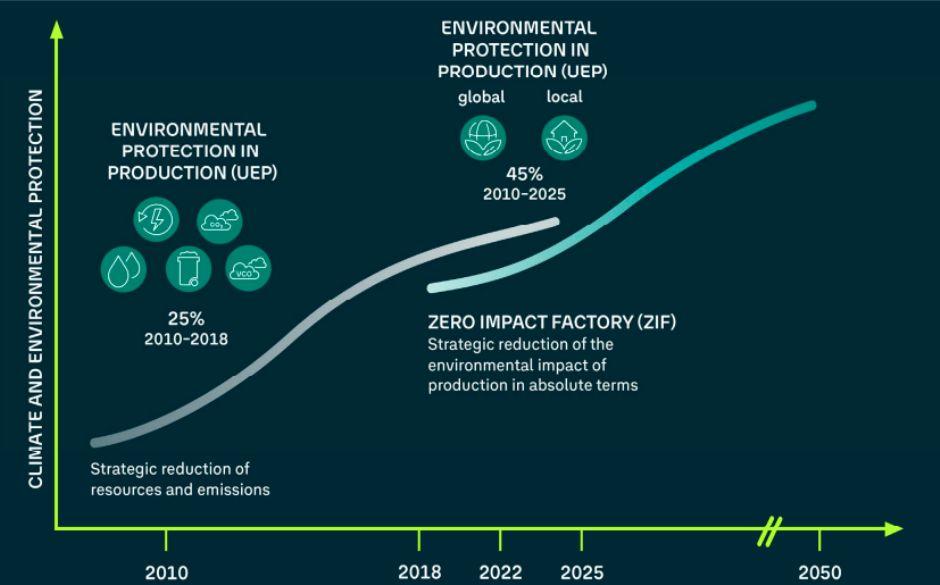
Through its Zero Impact Factory initiative, Volkswagen aims to reduce the absolute environmental impact of passenger car, light commercial vehicle, and component production facilities by 37.5 percent by 2030 and 68.8 percent by 2040, before reaching environmental neutrality by 2050, all compared with 2018 levels.
Volkswagen’s progress in emissions reduction is reflected in its Decarbonization Index, which reached 46.3 tonnes of CO₂ equivalent per vehicle in 2025. This performance surpassed the company’s target of 48.5 tonnes CO₂e per vehicle and exceeded its maximum target threshold of 47.5 tonnes CO₂e per vehicle, highlighting stronger-than-expected progress in reducing lifecycle emissions.
The company is also advancing circular economy initiatives to reduce dependence on virgin raw materials. Volkswagen aims to achieve a 40 percent circular materials usage rate by 2040 for passenger cars and light commercial vehicles. The strategy promotes wider adoption of recycled, bio-based, and carbon-based materials. Models within the ID. electric vehicle family already utilize recycled materials in headliners, carpets, fabrics, seats, door trims, decorative panels, seat covers made from recycled PET bottles, and yarn derived from ocean plastics.
Electric mobility remains a major driver of Volkswagen’s sustainability ambitions. Battery electric vehicles accounted for 10.9 percent of Volkswagen Group deliveries in 2025, compared with 8.2 percent in the previous year, demonstrating continued growth in zero-emission vehicle adoption.
Volkswagen is backing its decarbonization efforts with substantial investments. The company launched the Leitmotif venture capital fund with an initial commitment of US$300 million to accelerate the development of sustainable mobility solutions, clean energy technologies, and decarbonization innovations throughout the mobility value chain.
Biodiversity has become an increasingly important component of Volkswagen’s environmental strategy. In 2025, the company established a Biodiversity Fund with annual financing of up to €25 million and a planned duration of five years from 2025 to 2029. The fund supports ecosystem restoration, conservation projects, and biodiversity protection beyond Volkswagen’s direct operations and supply chain.
Sustainable finance is another strategic priority. Volkswagen plans to finance at least 30 percent of its outstanding bond volume through green bonds by 2030, increasing that proportion to 50 percent by 2040. Most annual euro bond issuances are already structured as green bonds or aligned with the European Union Taxonomy framework.
Volkswagen is also pursuing broader sustainability objectives across its supply chain. The company works with more than 63,000 supplier locations across 93 countries and aims to demonstrate by 2040 that more than 95 percent of relevant direct suppliers, measured by sales revenue, achieve a positive sustainability rating (S-Rating).
The company’s sustainability governance extends beyond climate action. Volkswagen reported a Diversity Index score of 168 in 2025, exceeding its target of 154 and maximum target value of 158, reflecting progress in workforce diversity and internationalization.
Aligned with the Paris Climate Agreement, Volkswagen’s sustainability roadmap combines ambitious climate targets, renewable energy adoption, circular economy principles, biodiversity investments, electric vehicle expansion, and green financing. With targets including 100 percent renewable electricity by 2030, 90 percent emissions reduction by 2040, 40 percent circular material usage by 2040, 30 percent green bond financing by 2030, 50 percent green bond financing by 2040, and net carbon neutrality by 2050, Volkswagen is positioning itself among the global leaders in sustainable mobility and industrial decarbonization.
SHAFANA FAZAL