


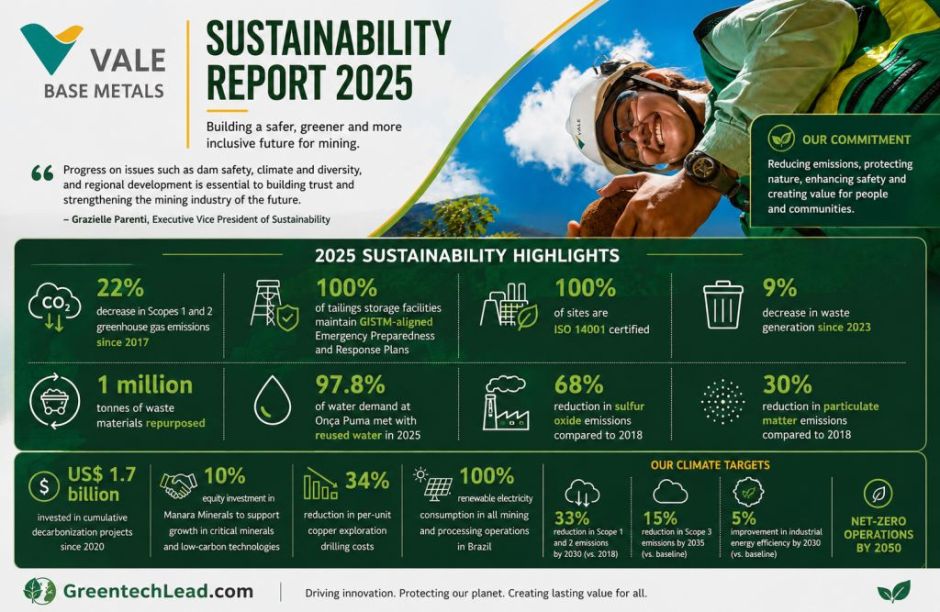
Vale Base Metals accelerated its sustainability agenda in 2025 through significant investments in climate action, renewable energy, circular mining, biodiversity conservation, water stewardship, dam safety, workforce protection, and social inclusion.
Vale Base Metals, under the guidance of Grazielle Parenti, Executive Vice President of Sustainability, has continued integrating sustainability into its long-term growth strategy while delivering measurable environmental, social, and governance results.
Vale has invested a cumulative USD 1.7 billion in decarbonization initiatives since 2020, reinforcing its commitment to reducing greenhouse gas emissions and achieving long-term climate targets. The company also strengthened its position in the global energy transition through a strategic partnership with Manara Minerals, which included a 10 percent equity investment aimed at supporting future growth in critical minerals and low-carbon technologies. In exploration activities, Vale achieved a 34 percent reduction in per-unit copper exploration drilling costs while expanding exploration programs across key mining assets.
Climate action remained a central focus during 2025. Vale continued progressing toward its goal of reducing Scope 1 and Scope 2 greenhouse gas emissions by 33 percent by 2030 and achieving net-zero operational emissions by 2050. By the end of 2025, the company had already achieved a 15 percent absolute reduction in Scope 1 and Scope 2 emissions compared with its 2018 baseline. Vale also maintained its commitment to reduce Scope 3 emissions by 15 percent by 2035 and improve industrial energy efficiency by 5 percent by 2030.
A major milestone was the achievement of 100 percent renewable electricity consumption across all mining and processing operations in Brazil. This accomplishment represents a significant step toward the company’s broader renewable energy goals and supports the transition away from fossil-fuel-based electricity. Vale also expanded the use of electric boiler systems to replace heavy fuel oil consumption and advanced electric heavy-vehicle pilot projects designed to reduce diesel dependence across mining operations, Vale Base Metals Sustainability Report 2025 indicated.
Environmental performance improvements extended beyond greenhouse gas reductions. Sulfur oxide emissions declined by 68 percent compared with 2018 levels, reflecting successful deployment of cleaner technologies and emissions-control systems. Particulate matter emissions fell by 30 percent, contributing to improved air quality and environmental conditions around operational sites.
Vale continued advancing circular economy initiatives through its circular mining strategy. The company achieved an 8 percent circularity yield during 2025 through the recovery and processing of 26 million tonnes of iron ore and other valuable materials from legacy waste deposits and tailings facilities. Vale remains on track to achieve its target of generating 10 percent of total production from circular sources by 2030. Tailings-derived sustainable sand products continued to create environmental and commercial value by reducing demand for conventional sand extraction while promoting resource efficiency.
Water stewardship also delivered strong results. Vale reduced freshwater withdrawal intensity by 32 percent compared with its 2017 baseline through expanded water recycling systems, operational improvements, and conservation measures. The achievement places the company ahead of its long-term water management objectives and strengthens resilience in water-stressed regions.
Biodiversity protection remained another important sustainability priority. Vale continued implementing its strategy to protect and restore 500,000 hectares of native ecosystems by 2030. The program includes protecting 400,000 hectares and restoring 100,000 hectares across multiple ecological regions. These initiatives support biodiversity conservation, ecosystem resilience, and natural carbon sequestration while enhancing environmental value in areas surrounding operations.
Dam safety remained one of the company’s most critical ESG priorities. During 2025, Vale achieved 63 percent completion of its upstream dam decharacterization program and eliminated 19 legacy upstream dams since 2019. The company reduced the number of structures classified under emergency conditions by 77 percent since 2020 and achieved zero dams classified at Emergency Level 3. All prioritized tailings facilities remained aligned with the Global Industry Standard on Tailings Management, supported by independent governance reviews and oversight mechanisms.
Workplace safety performance continued to improve across Vale’s global operations. The Total Recordable Injury Frequency Rate declined by 55 percent compared with the 2019 baseline, reflecting stronger safety culture, enhanced risk management practices, and operational discipline. High-potential incidents decreased by 21 percent, demonstrating progress in preventing serious workplace accidents and strengthening employee protection.
Diversity, inclusion, and community development also advanced during the year. Women represented 28.2 percent of Vale’s global workforce at the end of 2025, exceeding the company’s original diversity targets. Female representation in leadership positions increased to 25.7 percent, compared with 14 percent in 2019, highlighting substantial progress toward gender balance across management ranks.
Vale continued supporting regional economic development through social inclusion programs linked to its operations. The company remains committed to helping lift 500,000 people out of extreme poverty in communities connected to its business activities. During 2025, approximately 60,000 individuals participated in economic inclusion and community development programs designed to improve livelihoods, generate income opportunities, and support long-term socioeconomic development.
Vale Base Metals delivered measurable sustainability progress across climate action, renewable energy, circular mining, biodiversity, water stewardship, dam safety, workforce protection, and social inclusion during 2025. Key achievements included USD 1.7 billion in cumulative decarbonization investments since 2020, a 10 percent equity investment partnership with Manara Minerals, a 34 percent reduction in per-unit copper exploration drilling costs, a 15 percent reduction in Scope 1 and Scope 2 emissions, a target of 33 percent emissions reduction by 2030, a 15 percent Scope 3 emissions reduction target by 2035, a 5 percent industrial energy efficiency improvement target by 2030, 100 percent renewable electricity consumption across Brazilian operations, a 68 percent reduction in sulfur oxide emissions, a 30 percent decline in particulate matter emissions, recovery of 26 million tonnes of materials through circular mining, an 8 percent circularity yield, a target of 10 percent production from circular sources by 2030, a 32 percent reduction in freshwater withdrawal intensity, protection and restoration of 500,000 hectares of ecosystems by 2030 including 400,000 hectares protected and 100,000 hectares restored, 63 percent completion of the upstream dam decharacterization program, elimination of 19 legacy dams, a 77 percent reduction in emergency-classified structures, zero Emergency Level 3 dams, a 55 percent reduction in injury frequency rates, a 21 percent reduction in high-potential incidents, 28.2 percent female workforce representation, 25.7 percent female leadership representation compared with 14 percent in 2019, and participation of approximately 60,000 people in community development programs supporting the broader goal of lifting 500,000 people out of extreme poverty.
SHAFANA FAZAL