


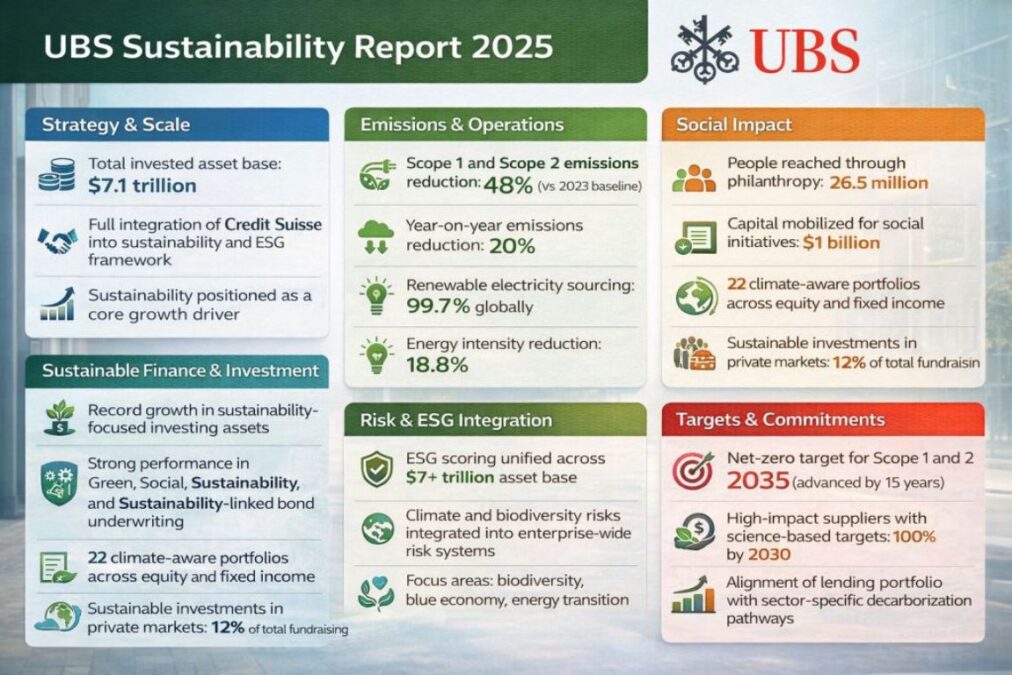
UBS has positioned sustainability at the core of its global strategy in 2025, transforming it from a compliance requirement into a major growth driver across its $7.1 trillion invested asset base. Following the full integration of Credit Suisse, the bank has scaled its climate transition initiatives, embedding ESG principles deeply into investment, risk management, and client offerings.
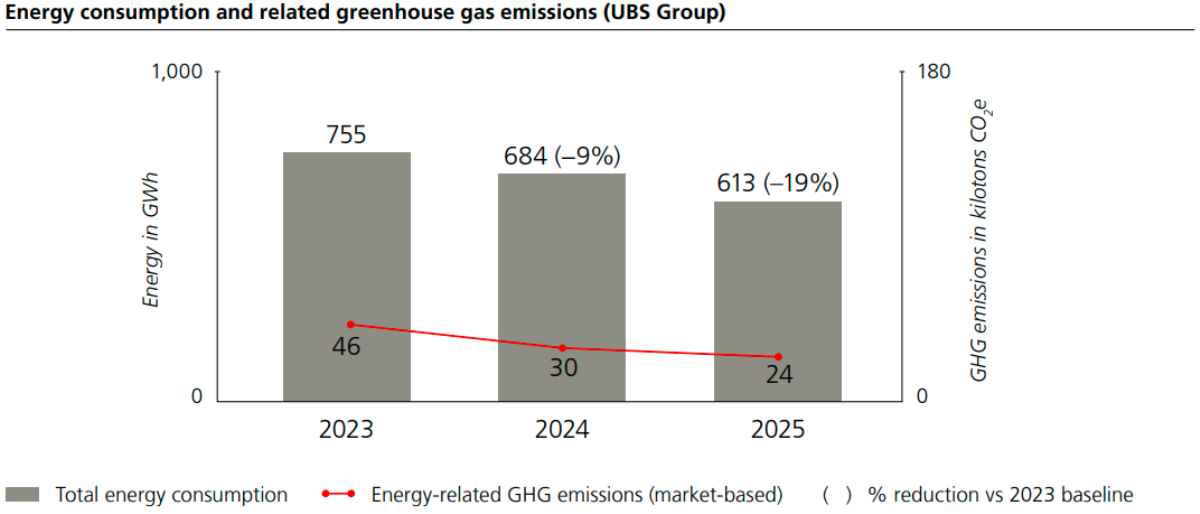
The bank reported strong progress in reducing its operational footprint. UBS achieved a 48 percent reduction in Scope 1 and Scope 2 emissions compared to its 2023 baseline, including a 20 percent year-on-year decline. Renewable electricity sourcing reached 99.7 percent globally, while energy intensity dropped by 18.8 percent due to facility consolidation and efficiency improvements. These measures highlight UBS’s rapid transition toward low-carbon operations.
UBS CEO Sergio P. Ermotti, in the Sustainability Report 2025, said: “We continued to work toward our objectives of supporting the transition of our financing and investing clients to low-carbon and climate-resilient business models and mobilizing private and institutional capital to facilitate an orderly transition.”
Sustainable finance continues to expand as a key pillar of UBS’s business model. Sustainability-focused investing assets reached record levels, supported by the integration of Credit Suisse’s product platforms into a unified ESG framework across Global Wealth Management and Asset Management divisions. The bank has also exceeded its revenue-apportioned targets in Green, Social, Sustainability, and Sustainability-linked bond underwriting, reinforcing its leadership in sustainable capital markets.

Beyond financial performance, UBS has delivered measurable social impact. The bank achieved its philanthropic goal of reaching 26.5 million people and mobilizing $1 billion in capital by the end of 2025. Employee participation in volunteering programs reached 37 percent globally, with a strong focus on skills-based initiatives supporting underserved communities.
UBS is scaling investment strategies aligned with climate and nature goals. Its Asset Management division now oversees 22 climate-aware portfolios across equity and fixed income markets, leveraging proprietary transition risk models. In private markets, sustainable investments accounted for 12 percent of total fundraising in 2025, reflecting growing demand for impact-driven capital allocation. The bank has also continued to expand its exposure to climate technology ventures, strengthening its long-term sustainability positioning.
The bank’s sustainability framework is anchored in three pillars: Protect, Grow, and Attract. UBS has integrated climate and biodiversity risks into its enterprise-wide financial risk and stress testing systems, ensuring resilience against environmental disruptions. It has also unified ESG scoring across its combined asset base, creating consistency in sustainability evaluation across more than $7 trillion in investments. Through thematic strategies such as biodiversity, blue economy, and energy transition, UBS is attracting a new generation of clients focused on sustainable wealth creation.
Looking ahead, UBS has brought forward its operational net-zero target for Scope 1 and Scope 2 emissions to 2035, accelerating its timeline by 15 years. The bank is also working to ensure that 100 percent of its high-impact suppliers adopt science-based climate targets by 2030. In parallel, UBS continues to align its lending portfolio with sector-specific decarbonization pathways in industries such as oil and gas, power generation, and real estate, in line with global net-zero banking standards. By embedding sustainability across its investment platform, operations, and client engagement strategies, UBS is redefining the role of global financial institutions in driving the transition to a low-carbon and inclusive economy.
BABURAJAN KIZHAKEDATH