


Trex Company has strengthened its leadership in sustainable building materials by advancing a circular economy model that transforms recycled plastic film and reclaimed wood into high-performance composite decking. According to its 2025 Sustainability Report, 95 percent of the raw materials used in Trex composite decking come from recycled and reclaimed sources, helping reduce landfill waste, conserve natural resources and minimize reliance on virgin timber.
Trex continues to expand its sustainability strategy by increasing the collection of waste polyethylene (PE) film and reclaimed wood, investing in research and development to recover additional plastic waste streams, recycling nearly all production scrap back into manufacturing, developing recycling solutions for end-of-life decking products, and improving energy efficiency, water conservation and manufacturing performance.
Adam D. Zambanini, President and Chief Executive Officer of Trex, said: “The values we hold today are the foundation for our future success. Trex is well positioned to continue leading our category, creating durable value for our customers, our shareholders and the generations to come.”
During 2025, Trex sourced 1 billion pounds of recycled and reclaimed materials for its products while recovering and reusing approximately 100 percent of process waste generated during manufacturing. The company also recycled 17 billion gallons of process water across its manufacturing operations, reinforcing its commitment to resource efficiency.
Trex has now recycled more than 6.4 billion pounds of waste plastic film since its founding, making it one of North America’s largest recyclers of polyethylene film. The company sources an average of 379 million pounds of recycled polyethylene film and 588 million pounds of reclaimed wood annually, representing approximately 967 million pounds of recycled raw materials based on the 2023-2025 rolling average.
The company’s circular manufacturing ecosystem is supported by the NexTrex recycling programme, which has expanded to more than 15,300 retail collection locations across the United States. The network enables consumers, retailers and businesses to recycle plastic bags, pallet wrap, stretch film and other polyethylene materials that are converted into durable outdoor living products.
Trex also continues investing in research and development to process increasingly complex recycled feedstocks and recover additional waste streams that are traditionally difficult to recycle. The company conducted a comprehensive waste audit during 2025 to identify new opportunities for internal and external recycling while exploring future solutions for recycling end-of-life composite decking products.
Responsible sourcing remains another key pillar of Trex’s sustainability strategy. Approximately 99 percent of reclaimed wood used in manufacturing comes from certified sustainable sources or agricultural waste streams. The company also sources recycled aluminum for its railing products, with supplier recycled content ranging from 30 percent to 100 percent and an average recycled aluminum content of 78 percent by weight.
Trex’s manufacturing process is designed to maximize circularity by converting post-consumer, post-commercial, post-retail and post-industrial plastic film into new products while minimizing waste and emissions. Nearly 95 percent of composite decking materials consist of recycled polyethylene plastic and reclaimed wood, while factory waste is continuously recovered and reintroduced into production.
The durability of Trex products further enhances sustainability by extending product life and reducing material consumption. Residential composite decking products are backed by warranties of 25 years, 35 years, or 50 years, depending on the product range. Trex estimates its decking lasts at least twice as long as traditional wood decks, reducing replacement frequency and lowering long-term environmental impacts.
Beyond manufacturing, Trex continues investing in employee development and community engagement. Employees completed more than 52,000 hours of leadership, onboarding and professional development training during 2025. The company distributed more than $450,000 in cash and equity through its Annual Distinguished Performance Awards to 71 employees, while 3,935 schools and community groups participated in the NexTrex Recycling Challenge.
Trex also maintains strong governance practices with 9 independent directors on its 10-member Board, 40 percent female board representation and 100 percent ethics training completion among office-based and field sales employees.
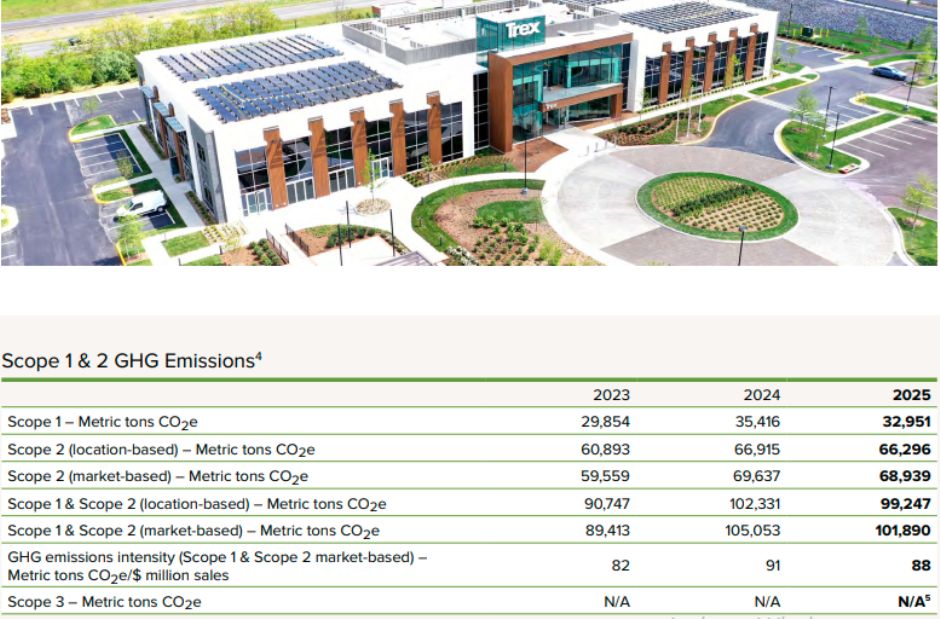
Although the 2025 Sustainability Report does not disclose a formal net-zero target, Scope 1, Scope 2 or Scope 3 greenhouse gas emissions figures, renewable electricity targets, or solar and wind energy investments, the company continues to advance sustainability through circular manufacturing, responsible sourcing, water conservation, waste reduction and continuous operational improvements.
With 95 percent recycled content, more than 6.4 billion pounds of waste plastic recycled since inception, 17 billion gallons of recycled process water, and an expanding recycling network of over 15,300 retail locations, Trex continues to demonstrate how circular manufacturing can reduce environmental impacts while delivering durable, low-maintenance building products.
SHAFANA FAZAL