


ST Telemedia Global Data Centres (STT GDC) has accelerated its sustainability strategy with significant progress across renewable energy adoption, emissions reduction, energy efficiency, green buildings, and sustainable finance, according to its 2025 ESG Report. The company is progressing toward its commitment to achieve carbon neutral data centre operations by 2030, while supporting the rapid growth of artificial intelligence (AI), cloud computing, and digital transformation.
President and Group Chief Executive Officer Bruno Lopez said the future of the data centre industry depends on balancing rising digital demand with responsible use of energy, water, and land. He said the next phase of digital growth will be defined by how the industry addresses increasing AI-driven demand alongside finite natural resources, making responsible scaling both a commercial and operational imperative.
Operating more than 100 data centres with a combined 2.7 GW IT load across Asia and Europe, STT GDC has embedded renewable energy, operational efficiency, sustainable financing, and responsible governance into its global expansion strategy, ST Telemedia Global Data Centres sustainability report 2025 indicated.
Renewable Energy Drives Faster Decarbonization
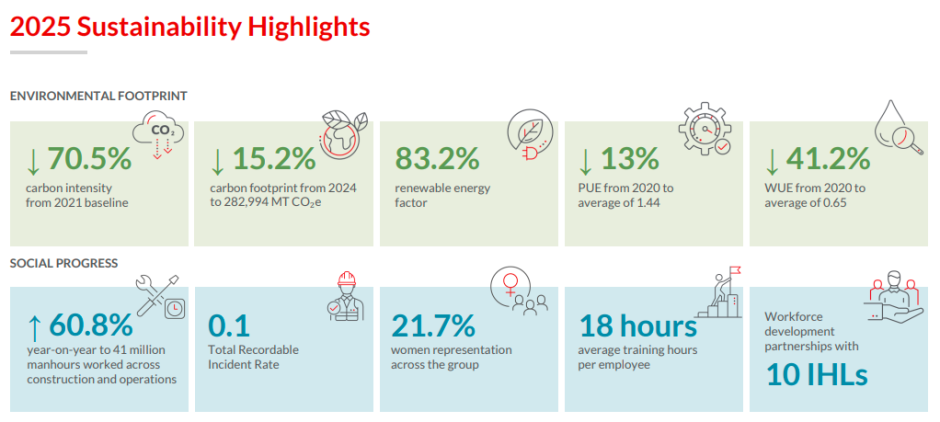
Renewable energy remained the biggest contributor to STT GDC’s environmental progress in 2025. Clean energy accounted for 83.2 percent of the company’s total electricity consumption, bringing it closer to its target of sourcing 85 percent of electricity from renewable energy by 2028.
To strengthen long-term clean energy availability, STT GDC expanded renewable electricity procurement through wind-solar hybrid Power Purchase Agreements (PPAs) and made 26 percent equity investments in captive renewable energy projects. These investments improve energy security while reducing dependence on conventional electricity generation.
The strategy enabled STT GDC to reduce its carbon intensity by 70.5 percent compared with the 2021 baseline, exceeding its 2028 carbon intensity reduction target three years ahead of schedule. The company also reduced its absolute Scope 1 and Scope 2 greenhouse gas emissions by 15.2 percent year over year, with its total carbon footprint declining to 282,994 metric tonnes CO₂e in 2025.
Advanced Cooling Improves Energy and Water Efficiency
STT GDC continued investing in next-generation cooling technologies and intelligent infrastructure to improve operational efficiency.
The company achieved an average Power Usage Effectiveness (PUE) of 1.44, representing a 13.0 percent improvement from the 2020 baseline. It is also deploying advanced cooling architectures capable of delivering PUE between 1.06 and 1.15, supporting high-density AI workloads while reducing electricity consumption.
Water conservation also improved significantly. Water Usage Effectiveness (WUE) reached 0.65, representing a 41.2 percent improvement from the 2020 baseline, demonstrating the company’s ability to optimize both electricity and water usage across its global operations.
Green Buildings and Workplace Safety Strengthen ESG Performance
STT GDC continued expanding sustainable infrastructure, with 48 percent of its data centres now externally certified as green data centres, reflecting continued investments in environmentally responsible design and efficient operations.
The company maintained its strong workplace safety performance, recording zero workplace fatalities and achieving a Total Recordable Incident Rate (TRIR) of 0.1 across more than 41 million hours worked during 2025.
Diversity also improved, with women representing 21.7 percent of the global workforce.
Sustainable Finance Supports Net Zero Strategy
Financial sustainability remains central to STT GDC’s ESG strategy. During the year, the company strengthened its capital structure by issuing S$500 million Sustainability-Linked Perpetual Securities, providing additional funding for renewable energy projects, low-carbon infrastructure, operational efficiency improvements, and future sustainability investments.
STT GDC also reinforced ESG governance by introducing Group ESG and Environmental Policies in 2025 and remains the first data centre operator in Asia to pledge carbon neutrality by 2030. It also became the first data centre operator in Singapore to deploy Hydrotreated Vegetable Oil (HVO) for backup generators, further reducing emissions from critical infrastructure.
STT GDC Advances Sustainable Digital Infrastructure
The STT GDC ESG Report 2025 highlights measurable progress across every major sustainability indicator. The company achieved 83.2 percent renewable electricity usage, reduced carbon intensity by 70.5 percent, lowered absolute greenhouse gas emissions by 15.2 percent to 282,994 metric tonnes CO₂e, improved PUE to 1.44 and WUE to 0.65, while advancing cooling technologies capable of PUE between 1.06 and 1.15. With 48 percent of its facilities certified as green data centres, more than 100 data centres delivering 2.7 GW of IT capacity, S$500 million in sustainability-linked financing, and a clear roadmap to carbon neutral operations by 2030, STT GDC continues to strengthen its position as a global leader in sustainable digital infrastructure.
SHAFANA FAZAL