


Signify has unveiled its 2025 Sustainability Report, showcasing strong progress across climate action, renewable energy, circular economy, sustainable innovation, and social impact. The company completed its five-year Brighter Lives, Better World sustainability program while reinforcing its commitment to achieving net zero greenhouse gas emissions across its entire value chain by 2040. The report highlights continued investment in energy-efficient LED technologies, renewable electricity, responsible resource management, and sustainable innovation, positioning Signify as a leader in the transition to a low-carbon economy.
EUR 255 Million Invested in Sustainable Innovation
Innovation remained the foundation of Signify’s sustainability strategy in 2025. The company invested EUR 255 million in sustainable innovation, representing 96 percent of its total research and development expenditure, up from 95 percent in 2024. These investments continue to accelerate the development of energy-efficient, connected, and circular lighting technologies that help customers reduce energy consumption, carbon emissions, and resource use while improving safety, health, and well-being.
Net Zero Roadmap Targets 90 Percent Emissions Reduction by 2040
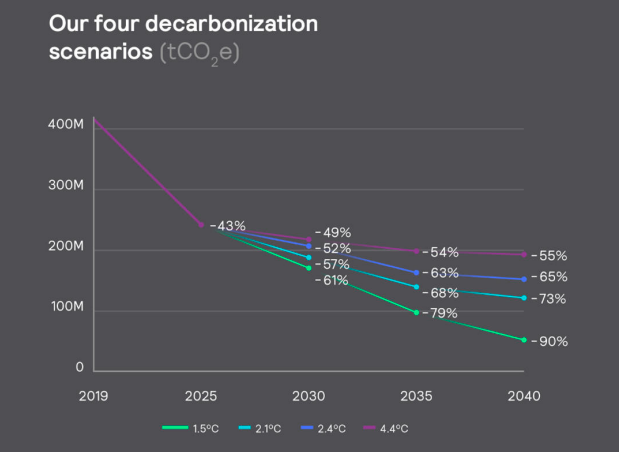
Signify reaffirmed its ambition to achieve net zero greenhouse gas emissions across its entire value chain by 2040. Its science-based climate roadmap targets a 50 percent reduction in absolute Scope 1, Scope 2, and Scope 3 greenhouse gas emissions by 2030 compared with the 2019 baseline, followed by a 90 percent reduction by 2040.
The targets cover 100 percent of Scope 1, Scope 2, and Scope 3 emissions, including all seven Kyoto greenhouse gases, with the remaining up to 10 percent of emissions expected to be neutralized through carbon removals. The company’s Climate Transition Plan is aligned with the 1.5°C pathway under the Paris Agreement and incorporates analysis of four climate scenarios ranging from 1.5°C to 4.4°C global warming. Signify also applied an internal carbon shadow price of USD 158.8 per tonne CO2e during 2025 to support investment and business decisions.
Carbon Reduction Across the Value Chain Accelerates
Signify continued delivering measurable decarbonization results across its operations and value chain. The company increased its cumulative carbon reduction to 655 million tonnes CO2e in 2025 from 498 million tonnes CO2e in 2024, reflecting the growing impact of its energy-efficient lighting technologies and sustainability initiatives.
The company expects renewable electricity to contribute more than 40 percent of total emissions reductions required to achieve its 2040 climate target, while continued improvements in LED efficiency and circular product design are expected to drive significant reductions in Scope 3 emissions.
Renewable Electricity Powers Global Operations
Renewable energy remained a key pillar of Signify’s sustainability strategy. The company continued operating with 100 percent renewable electricity across its global operations and plans to maintain this commitment as part of its long-term decarbonization strategy.
Signify also expanded the deployment of solar-powered LED lighting solutions for streets, public spaces, and off-grid communities, combining renewable energy with high-efficiency lighting technologies to reduce emissions while improving access to reliable lighting in underserved regions.
LED Innovation Drives Energy Efficiency
Energy-efficient LED lighting continued gaining momentum across Signify’s portfolio. LED-based products accounted for 91 percent of total sales in 2025, compared with 90 percent in 2024 and 85 percent in 2023.
The company’s Ultra Efficient LED portfolio delivers 50 percent to 75 percent higher energy efficiency than first-generation LED products, enabling customers to significantly reduce electricity consumption while lowering indirect greenhouse gas emissions. Continued advances in LED innovation are expected to remain one of the largest contributors to future Scope 3 emissions reductions.
Circular Economy Performance Improves
Signify continued strengthening its circular economy strategy during 2025. Circular revenues increased to 37 percent from 35 percent in 2024, reflecting greater adoption of products designed for longer life, improved material efficiency, and reuse.
The company also maintained total waste sent to landfill below 1 percent, demonstrating continued progress in waste reduction, recycling, material recovery, and responsible manufacturing across its global operations.
ESG Performance Shows Broad-Based Progress
The report highlights continued improvement across social and supply-chain sustainability indicators. Brighter Lives revenues increased to 35 percent from 33 percent in 2024, while Supplier Sustainability Performance improved to 97 percent from 96 percent.
Through the Signify Foundation, cumulative access to lighting reached 14.8 million people since 2017, up from 10.5 million a year earlier. Workplace safety improved with the Total Recordable Case rate declining to 0.12 from 0.17, while the Employee Net Promoter Score increased to 39 from 29. Women represented 27 percent of leadership positions across the company in 2025.
Maurice Loosschilder, Head of Sustainability at Signify, said the completion of the five-year Brighter Lives, Better World program marks the beginning of the company’s next sustainability chapter. Building on more than a decade of progress, Signify plans to further reduce customers’ energy and resource consumption while accelerating innovations that improve safety, security, health, and well-being, reinforcing its ambition to achieve net zero emissions by 2040 through sustainable innovation, renewable energy, and circular business practices.
SHAFANA FAZAL