


Schneider Electric has delivered strong sustainability performance in 2025, achieving significant progress in climate action, renewable energy adoption, supply-chain decarbonization, circular economy initiatives, workforce development, and social impact. The company completed its Schneider Sustainability Impact (SSI) 2021–2025 program with a score of 8.86 out of 10, compared with 7.55 out of 10 in 2024, reflecting measurable progress across its six sustainability commitments and 11 strategic programs.
Climate action remained the centerpiece of Schneider Electric’s sustainability strategy. The company reported that its technologies and solutions helped customers save and avoid 862 million tonnes of CO₂ emissions since 2018, including 183 million tonnes in 2025 alone, surpassing its original target of 800 million tonnes. Schneider Electric’s sustainability-driven business model also continued to expand, with Impact Revenues accounting for 75 percent of total revenue in 2025, compared with a baseline of 70 percent in 2019.
The company accelerated its net-zero transition through multiple initiatives. Schneider Electric stated that 100 percent of operational emissions were addressed by 2025 and reaffirmed its ambition to become Net-Zero Ready across operations by 2030 while achieving a 25 percent absolute reduction in greenhouse gas emissions across its value chain. Its long-term target remains net-zero CO₂ emissions across the entire value chain by 2050, Schneider Electric Sustainability Report 2025 indicated.
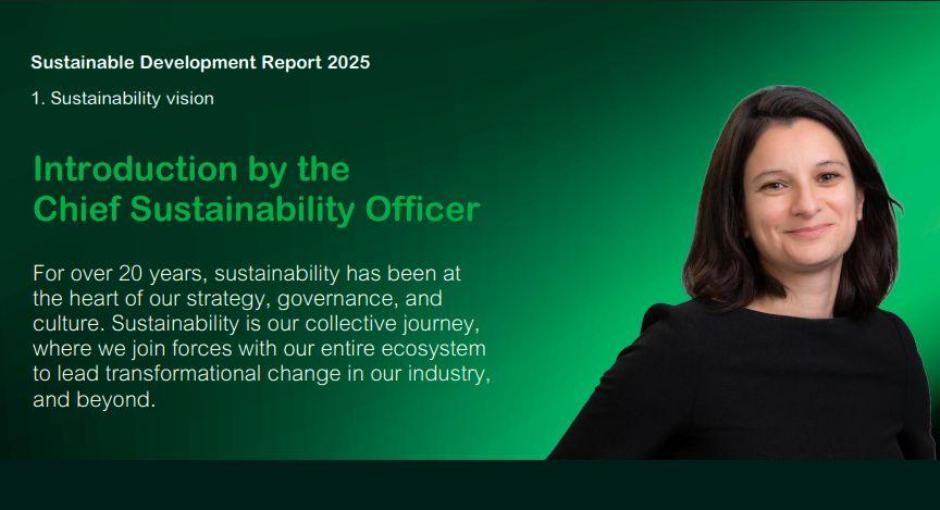
Esther Finidori, Chief Sustainability Officer of Schneider Electric, said: “Through solutions and services, we have helped customers save and avoid 862 million tonnes of CO2 emissions, and through the Zero Carbon Project, our top 1,000 suppliers reduced their operational emissions by 56 percent, surpassing here again the programs 2025 ambition.”
Supply-chain sustainability delivered notable results. Through the Zero Carbon Project, Schneider Electric’s top 1,000 suppliers reduced operational CO₂ emissions by 56 percent since 2021, exceeding the 2025 target of 50 percent. More than 2,700 suppliers participated in supply-chain decarbonization programs focused on Scope 1 and Scope 2 emissions reductions. The company also reported that 98 percent of strategic suppliers comply with its Decent Work requirements, while 79 percent achieved verified Decent Work standards. In addition, Schneider Electric assessed 4,348 suppliers under its vigilance program, exceeding its target of 4,000 suppliers.
Renewable energy remained a core pillar of the company’s sustainability strategy. Schneider Electric sourced 99 percent of electricity from renewable energy across its global operations in 2025, surpassing its target of 90 percent. The company operated 195 Zero-CO₂ sites worldwide, including 41 newly certified sites during the year, significantly exceeding its target of 150 sites. Schneider Electric also improved transportation carbon efficiency by 14 percent and increased electrification of its corporate vehicle fleet to 43 percent, well above its 2025 target of 33 percent.
Energy access and social impact programs continued to expand globally. Schneider Electric reported that 61.7 million people have gained access to sustainable electricity since 2009, including 8.3 million people during 2025 alone, surpassing its original ambition of 50 million beneficiaries. The company also trained 1.09 million people in energy management since 2009, including more than 266,000 individuals in 2025. Its Youth Training and Entrepreneurship program now operates in 60 countries, supporting workforce development for the global energy transition.
Schneider Electric’s commitment to local sustainability initiatives continued to grow. Since 2021, nearly 500 local sustainability programs have been deployed across more than 50 countries. In the Middle East and North Africa, renewable-energy and water-management projects reached more than 110,000 people in Jordan, Lebanon, and Egypt. In Canada, 18 sustainable home construction kits were delivered through Habitat for Humanity partnerships. In Spain, 24,053 surplus equipment units were donated to schools and non-profit organizations, including 20,000 units supporting communities affected by the Valencia floods. In Chile, Peru, and Bolivia, more than 190 women received training in energy management and electrical installation. In the Philippines, Schneider Electric supported more than 431 young people through mentorship and sustainability programs. In Denmark, biodiversity and environmental initiatives resulted in the collection of 102 kilograms of waste.
Resource efficiency and circular economy initiatives also achieved significant milestones. Green material content in products increased to 48 percent, approaching the company’s target of 50 percent. Sustainable packaging adoption reached 85 percent in 2025, up from 78 percent in 2024. Schneider Electric recovered 428,450 tonnes of materials through take-back programs since 2017, exceeding its target of 420,000 tonnes and increasing by 69,370 tonnes compared with 2024. The company reported 176 Waste-to-Resource sites, advancing toward its ambition of 200 sites. Energy efficiency across operational sites improved by 17 percent, exceeding the target of 15 percent.
Environmental stewardship programs continued to expand. Schneider Electric achieved 100 percent deployment of biodiversity conservation and restoration programs across operational sites and 100 percent implementation of water-conservation plans at facilities located in water-stressed regions. The company also reported that 80 percent of relevant medium-voltage offerings have been converted to SF₆-free technologies, up from 69 percent in 2024.
Technology innovation played a key role in sustainability progress. Schneider Electric expanded deployment of Zeigo Hub, an AI-powered platform that supports emissions tracking, carbon accounting, and renewable-energy procurement across supply chains. The company also advanced GM AirSeT, a next-generation SF₆-free switchgear solution designed to eliminate the use of one of the power sector’s most potent greenhouse gases.
Schneider Electric’s sustainability achievements were recognized through multiple global ESG rankings and awards, including an EcoVadis Platinum Medal, inclusion on the CDP Climate Change A List, recognition as the World’s Most Sustainable Corporation by Corporate Knights, and ranking as the world’s most sustainable company by TIME and Statista. The company also secured first place in the World Benchmarking Alliance Social Benchmark and third place in the World Benchmarking Alliance Gender Benchmark.
The Sustainability Report 2025 demonstrates Schneider Electric’s ability to combine sustainability leadership with business performance. Key achievements include 862 million tonnes of CO₂ emissions avoided, 183 million tonnes avoided in 2025, a 56 percent reduction in supplier emissions across 1,000 suppliers, 99 percent renewable electricity sourcing, 195 Zero-CO₂ sites, 61.7 million people gaining access to sustainable electricity, 1.09 million people trained in energy management, 428,450 tonnes of materials recovered, 176 Waste-to-Resource sites, 85 percent sustainable packaging, 48 percent green materials in products, 4,348 suppliers assessed, 43 percent fleet electrification, 14 percent transportation carbon-efficiency improvement, and nearly 500 sustainability initiatives deployed across more than 50 countries.
SHAFANA FAZAL