


RS Group has accelerated its sustainability transformation by delivering significant progress in emissions reduction, renewable energy adoption, circular economy initiatives, supply chain decarbonization, and ESG governance, according to its ESG Report 2026. The company continues to advance toward its ambitious climate goals, targeting net zero across direct operations by 2030 and its entire value chain by 2050 while strengthening support for customers and suppliers in reducing their environmental impact.
Andrea Barrett, Chief Sustainability Officer at RS Group, said the company is embedding sustainability throughout its operations while helping maintenance, repair and operations (MRO) customers and suppliers achieve their own decarbonization goals. The latest ESG report highlights strong progress across climate action, renewable energy, responsible sourcing, workforce engagement, and community impact.
Net Zero Strategy Gains Momentum
RS Group remains ahead of its operational decarbonization pathway after cutting absolute Scope 1 and Scope 2 greenhouse gas emissions by 67 percent compared with its 2019/20 baseline. The company remains on track to achieve a 75 percent reduction in Scope 1 and Scope 2 emissions by 2030 and net zero direct operations by 2030, while aiming for net zero across its value chain by 2050, RS Group Sustainability Report 2025 indicated.
The company has also introduced a Science Based Targets initiative (SBTi)-validated goal to reduce Scope 3 emissions by 51.6 percent per £ million of value added by 2030. Additional climate targets include achieving 100 percent renewable electricity, a 100 percent net zero company car fleet, and a 40 percent reduction in product transport emissions intensity by 2030 while encouraging strategic suppliers to adopt Science Based Targets.
Renewable Energy Drives Emissions Reduction
Renewable electricity continues to play a central role in RS Group’s climate strategy. During 2025/26, 92 percent of total electricity consumption came from renewable sources, while 3 percent of Group electricity was generated through the company’s own renewable energy assets. The business completed solar installations at five sites and continues progressing toward its goal of sourcing 100 percent renewable electricity by 2030.
Energy efficiency initiatives delivered measurable benefits. RS Group completed 23 energy-efficiency projects across its global operations, reducing energy consumption by 15 percent and gas consumption by 10 percent, further lowering operational emissions and improving energy productivity.
Greenhouse Gas Emissions Continue to Fall
The company’s greenhouse gas emissions profile reflects steady operational improvements.
During 2025/26:
Scope 1 emissions: 4,795 tonnes CO₂e
Scope 2 emissions (market-based): 1,055 tonnes CO₂e
Scope 2 emissions (location-based): 6,110 tonnes CO₂e
Total Scope 1 and Scope 2 (market-based): 5,850 tonnes CO₂e
Premises emissions: 3,138 tonnes CO₂e
Vehicle emissions: 2,712 tonnes CO₂e
Emissions intensity: 2.0 tonnes CO₂e per £ million revenue
Total energy consumption: 52 GWh
Supply Chain Decarbonization Accelerates
RS Group continues to address emissions beyond its own operations through logistics optimization and supplier engagement.
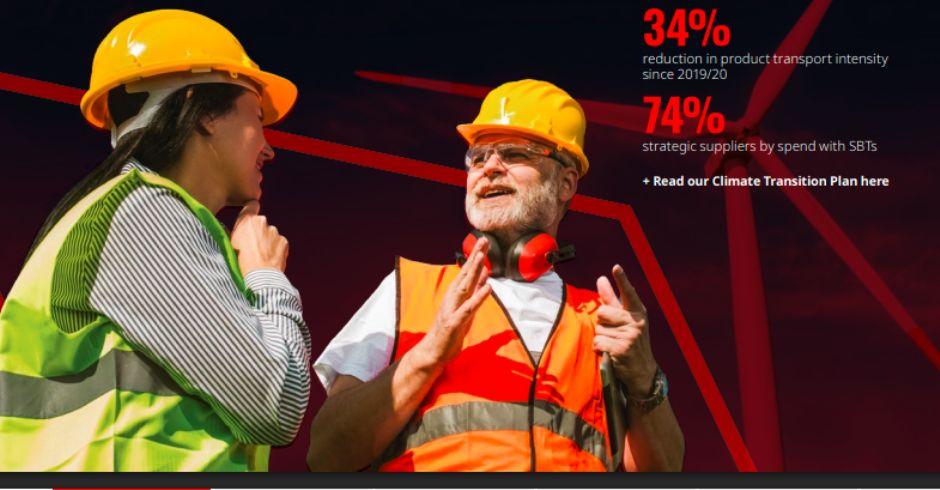
The company reduced product transport emissions intensity by 34 percent since 2019/20 and achieved a 17 percent reduction in absolute air transport emissions by shifting freight from air transport toward lower-carbon sea and road logistics.
Supplier sustainability also advanced significantly. 74 percent of strategic suppliers by procurement spend now have Science Based Targets, while approximately 160 strategic suppliers, representing 43 percent of total procurement spend, are actively engaged in decarbonization initiatives.
In addition, 59 percent of suppliers by spend now hold an EcoVadis ESG rating, while 41 percent of suppliers have established Science Based CO₂ reduction targets, strengthening emissions reductions throughout the value chain.
Electric Fleet and Sustainable Transportation
The company’s transition toward cleaner transportation continued during the reporting period.
Electric and hybrid vehicles now represent 60 percent of the corporate vehicle fleet, supporting the company’s ambition to achieve a 100 percent net zero company car fleet by 2030 while lowering transport-related emissions.
Better World Portfolio Expands
RS Group continued expanding its Better World sustainable product portfolio to help industrial customers reduce environmental impacts.
The portfolio now includes approximately 33,000 sustainable products, following the addition of around 4,000 products during FY2025/26. The range also welcomed 35 new suppliers, now covering more than 350 product families supplied by 167 suppliers across 30 countries.
The company plans to expand the portfolio to 100,000 Better World products by 2030, enabling customers to make more sustainable procurement decisions.
Circular Economy and Sustainable Packaging
Circular economy initiatives also recorded significant progress.
Packaging intensity has been reduced by 33 percent since 2019/20, with a target of 45 percent reduction by 2030.
Today, 90 percent of packaging contains at least 50 percent recycled content, while the long-term objective remains 100 percent reusable or recyclable packaging. Through its Plastic Out initiative, RS Group continues replacing single-use plastics with paper tape, paper air pillows, and bio-based alternatives.
Waste management performance also improved, with 88 percent of total waste recycled. Long-term targets include 50 percent lower waste intensity, more than 95 percent recycling, and zero waste to landfill across direct operations.
ESG Creates Business Value
RS Group’s sustainability strategy is generating measurable commercial benefits.
The company reported £260 million in revenue supported by ESG credentials, alongside £18 million in cumulative cost savings from sustainability initiatives since 2019/20.
Research cited in the report also found that 64 percent of procurement professionals consider sustainability an important purchasing factor, reinforcing the growing commercial value of ESG leadership.
Climate Leadership and Community Impact
RS Group strengthened its sustainability reputation by maintaining its position on the CDP Climate A List, earning the Platinum EcoVadis Medal, publishing its first Climate Transition Plan, and aligning its climate strategy with the Paris Agreement 1.5°C pathway through SBTi-verified targets.
The company also expanded its social impact through a new partnership with SolarAid, helping improve access to clean energy, while donating more than £400,000 to employee-selected local community initiatives during 2025/26.
Outlook
RS Group’s ESG Report 2026 demonstrates substantial progress across emissions reduction, renewable energy, supplier engagement, sustainable transportation, circular economy, and climate governance. With 67 percent lower operational emissions, 92 percent renewable electricity, 60 percent electrified company vehicles, 74 percent of strategic suppliers adopting Science Based Targets, and 33,000 sustainable products available globally, the company is well positioned to achieve its 2030 net-zero and sustainability objectives while supporting industrial customers in accelerating their own decarbonization journeys.
SHAFANA FAZAL