


The Prada Group Sustainability Report 2025 presents a structured ESG roadmap built around three pillars — Planet, People, and Culture — reinforcing its position in sustainable luxury fashion. Following the integration of Versace, the Prada Group has accelerated investments in industrial capacity, decarbonization, circular materials, and supply chain governance. Sustainability is now fully embedded into operations, shaping long-term value creation, risk management, and competitive positioning across global markets.
Planet Pillar: Climate Action, Net Zero Commitment & Circular Materials
The Planet pillar is anchored in the Science Based Targets initiative (SBTi), with a clear pathway toward Net Zero by 2050. In 2025, the Group exceeded its approved SBTi targets for Scope 1 and Scope 2 emissions, supported by energy efficiency upgrades, renewable energy adoption, and improved operational controls across manufacturing sites and logistics networks.
A major structural advantage is the Group’s vertically integrated production model, consisting of 25 owned industrial facilities. This enables tighter control over emissions, water usage, and environmental performance while improving traceability across the entire value chain. It also reduces dependence on outsourced manufacturing, strengthening sustainability governance.
Circular innovation continues through the Re-Nylon program, which targets the 100 percent conversion of virgin nylon into regenerated nylon across all product categories. The program has reached near-complete implementation, significantly reducing fossil-based material dependency and reinforcing circular economy practices in luxury fashion.
Environmental stewardship is further strengthened through Water Stewardship and biodiversity programs. These initiatives focus on reducing water consumption, improving efficiency in textile processing, and minimizing ecological impact across sourcing regions. Together, they support a nature-positive transition strategy aligned with global environmental priorities.
People Pillar: Diversity, Inclusion, Ethical Sourcing & Workforce Development
The People pillar emphasizes inclusive growth, ethical sourcing, and workforce capability building. In 2025, 45 percent of top and senior leadership roles were held by women, reflecting steady progress in gender diversity at decision-making levels. This achievement is supported by the Gender Equality Certification (UNI/PdR 125:2022), which formalizes structured governance for workplace equity, equal opportunity, and fair compensation practices.
Supply chain sustainability remains a core focus area. The Group has expanded responsible sourcing systems, with 91 percent of raw-material suppliers now participating in the ZDHC (Zero Discharge of Hazardous Chemicals) programme. This improves chemical safety, reduces environmental risks, and strengthens compliance across global production networks.
Prada Group, which has reported revenue of €5.7 billion in 2025, has implemented standardized ESG assessment tools across its supplier base, covering hundreds of evaluations annually. This system enhances traceability, improves reporting accuracy, and enables data-driven sustainability decisions throughout the supply chain.
Workforce development is anchored in the Prada Group Academy, which celebrated its 25th anniversary in 2025. The Academy has trained thousands of artisans over time, preserving traditional craftsmanship while integrating modern production skills. This ensures continuity of luxury manufacturing expertise across generations and supports long-term talent development.
Culture Pillar: Education, Ocean Conservation & Social Impact
The Culture pillar reflects Prada Group’s commitment to leveraging cultural influence for environmental education and social impact. Through SEA BEYOND, developed in partnership with UNESCO-IOC, the Group promotes ocean literacy and marine conservation awareness on a global scale. The program has reached millions of students worldwide through educational initiatives and outreach programs.
In 2025, the Group expanded its cultural infrastructure with the Ocean Literacy Centre in Venice. This facility combines science, education, and public engagement to increase awareness of ocean ecosystems and climate-related marine challenges. It serves as a hub for research communication and environmental learning.
Additional initiatives such as Forestami Academy support urban reforestation and biodiversity enhancement. These programs extend the Group’s ESG impact beyond fashion into broader environmental education, climate awareness, and community engagement.
Sustainability Investment & Industrial Transformation
Prada Group’s sustainability transition is supported by significant financial commitment. In 2025, the Group reported €535 million in capital expenditure (Capex), allocated across industrial expansion, sustainability infrastructure, and innovation programs. This investment strengthens production efficiency and supports long-term environmental transformation.
With 25 fully owned industrial facilities, the Group maintains direct control over environmental compliance, labor conditions, and production quality. This vertically integrated structure enhances operational transparency while improving efficiency across manufacturing and logistics.
The model also strengthens Scope 3 emissions management by reducing reliance on external suppliers and improving coordination across sourcing networks. This supports better carbon accounting and long-term decarbonization planning across the value chain.
Strategy Integration & Versace Alignment
Sustainability is fully integrated into Prada Group’s corporate strategy, ensuring alignment between ESG performance and financial growth. Environmental and social indicators are embedded into decision-making processes, product development, and supply chain design, reinforcing a data-driven governance model.
Following the acquisition of Versace, a key priority for 2026 is full ESG integration across all brands. This includes harmonizing sustainability KPIs, aligning supplier standards across thousands of vendors, and integrating decarbonization roadmaps into a unified reporting system. The integration is expected to strengthen transparency, improve efficiency, and scale sustainability best practices across the expanded portfolio.
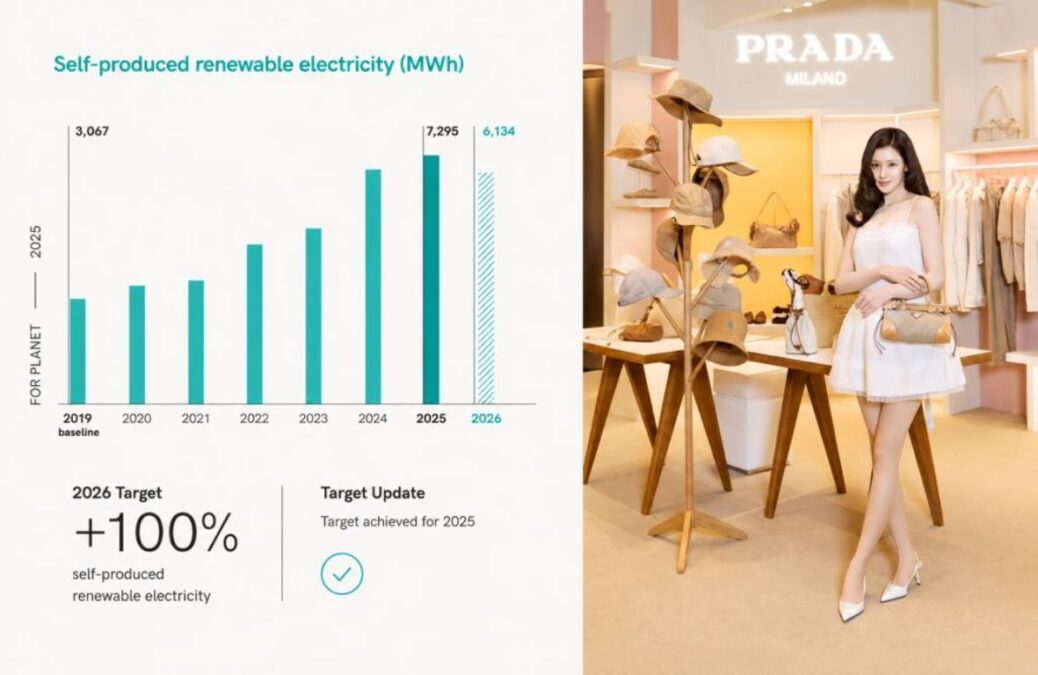
The Prada Group expanded its renewable energy and sustainability initiatives in 2025, with installed photovoltaic systems supplying around 6 percent of the company’s total global electricity demand. At its industrial facilities, solar self-consumption accounted for approximately 19 percent of electricity used in production, bringing the company close to its 2026 target of 20 percent.
To improve on-site energy efficiency and energy autonomy, Prada added battery storage systems at the Montegranaro plant and the Levanella central logistics hub in 2025, following the first installation at the Torgiano plant in 2024. These systems enable surplus solar energy to be stored during low-demand periods and used when energy consumption rises.
The company also accelerated the transition of its corporate vehicle fleet toward low-emission mobility. Under a new headquarters car policy introduced in 2024, only hybrid and fully electric vehicles are permitted. By the end of 2025, 94 percent of Prada Group’s fleet consisted of low-emission vehicles, putting the company close to its 2026 goal of 95 percent.
Conclusion
The Prada Group Sustainability Report 2025 highlights strong measurable ESG progress supported by key figures, including €535 million Capex investment, 25 industrial facilities, 45 percent female leadership representation, and 91percent supplier engagement in ZDHC programmes. These metrics reflect a structured and data-driven approach to sustainability transformation.
With advancements in circular materials through Re-Nylon, expanded renewable energy use, strengthened supplier governance, and global education initiatives reaching millions of learners, Prada Group is redefining sustainable luxury at scale. The ongoing integration of Versace further enhances its ability to unify ESG standards and strengthen leadership in climate-conscious fashion and circular economy innovation.
SHAFANA FAZAL