


The 2025 Sustainability Report from Nordnet highlights how digital financial platforms are integrating sustainability into their core operations. As one of the leading fintech players in the Nordic region, Nordnet is combining technology-driven investing with environmental accountability, transparent governance, and inclusive financial access. The report underscores how digital finance can align growth with climate goals while empowering millions of retail investors.
Embedding Sustainability into Digital Finance
Sustainability at Nordnet is closely tied to its mission of democratizing access to financial markets. By offering a fully digital investment platform, the company reduces the need for physical infrastructure while enabling individuals to build long-term wealth.
The platform integrates ESG considerations into its product offerings, giving customers access to data on the environmental performance of funds and investment portfolios. This transparency allows users to make informed, climate-conscious financial decisions, reinforcing Nordnet’s role in shaping responsible investing behaviors across the Nordic market.
Carbon Emissions and Net-Zero Commitments
Nordnet continues to align its operations with the 1.5 degree Celsius ambition of the Paris Agreement, focusing on measurable reductions in greenhouse gas emissions across Scope 1, 2, and 3.
While direct emissions from office operations remain relatively low, the company has taken steps to optimize energy consumption through efficient heating, cooling, and electricity usage. A more complex challenge lies in Scope 3 emissions, particularly financed emissions linked to customer investment portfolios.
To address this, Nordnet has enhanced disclosure around the carbon intensity of its fund offerings. This enables customers to evaluate the climate impact of their investments. The company is also working toward full alignment with the Science Based Targets initiative and has set a target to achieve net-zero emissions in its own operations by 2030.
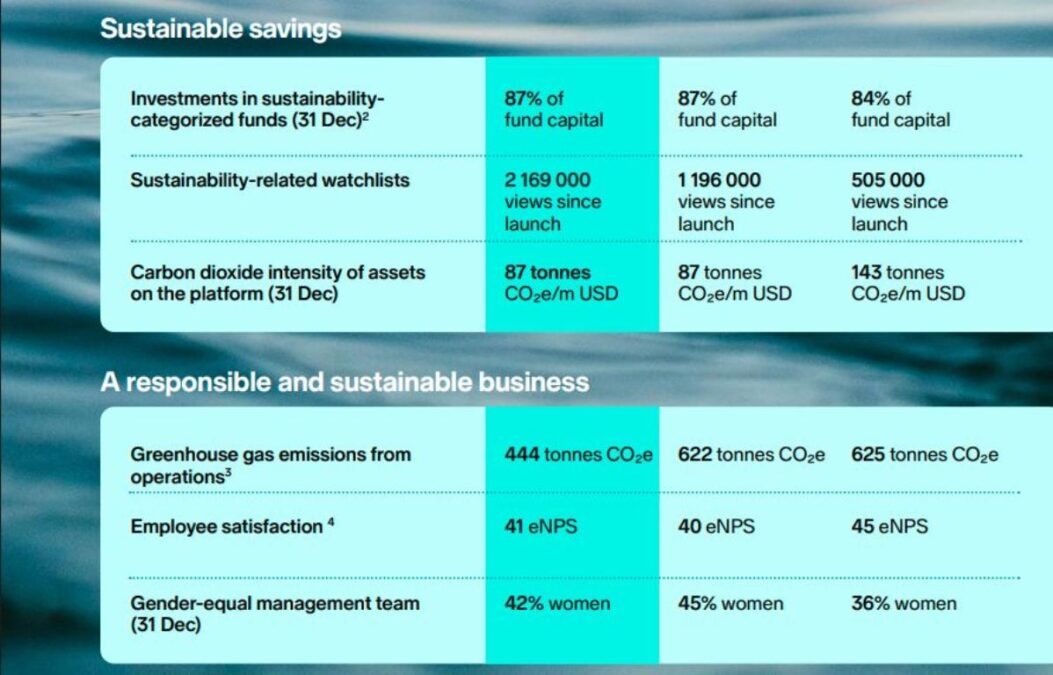
Nordnet’s sustainability performance between 2023 and 2025 shows clear progress toward long-term climate and ESG targets, though momentum varies across key metrics such as carbon intensity, sustainable investments, and social indicators.
Sustainability targets vs achievements (2023–2025)
Nordnet’s overarching target is aligned with the Paris Agreement, aiming to halve emissions over time and reach net zero by 2050, with a specific goal to cut emissions by at least 50 percent by 2033.
Carbon intensity of customer investments
Target: Long-term reduction, aiming to halve emissions intensity
2023: 143 tonnes CO2e/m USD
2024: 87 tonnes CO2e/m USD (39 percent reduction)
2025: 87 tonnes CO2e/m USD (stable)
Nordnet achieved a sharp improvement in 2024, effectively meeting near-term decarbonization expectations, but progress plateaued in 2025, indicating the need for further measures to continue downward momentum.
Sustainable fund investments
Target: Increase allocation to ESG-aligned funds
2023: 84 percent of fund capital
2024: 87 percent
2025: 87 percent
The company has consistently improved and then maintained a high level of sustainable fund allocation, showing alignment with its strategy to promote responsible investing, though growth stabilized after 2024.
Platform engagement with sustainability (watchlists)
Trend: Strong growth in user engagement
2023: 505,000 views
2024: 1,196,000 views
2025: 2,169,000 views
This reflects rapidly increasing customer interest in sustainable investing tools, supporting Nordnet’s goal of influencing indirect emissions through client behavior.
Operational emissions (own operations)
Target: Reduce emissions by at least 50 percent by 2033
2023: ~625 tonnes CO2e
2024: ~622 tonnes CO2e
2025: ~444 tonnes CO2e
Operational emissions show limited improvement in 2024 but a strong reduction in 2025, indicating accelerating internal decarbonization efforts.
Employee satisfaction (eNPS)
2023: 45
2024: 40
2025: 41
Employee satisfaction dipped in 2024 but stabilized in 2025, remaining broadly consistent over the period.
Gender diversity in management
2023: 36 percent women
2024: 45 percent women
2025: 42 percent women
Nordnet made significant progress in 2024, exceeding previous levels, though representation slightly declined in 2025 while remaining above 2023 levels.
Overall assessment
Nordnet has made substantial progress toward its sustainability targets, particularly in reducing carbon intensity and increasing sustainable fund allocation. The sharp improvement in 2024 demonstrates effective execution of its climate strategy. However, 2025 shows a phase of consolidation, with stable performance in key areas like emissions intensity and ESG investments.
Energy Efficiency in a Digital-First Model
As a digital-only financial institution, Nordnet’s energy usage is largely concentrated in office environments and third-party data centers that power its trading platforms.
In 2025, the company achieved 100 percent renewable electricity sourcing across its offices in Sweden, Norway, Denmark, and Finland. This milestone significantly reduces operational emissions and supports regional renewable energy markets.
Data center efficiency remains a critical priority. Nordnet collaborates with providers that use advanced cooling systems and heat recovery technologies to reduce energy waste and improve Power Usage Effectiveness. These efforts ensure that the platform can handle high trading volumes with minimal environmental impact while maintaining speed and reliability.
Circular Resource Management and Low-Impact Operations
Nordnet’s resource strategy focuses on minimizing waste and extending the lifecycle of IT equipment. The company has implemented a structured approach to managing electronic waste, ensuring that outdated hardware is reused, resold, or recycled through certified partners.
In addition, Nordnet prioritizes sustainable procurement practices, selecting suppliers that offer environmentally responsible products, including recycled materials and certified packaging. The company’s shift toward paperless communication has further reduced material consumption, aligning with its low-impact digital business model.
Water consumption is also monitored, with efficiency measures such as low-flow systems introduced across office spaces, demonstrating a comprehensive approach to resource stewardship.
Social Impact Through Financial Inclusion
A key pillar of Nordnet’s sustainability strategy is “Financial Democracy,” which focuses on improving financial literacy and expanding access to investment tools.
The company continues to invest in educational content, including digital courses, podcasts, and community platforms that help individuals better understand savings and investments. This approach supports long-term wealth creation and reduces barriers to entry for new investors.
Internally, Nordnet promotes diversity and inclusion, maintaining balanced gender representation and implementing initiatives to increase female participation in technology and leadership roles. Employee wellbeing is supported through flexible work policies, mental health programs, and comprehensive benefits, contributing to strong engagement and retention levels.
Governance, Compliance, and Digital Trust
Governance at Nordnet is defined by strict adherence to Nordic financial regulations and proactive ESG oversight.
In 2025, the company strengthened its anti-money laundering and anti-corruption frameworks by deploying advanced AI-driven monitoring systems to detect suspicious activities in real time. These systems enhance compliance while maintaining a seamless user experience.
Data privacy and cybersecurity remain top priorities. Nordnet applies privacy-by-design principles and end-to-end encryption to safeguard customer data. Regular audits and stress testing ensure the resilience of its platform against emerging cyber threats, reinforcing trust among its growing user base.
ESG Metrics and Transparent Reporting
Nordnet tracks its sustainability progress using clearly defined KPIs aligned with global frameworks such as the Global Reporting Initiative and the Task Force on Climate-related Financial Disclosures.
The 2025 report shows continued reductions in operational emissions and improved transparency in reporting financed emissions. By integrating climate-related risks into its financial and strategic planning, Nordnet ensures that sustainability is not treated as a separate initiative but as a core component of business performance.
Conclusion: Redefining Sustainable Growth in Fintech
The 2025 sustainability report demonstrates how Nordnet is redefining the role of digital finance in a low-carbon economy. By combining technological innovation, responsible investing tools, and strong governance, the company is enabling a more sustainable financial ecosystem.
FASNA SHABEER