


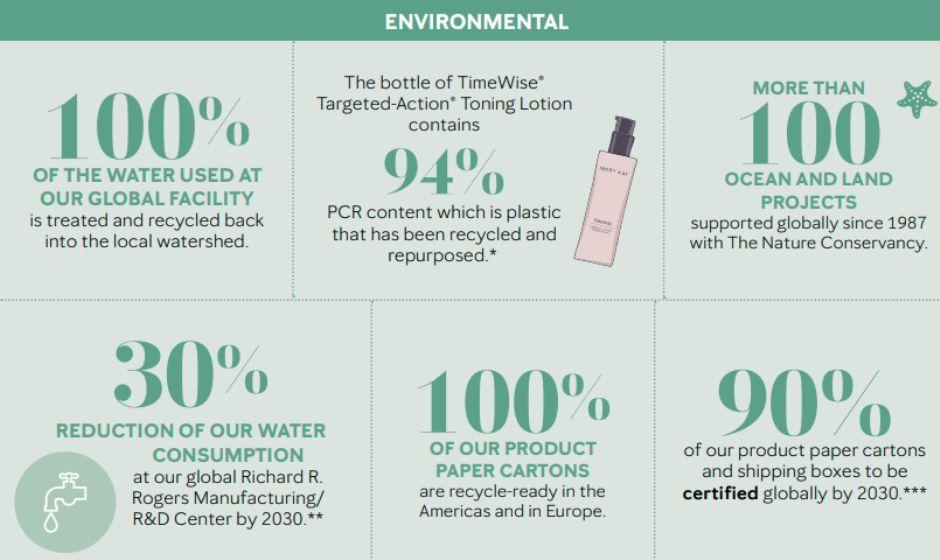
Mary Kay is accelerating its sustainability strategy through measurable progress in circular packaging, responsible sourcing, water stewardship, supply chain transparency, and social impact. The company’s latest Sustainability Report highlights significant achievements, including 100 percent recycle-ready paper cartons across the Americas and Europe, expanded use of recycled materials, enhanced ESG oversight across global operations, and continued investment in women’s leadership and community development.
A major milestone in Mary Kay’s circular economy strategy is the achievement of 100 percent recycle-ready product paper cartons across the Americas and Europe, reducing packaging waste and supporting the transition to more sustainable materials. The company is also progressing toward its goal of sourcing 90 percent of its paper cartons from Forest Stewardship Council (FSC)-certified materials by 2030, reinforcing responsible forest management and sustainable fiber sourcing.
Mary Kay is further reducing its reliance on virgin plastics by expanding the use of post-consumer recycled materials. The TimeWise Targeted-Action Toning Lotion bottle now contains 94 percent post-consumer recycled content, demonstrating the company’s commitment to circular packaging and increased recycled material utilization.
Sustainable sourcing has been strengthened through partnerships with the Global Shea Alliance and The Nature Conservancy, supporting biodiversity conservation, ethical sourcing, and resilient raw material supply chains, CEO Ryan Rogers indicated in the Mary Kay Sustainability Report 2025.
“We explored ways to enhance the packaging’s sustainability. We also focused on the dispensing method to ensure a seamless transition for consumers,” Kristin Dasaro, Director of Packaging Engineering & Sustainability and Process Development & Commercialization, said.
Water conservation remains a core pillar of Mary Kay’s environmental strategy. The company maintained a 100 percent water recycling rate at its Richard R. Rogers Manufacturing and Research & Development Center in Texas, where all operational water is treated and returned to the local watershed through a closed-loop recycling system. Mary Kay is also targeting a 30 percent reduction in facility water consumption by 2030 through operational efficiencies and resource conservation initiatives.
The company continues to strengthen ESG governance and supply chain transparency by deploying advanced digital sustainability tools. EcoVadis Carbon Action Manager enhances visibility into supplier Scope 3 greenhouse gas emissions, while the EverStream platform provides real-time monitoring of Tier 3 supplier ESG risks. Mary Kay has also expanded EcoVadis sustainability assessments across 40 operating markets and more than 100 trade and industry organizations, improving supplier accountability and environmental performance throughout its global value chain.
Mary Kay’s social impact initiatives also reached significant milestones. Since 1996, the company has contributed a cumulative $230 million through monetary and in-kind donations via its global foundations, supporting education, humanitarian assistance, community development, and charitable initiatives. Women continue to play a leading role across the organization, representing 63 percent of the executive team, 60 percent of leadership positions across the company’s top ten markets, 64 percent of Research and Development scientists, 79 percent of the Global Brand and Global Creative Team, and 63 percent of the total global workforce.
The company also continues to invest in future scientific talent through STEM programs, scholarships, and grants in partnership with the Society of Cosmetic Chemists, expanding opportunities for women in science, research, and innovation.
While Mary Kay highlights its climate strategy, supplier engagement, and energy efficiency initiatives, the report does not disclose quantitative greenhouse gas reduction results, renewable energy capacity, renewable electricity usage, or a corporate Net Zero target. Instead, the company focuses on advancing circular packaging, responsible sourcing, water conservation, transparent supply chains, and inclusive growth, reinforcing sustainability as a core driver of long-term business resilience.
SHAFANA FAZAL