


Mars has strengthened its environmental, social and governance (ESG) strategy by reporting significant progress in climate action, renewable energy, sustainable agriculture, circular packaging and community development in its latest Sustainable in a Generation (SiGP) Report. The company remains committed to reducing absolute greenhouse gas emissions across its value chain by 50 percent by 2030 from a 2015 baseline and achieving Net Zero emissions by 2050.
The sustainability programme is led by Alastair Child, Chief Sustainability Officer, and Kevin Rabinovitch, Global Vice President of Sustainability and Chief Climate Officer. Commenting on the company’s long-term vision, Alastair Child said, “We believe the world we want tomorrow starts with how we do business today.”
Mars delivers major greenhouse gas emissions reductions
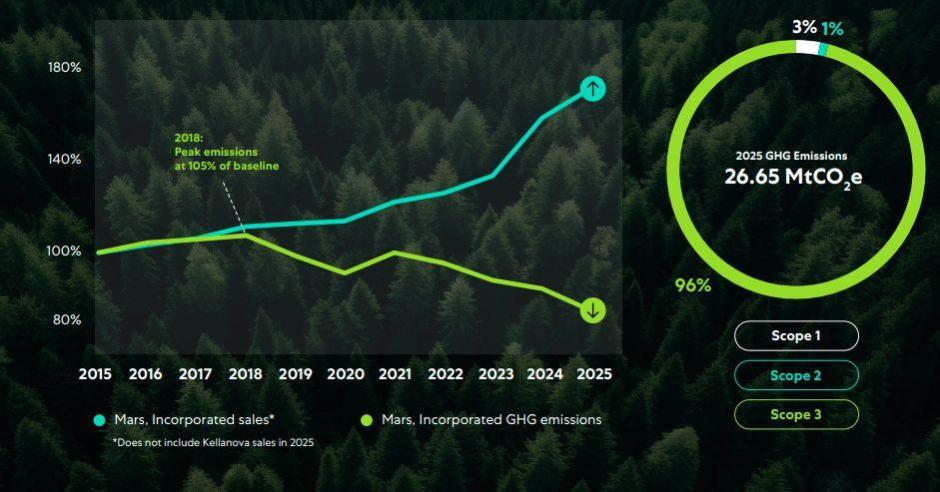
Mars reported one of its strongest annual climate performances, reducing absolute greenhouse gas emissions across Scopes 1, 2 and 3 by 16.9 percent compared with the 2015 baseline, including a 6.4 percent reduction during the latest reporting year.
Operational emissions also improved significantly, with Scope 1 and Scope 2 emissions falling by 42.6 percent. The company continues targeting a 50 percent reduction in value chain emissions by 2030, Net Zero emissions by 2050, and a 90 percent reduction in operational emissions by 2040, Mars Sustainability Report 2025 said.
Because approximately 96 percent of Mars’ total carbon footprint comes from Scope 3 emissions, the company continues prioritizing supplier engagement and value chain decarbonization.
Renewable electricity reaches 78.4 percent globally
Renewable energy continues to play a central role in Mars’ decarbonization strategy. Renewable electricity now supplies 78.4 percent of the company’s global electricity consumption, while operations in 14 countries are powered entirely by renewable electricity.
Mars has also achieved 100 percent renewable electricity across all manufacturing sites, offices, laboratories and veterinary operations in the United States. The company is further supporting supplier decarbonization through its Renewables Acceleration Program (RAcc) and long-term renewable energy agreements supporting projects including Sweden’s Kölvallen Wind Farm and Lithuania’s Skuodas Wind Farm.
US$250 million sustainability fund drives innovation
Mars continues investing heavily in climate innovation through the Mars Sustainability Investment Fund, committing up to US$250 million to accelerate sustainable packaging technologies, climate-smart ingredients and next-generation agricultural solutions.
The company has also committed US$47 million over five years through its Farmer Forward partnership with Fonterra to reduce methane emissions from dairy production while helping farmers adopt lower-emission practices.
In addition, Mars is investing US$20 million between 2020 and 2030 in its Raising Rice Right initiative to expand alternate wetting and drying techniques that reduce methane emissions and improve water efficiency in rice cultivation.
Climate-smart agriculture expands across 26 countries
Mars has expanded its sustainable agriculture programmes to 77 climate-smart agriculture initiatives covering 12 priority crops across 26 countries. These programmes promote regenerative farming, improve soil health, strengthen climate resilience and reduce agricultural emissions.
The company has also reduced land use across its value chain by 8.6 percent while narrowing the sustainable water use gap in priority high-stress watersheds by 35.5 percent, demonstrating continued improvements in natural resource management.
Circular packaging and plastic reduction gain momentum
Mars continues advancing its circular economy strategy through more sustainable packaging. The company reported that 67.6 percent of customer-facing packaging is now designed to be reusable, recyclable or compostable.
Post-consumer recycled plastic now represents 9.2 percent of total plastic packaging, while virgin plastic use has been reduced by 5.9 percent, supporting the company’s efforts to reduce plastic waste and improve resource efficiency.
Sustainability programmes benefit more than 885,000 people
Mars’ social sustainability initiatives have positively impacted more than 885,000 people worldwide since 2017.
More than 184,000 smallholder farmers have received technical training, financial inclusion support and climate resilience assistance, while over 130,000 women have benefited from leadership development, financial literacy and economic empowerment programmes.
Responsible nutrition and governance strengthen ESG performance
Mars continues improving nutrition across its food portfolio by reducing sodium levels by 3.9 percent compared with its 2019 baseline.
The company also reported 99.67 percent compliance with media placement requirements and 99.4 percent compliance with advertising content standards under its global Marketing Code, reinforcing its commitment to responsible marketing and strong corporate governance.
Mars advances toward Net Zero 2050
Mars continues to strengthen its sustainability performance through measurable environmental and social progress. Since 2015, the company has reduced greenhouse gas emissions by 16.9 percent, cut operational emissions by 42.6 percent, increased renewable electricity usage to 78.4 percent, and expanded renewable operations across 14 countries.
Supported by investments of up to US$250 million through its Sustainability Investment Fund, US$47 million for the Farmer Forward programme, and US$20 million for the Raising Rice Right initiative, Mars is accelerating climate innovation and sustainable agriculture. With 77 climate-smart farming initiatives across 26 countries, 67.6 percent of packaging designed for circularity, and more than 885,000 people benefiting from its sustainability programmes, the company is making steady progress toward its goal of reducing value chain emissions by 50 percent by 2030 and achieving Net Zero emissions by 2050.
SHAFANA FAZAL