


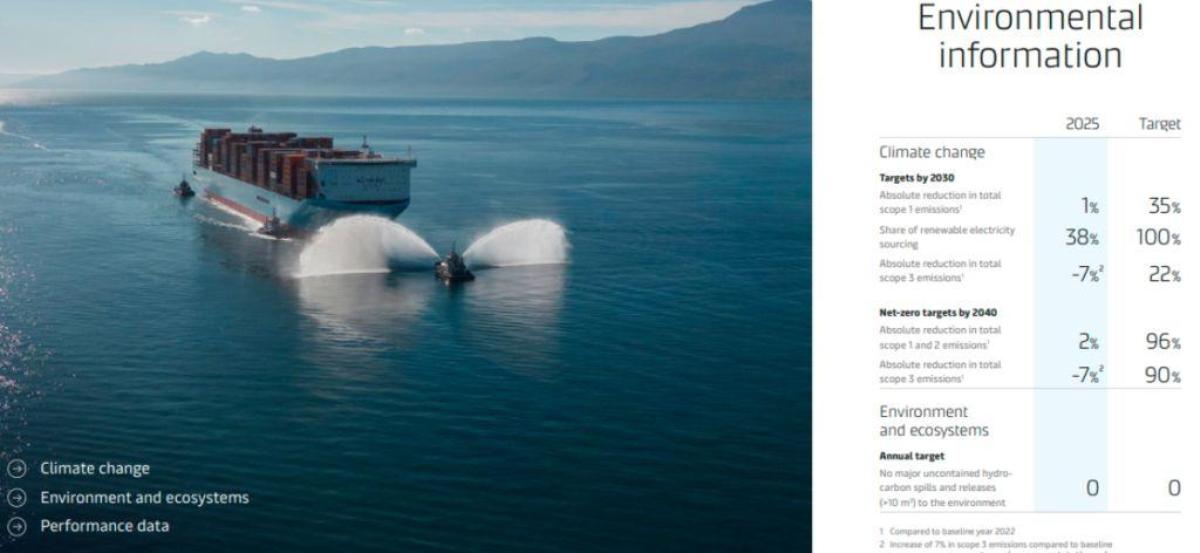
A.P. Moller – Maersk’s 2025 Sustainability Report highlights a structural shift toward decoupling operational growth from carbon intensity, as the company advances its “All the Way to Net Zero by 2040” ambition. Backed by Science Based Targets initiative validation, Maersk remains the first shipping company with 1.5°C-aligned targets for both 2030 and 2040, positioning sustainability at the core of its capital allocation, fleet modernization, and logistics transformation strategy.
In 2025, Maersk reported greenhouse gas emissions of 85.4 million metric tonnes CO2e, compared with 83.5 million metric tonnes in 2024, marking a 2 percent increase driven by extended rerouting around the Cape of Good Hope and expansion in Scope 3 value chain activities.
Maersk’s Scope 1 emissions remained stable at 33,953 thousand tonnes, while Scope 2 emissions declined by 12 percent to 313 thousand tonnes due to increased renewable electricity sourcing. Scope 3 emissions rose to 51,183 thousand tonnes, underlining the complexity of reducing indirect emissions across global logistics networks.
Despite higher absolute emissions, Maersk delivered a record operational efficiency improvement, with its Energy Efficiency Operational Indicator reaching 10.8 grams of CO2 per tonne-nautical mile in 2025, down from 11.1 in 2024. This represents a 6.1 percent improvement and the third consecutive year of record-low carbon intensity. The gains were supported by 640 fuel-saving initiatives implemented across 380 vessels, alongside continued route optimization and enhanced fleet utilization.
Fleet transformation remains a central pillar of Maersk’s decarbonization roadmap. The company added 10 new dual-fuel methanol vessels in 2025, bringing the total to 19 ships, a significant increase from just one vessel in 2023. An additional 6 dual-fuel vessels are scheduled for delivery in 2026, reinforcing a large-scale transition supported by an 800,000 TEU fleet renewal program. This strategy is complemented by successful green fuel trials, including 10 percent and 50 percent e-methanol blends tested on the Laura Mærsk, as well as the first commercial-scale bunkering of e-methanol from the Kasso facility in Denmark.
Investment in alternative fuel pathways reflects a diversified approach to decarbonization. While methanol remains the primary focus for the current decade, Maersk is advancing bio-methane adoption through a framework agreement with Avenir Marine for supply starting in 2027, alongside ongoing research into green ammonia despite scalability and safety challenges. In parallel, the company incurred $316 million in costs related to compliance with the EU Emissions Trading System, embedding carbon pricing into its financial and operational framework.
Infrastructure and network optimization also contributed to sustainability progress. The Gemini Cooperation network, launched in February 2025, is targeting more than 90 percent schedule reliability, reducing fuel-intensive disruptions such as rush sailing and port congestion. Within APM Terminals, renewable electricity usage increased to 62 percent in 2025 from 46 percent in 2024, strengthening energy cost stability through power purchase agreements and on-site renewable generation.
Maersk’s 2030 intermediate targets remain ambitious and measurable, including a 35 percent absolute reduction in Scope 1 emissions from a 2022 baseline, 100 percent renewable electricity sourcing, and a 22 percent reduction in Scope 3 emissions. The company is also targeting 25 percent of ocean freight volume to use green fuels, with 15-20 percent of total fuel consumption expected to be green by 2030. In logistics, 90 percent of facilities are targeted to operate on green energy, with all new warehouses, including sites in Shanghai and Malaysia, designed to meet LEED Gold certification standards.
Social and governance metrics show mixed progress. Women represented 35 percent of management roles in 2025 against a target of more than 40 percent, while employee engagement reached the 65th percentile compared with a goal above the 75th percentile. Training performance remained strong, with 93 percent of employees completing data and AI ethics training and 94 percent trained on the Code of Conduct, while the most recent cycle reported full completion of mandatory compliance training. Supplier alignment improved to 87 percent adherence to the Supplier Code of Conduct.
Governance oversight expanded significantly, with 1,174 whistleblower reports recorded in 2025, a 24 percent year-on-year increase, alongside 67 critical compliance spot checks. Sustainability integration into finance is advancing through a 1.5 billion EUR revolving credit facility linked directly to greenhouse gas reduction targets, ensuring that climate performance influences capital access and cost of funding.
Overall, Maersk’s 2025 performance underscores a complex transition phase where efficiency gains, renewable energy adoption, and dual-fuel fleet expansion are progressing at scale, even as absolute emissions remain sensitive to global trade disruptions. The company’s continued reduction in carbon intensity, combined with accelerated green fuel adoption and ESG-linked financial structures, reinforces its long-term trajectory toward net-zero emissions by 2040 while highlighting the systemic transformation required across global shipping and logistics.
FASNA SHABEER