


Lufthansa Group significantly accelerated its sustainability strategy in 2025 by expanding sustainable aviation fuel (SAF) adoption, investing in next-generation aircraft, improving operational efficiency, and strengthening climate action initiatives.
The airline group aims to halve net carbon emissions from flight operations by 2030 compared with 2019 and achieve net carbon neutrality by 2050. Its climate roadmap, validated by the Science Based Targets initiative (SBTi), also targets a 30.6 percent reduction in CO₂ intensity by 2030, while the company improved its core CO₂ intensity performance by 7.1 percent compared with 2019 during 2025, Lufthansa Sustainability Report 2025 indicated.
The airline continued to expand the use of Sustainable Aviation Fuel, increasing SAF’s share of total fuel consumption to 1.5 percent in 2025 from 0.2 percent a year earlier. The higher SAF usage reduced 440,372 tonnes of fossil CO₂, while emissions from biogenic energy sources, primarily SAF, reached 493,392 tonnes CO₂e.
Renewable energy accounted for 1.7 percent of Lufthansa Group’s total energy consumption, up sharply from 0.4 percent in 2024, while the share of fossil energy declined to 98.3 percent from 99.6 percent.
Lufthansa Group generated total greenhouse gas emissions of 45.22 million tonnes CO₂e, comprising 29.56 million tonnes of Scope 1 emissions, 71,598 tonnes of Scope 2 emissions, and 15.59 million tonnes of Scope 3 emissions. CO₂ emissions from flight operations totaled 29.37 million tonnes, while specific passenger CO₂ emissions improved to 8.54 kg CO₂e per 100 passenger-kilometres, reflecting better fuel efficiency despite increased flight activity.
Climate protection investments also expanded during the year. Lufthansa offset 865,038 tonnes of CO₂ through certified climate protection projects, a 42.7 percent increase over 2024. Customers accounted for 778,000 tonnes of offsets, while the airline contributed 87,000 tonnes through employee business travel.
More than 4 million customers selected Green Fares, around 7 million passengers chose sustainable travel options, and customer contributions addressed 860,000 tonnes of fossil CO₂, including 144,000 tonnes reduced through SAF and 716,000 tonnes avoided or removed via climate protection projects. Approximately 5 percent of customers selected ticket options that included contributions toward sustainable aviation.
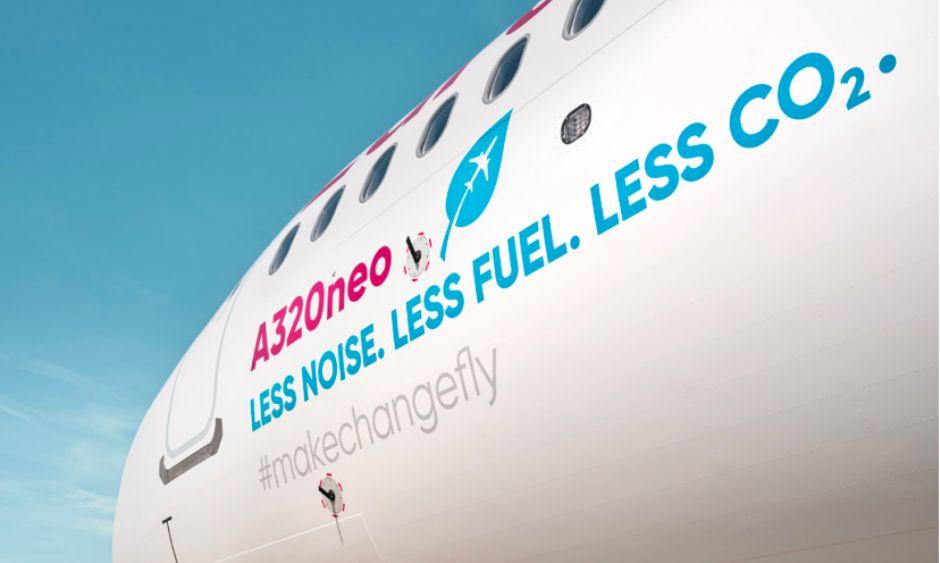
Fleet modernization remained Lufthansa Group’s most important decarbonization initiative. During 2025, the company introduced 23 new fuel-efficient aircraft, including Airbus A320neo, A321neo, A350-900 and Boeing 787-9 models, while retiring 21 older aircraft. Lufthansa expects delivery of around 45 additional aircraft in 2026. The operational fleet reached 737 aircraft, with 99.6 percent complying with ICAO Chapter 4 aircraft noise standards, reducing both emissions and noise pollution.
Operational efficiency initiatives also delivered measurable sustainability gains. The airline completed 81 emission-reduction projects, cutting 67,800 tonnes of CO₂ and saving 21,700 tonnes of kerosene, equivalent to approximately 258 return flights between Munich and New York using an Airbus A350-900. Through AerolutionsLAB, Lufthansa developed innovations capable of delivering over 1 percent aircraft efficiency improvements, reducing up to 900 tonnes of CO₂ emissions and 275 tonnes of kerosene consumption per long-haul aircraft annually, while aerodynamic improvements alone generated an additional 0.3 percent efficiency gain.
The airline also expanded its intermodal transport strategy, offering around 800 rail and bus connections daily from its hubs. The integrated network now connects 71 cities worldwide, with more than 1.1 million passengers using these lower-emission transport options during 2025.
Fuel efficiency continued to improve despite higher passenger demand. Total fuel consumption rose modestly to 9.29 million tonnes, an increase of 1.4 percent, while transport performance grew 3.3 percent, demonstrating improved operational efficiency.
Specific fuel consumption declined to 257 grams per tonne-kilometre, 3.39 litres per 100 passenger-kilometres, and 0.270 litres per freight tonne-kilometre. Since 1991, Lufthansa has increased transport performance by 415 percent while fuel consumption has risen only 197 percent, improving overall fuel efficiency by 42 percent and reducing specific fuel consumption from 446 g/tkm to 257 g/tkm.
The company’s sustainability investments are also reflected in its EU Taxonomy alignment. Taxonomy-aligned turnover reached €6.89 billion, representing 17 percent of total turnover, while taxonomy-aligned capital expenditure totaled €3.75 billion, accounting for 69 percent of total CapEx. Taxonomy-aligned operating expenditure reached €1.72 billion, or 33 percent of total OpEx, highlighting continued investment in low-carbon aviation technologies and fleet modernization.
Lufthansa’s sustainability performance also received external recognition in 2025. The airline earned the Investors’ Darling Award for Sustainability Communications, achieved an ESG Transparency Award score of 92.59 percent, maintained a CDP climate score of B, an MSCI ESG rating of A, a Sustainalytics risk score of 22.9, and an S&P Global ESG score of 43, reflecting continued progress in environmental transparency, governance, and climate strategy.
SHAFANA FAZAL