


LP Building Solutions has strengthened its sustainability strategy in 2025 by accelerating renewable energy adoption, reducing greenhouse gas emissions, expanding carbon-negative products, and increasing investments in employees and local communities.
Led by Jenni Galiotto, Director of Sustainability and Public Policy, the company’s environmental, social, and governance (ESG) initiatives are guided by a five-pillar framework covering Governance, People, Environment, Products, and Community, with oversight from the Board’s Governance and Corporate Responsibility Committee.
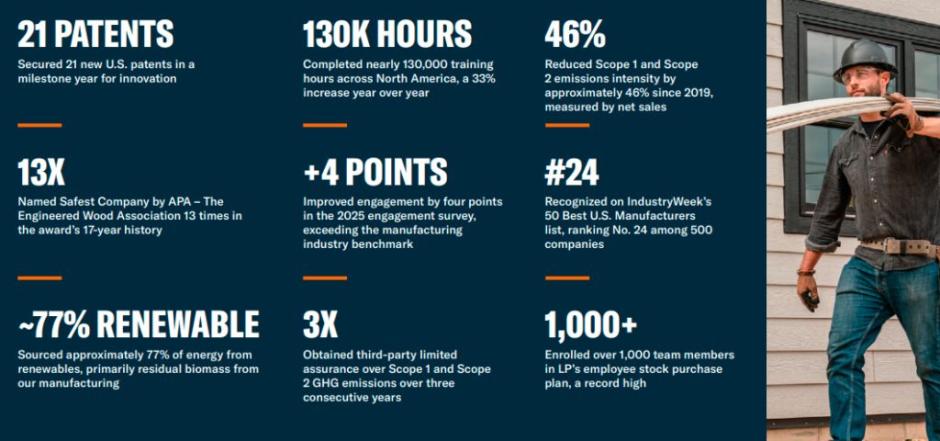
Climate action remains a central focus of LP Building Solutions’ sustainability agenda. The company reduced its Scope 1 and Scope 2 greenhouse gas emissions intensity by approximately 46 percent compared with its 2019 baseline, measured per dollar of net sales.
Renewable energy plays a significant role in this achievement, with approximately 77 percent of the energy consumed across manufacturing facilities generated from renewable sources through the reuse of residual biomass such as tree bark, sawdust, and wood shavings.
Sustainable sourcing continues to strengthen LP Building Solutions’ environmental performance. The company sources 100 percent of the wood fiber used in manufacturing from forests certified under independent third-party forest management programs, including the Sustainable Forestry Initiative and the Forest Stewardship Council. This approach supports responsible forestry, biodiversity conservation, sustainable land management, and long-term supply chain resilience while the company continues to expand its Scope 3 emissions accounting, LP Building Solutions Sustainability Report 2025 indicated.
LP Building Solutions has also expanded transparency across its product portfolio. Environmental Product Declarations now cover 93 percent of North American net sales, providing independently verified environmental data for most of its building products. All nine product portfolios included in these declarations have been certified by ASTM International as net carbon-negative, meaning they store more carbon during their life cycle than is emitted during manufacturing. In addition, seven LP products have achieved National Green Building Standard Resource Efficiency certification, helping builders meet green building standards and support net-zero housing developments.
Innovation remains an important driver of sustainable growth. During the reporting year, LP Building Solutions received 21 patents from the United States Patent and Trademark Office, increasing its total patent portfolio to 48. The company also expanded manufacturing capacity by constructing a new LP SmartSide ExpertFinish facility in North Branch, Minnesota, which is expected to create approximately 125 new jobs while increasing the supply of sustainable engineered wood siding products.
Employee safety and workforce development continue to support the company’s social sustainability goals. LP Building Solutions earned recognition as the Safest Company from APA – The Engineered Wood Association for the 13th time in the award’s 17-year history. The company delivered nearly 130,000 hours of employee training during the reporting year, representing a 33 percent increase from the previous year and contributing to a four-point improvement in employee engagement. LP was also recognized with The Tennessean’s Top Workplaces Award for the fifth consecutive year.
Community investment also increased significantly. LP Building Solutions contributed $1.7 million in charitable giving during the reporting year, up from $1.3 million in the previous year, supporting more than 100 nonprofit organizations focused on education, housing, environmental stewardship, and community development. The LP Foundation’s matching gift program has now surpassed $1 million in matched donations since its launch, supporting nearly 1,900 employee donations and encouraging greater employee participation in community initiatives.
LP Building Solutions’ governance framework continues to reinforce its long-term ESG performance by integrating environmental stewardship, ethical governance, sustainable product innovation, employee engagement, and community investment into business strategy. Through measurable progress in emissions reduction, renewable energy, certified sustainable sourcing, carbon-negative products, workforce development, and community support, the company is advancing sustainable manufacturing while helping customers build lower-carbon, resource-efficient buildings.
SHAFANA FAZAL