


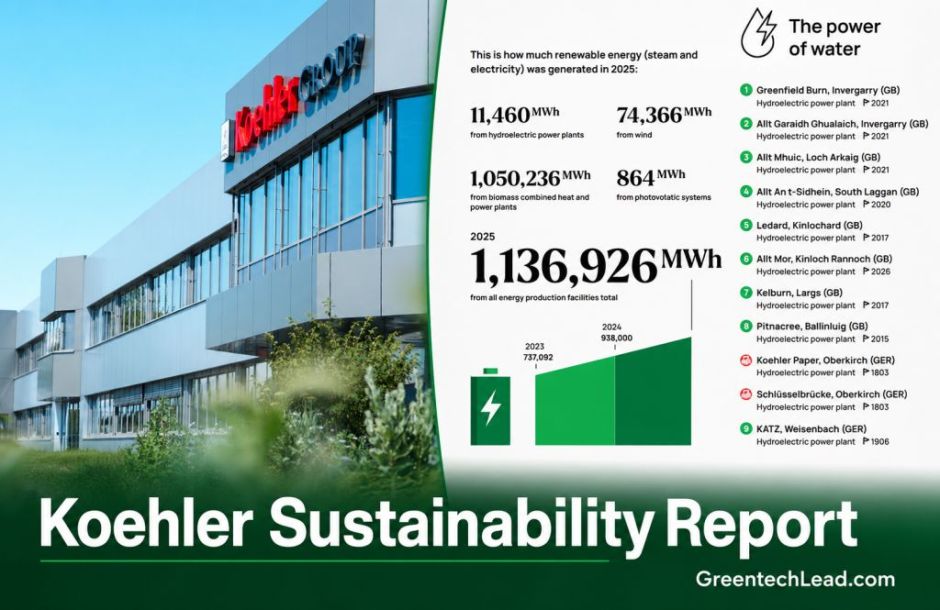
Koehler Group’s Sustainability Report 2025 shows strong progress in renewable energy, greenhouse gas reduction, circular products, responsible sourcing and workforce development, although resource efficiency and occupational safety remain challenges.
Koehler Sustainability Report indicated that it achieved 98.6 percent of its “Koehler Promise” in 2025, exceeding its annual target of 88 percent. By 2030, the paper and renewable-energy group aims to generate more sustainable energy than it requires for paper production.
Koehler cuts Scope 1, 2 and 3 emissions
Direct greenhouse gas emissions per MWh of electricity generated declined 82 percent, exceeding Koehler’s 2030 target of 80 percent.
Other relevant Scope 1 and Scope 2 emissions fell 62 percent, meeting the 2025 target of at least 60 percent. Scope 3 emissions declined approximately 8 percent, outperforming the annual reduction target of more than 5 percent.
The Scope 3 result is based on a provisional extrapolation completed in May 2026. Koehler plans to automate more of the calculation process as it advances its Science Based Targets initiative-validated climate pathway.
Fuel conversion projects at Oberkirch and Greiz are expected to eliminate approximately 150,000 metric tons of CO2 annually. Oberkirch is converting industrial energy generation to biomass, while Greiz is switching to wood dust.
Renewable power and heat exceed targets
Koehler generated 384 GWh of renewable electricity in 2024, exceeding its target of 300 GWh. Renewable heat generation reached 779 GWh, surpassing the 600 GWh target.
Renewable capacity expanded further in 2025 with the commissioning of the 31 MW Langer Wald wind farm, which is expected to generate approximately 70 GWh annually.
The company is also developing the Rowancraig and Blackhills wind projects as part of its renewable-energy expansion through 2033.
Solar assets include the 11.67 MWp Hemmingstedt Solar Farm and an operational 267 kWp rooftop photovoltaic installation at Kehl.
Circular innovation exceeds 2030 goals
Product innovations generated 19.6 percent of revenue in 2025, already exceeding Koehler’s 2030 target of more than 15 percent. Patent utilisation reached 24 percent, ahead of the target of more than 18 percent.
More than 86 percent of raw materials were renewable or mineral in origin, surpassing the annual target of more than 85 percent.
Koehler prepared Product Environmental Footprints for products from its Oberkirch mill for the first time. The group also maintained 39 active external partnerships, almost double its annual target of more than 20.
Certified fibre and responsible biomass reach 100%
Koehler reports that 100 percent of virgin fibres are certified under FSC or PEFC standards, meaning its 2030 responsible-fibre sourcing target has already been achieved.
The company also sources 100 percent of biomass used as a production material or for energy generation from responsible sources.
EcoVadis standards or an equivalent Supplier Code of Conduct covered 73 percent of purchasing volume for raw materials used in paper and board production. This substantially exceeded the 2025 target of 50 percent.
Investment reaches €144 million
Koehler invested €144 million in 2024 in modernisation and sustainability initiatives, exceeding its target of more than €85 million by €59 million.
The investment supports renewable-energy capacity, cleaner production systems, plant modernisation and operational improvements required to deliver the company’s Sustainability Strategy 2030.
Koehler received an EcoVadis Platinum Medal with a score of 91 out of 100, placing it among the top 1 percent of companies assessed globally.
Water and biodiversity management expand
Water is Koehler’s largest raw material by volume. Fresh water is initially used for cooling and then reused in pulping and other production processes until further reuse is no longer economically viable. Effluent is treated before being returned to the natural water cycle.
According to the WRI Aqueduct Water Risk Atlas, Greiz is in a low-medium water-stress area, while Oberkirch, Kehl, Weisenbach and Willstätt are in low water-stress areas.
Koehler supplements water and emissions management with certified sourcing, cascading use of waste materials, habitat restoration, compensation measures, adopt-a-creek programmes and meadow-orchard cultivation.
Training improves, but workplace safety misses targets
Koehler’s apprenticeship rate reached 4.5 percent, exceeding its 2030 target of at least 4 percent. Advanced training increased to 28.7 hours per employee annually, above the 25-hour target.
The employee health rate reached 93.7 percent, beating the 2025 target of 93.3 percent.
However, the lost-time injury frequency rate was 2.68 accidents per 200,000 working hours, compared with the maximum target of 1.53. Lost-time injury severity reached approximately 78.82 days, more than double the target ceiling of 37.55 days.
Material and fuel efficiency deteriorate
Raw and auxiliary material consumption per square metre of paper and board increased 0.4 percent, missing Koehler’s annual reduction objective.
Fuel efficiency deteriorated 2.5 percent, while the overall environmental performance indicator worsened 3 percent, partly due to low machine utilisation.
Koehler’s 2025 results nevertheless demonstrate substantial progress towards its 2030 sustainability agenda. The next priorities are to maintain GHG reductions, scale renewable energy, improve Scope 3 measurement, reverse material and fuel-efficiency declines and strengthen occupational safety.
SHAFANA FAZAL