


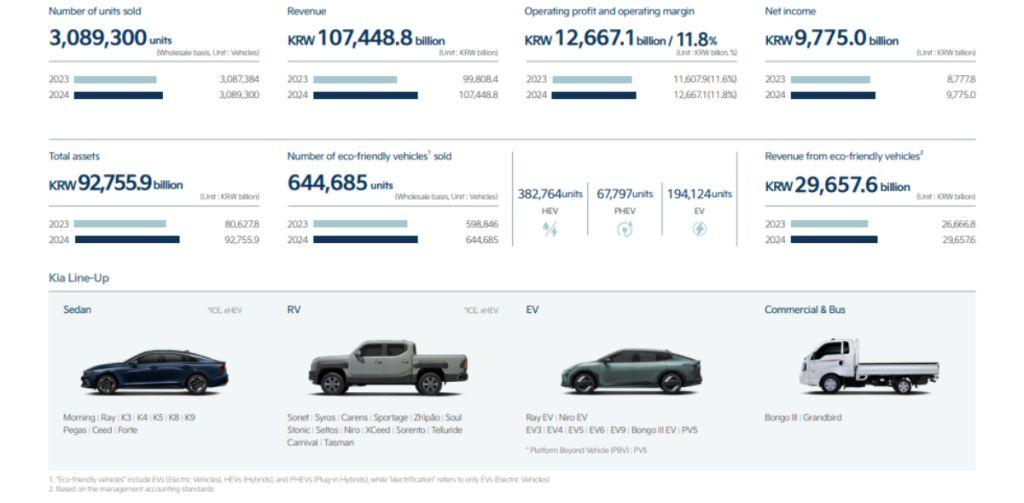
Kia’s Sustainability Report 2025 outlines the company’s transition from a traditional automaker to a sustainable mobility solutions provider, driven by its long-term “Plan S” strategy. The report highlights strong progress in electric vehicle adoption, emissions reduction, and circular economy initiatives as the company expands its global footprint in clean transportation.
A key milestone in 2025 is the significant rise in eco-friendly vehicle sales, including battery electric vehicles and hybrid models. This growth reflects Kia’s focused investment in its Electric Global Modular Platform (E-GMP), which supports the development of both entry-level and premium EVs. By diversifying its product lineup, Kia is lowering barriers to adoption and expanding access to zero-emission mobility across different customer segments.
Kia has also made measurable progress in decarbonizing its manufacturing operations. The company reported a 14 percent reduction in greenhouse gas emissions from production compared to its 2019 baseline. This achievement is supported by energy-efficient manufacturing technologies, large-scale solar installations at production sites, and carbon reduction initiatives across the supply chain. As part of its RE100 commitment, Kia aims to achieve 100 percent renewable energy usage across all manufacturing facilities by 2040, with several plants in Europe and North America already reaching interim targets ahead of schedule.
Circular economy principles are a central focus of Kia’s sustainability strategy, particularly in battery lifecycle management. The company has implemented a closed-loop system for EV batteries that includes real-time monitoring, second-life energy storage applications, and advanced recycling processes to recover critical materials such as lithium and cobalt. In vehicle production, Kia’s “10 Must-Have Items” initiative has replaced traditional materials with sustainable alternatives, including bio-based polyurethane and recycled PET fabrics. In 2025, recycled plastics accounted for 15 percent of materials used in new vehicles, demonstrating progress toward reducing reliance on virgin resources.
Supply chain transparency and ESG compliance have also been strengthened. Kia now ensures that 100 percent of high-priority suppliers undergo sustainability audits, covering labor practices and environmental standards. The company is also advancing hydrogen innovation through its involvement in Hyundai Motor Group’s HTWO initiative, focusing on fuel cell technologies for heavy-duty logistics and multi-purpose vehicles to complement its battery electric portfolio.
Environmental stewardship extends to water conservation and biodiversity protection. Kia achieved a 12 percent reduction in water consumption per vehicle produced compared to the previous year, driven by wastewater recycling systems and waterless painting technologies. These efforts are particularly critical in regions facing water scarcity. Additionally, through its Ocean Cleanup partnership, the company has removed hundreds of tonnes of plastic waste from marine environments, repurposing it into vehicle components.
Under the leadership of Chief Executive Officer Ho-Sung Song, Kia has also strengthened its social responsibility initiatives. The company reported improvements in workplace safety, with reduced accident rates supported by increased automation and employee wellness programs.
Overall, Kia’s Sustainability Report 2025 reflects a comprehensive and data-driven approach to sustainable mobility, combining EV expansion, clean manufacturing, circular resource use, and responsible supply chain management to create long-term value in a rapidly evolving automotive industry.
FASNA SHABEER