


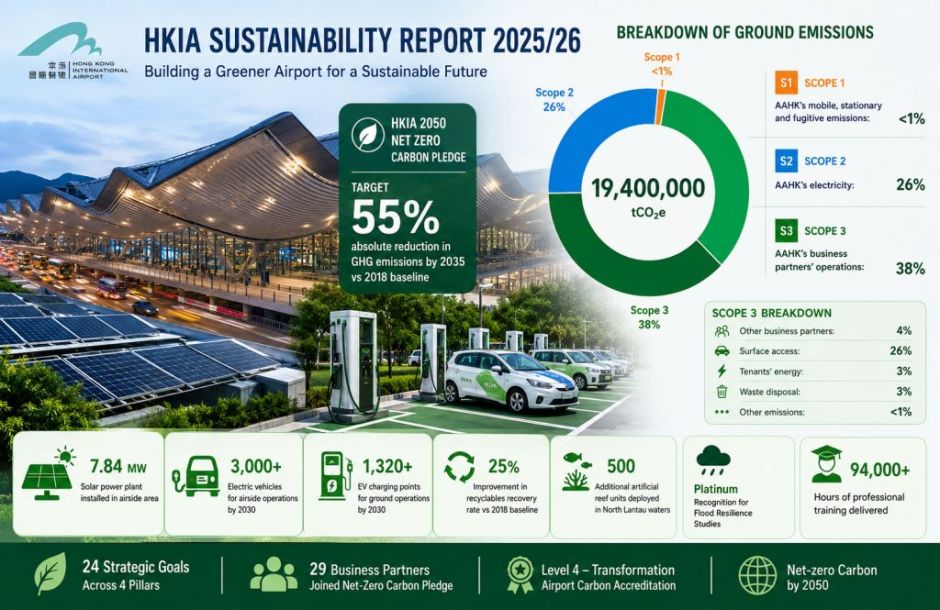
Hong Kong International Airport (HKIA) is accelerating investment in renewable energy, electric vehicles, energy efficiency and climate resilience as it targets a 55 percent absolute reduction in greenhouse gas (GHG) emissions by 2035 from its 2018 baseline.
The 2035 target represents a major milestone toward the airport-wide commitment by Airport Authority Hong Kong (AAHK) and key aviation-related business partners to achieve net-zero carbon emissions by 2050.
According to the Hong Kong International Airport Sustainability Report 2025-26, the airport’s Ascend sustainability framework contains 24 strategic goals across four pillars: Environmental Excellence, Operational Excellence, Thriving Economies and Societies, and Thriving People.
Scope 3 Sources Account for 60% of Airport Community Emissions
One of HKIA’s biggest decarbonisation challenges comes from emissions outside AAHK’s direct operations.
AAHK’s operations represent approximately 40 percent of the airport community’s overall emissions footprint, while the remaining 60 percent is associated with Scope 3 sources and external business partners.
The emissions profile means HKIA’s 2050 net-zero ambition will depend heavily on airlines, ground-handling companies, logistics providers and other businesses operating across the airport ecosystem.
A total of 29 key aviation-related business partners have joined HKIA’s airport-wide Net-Zero Carbon Pledge.
HKIA has also achieved Level 4 – Transformation under the Airport Carbon Accreditation programme, reflecting its approach to carbon management and Scope 3 emissions.
Electricity Generates 90% of AAHK’s Direct Carbon Footprint
Electricity consumption in terminal buildings and other airport facilities accounts for approximately 90 percent of AAHK’s direct carbon footprint, making clean electricity and energy efficiency central to the 2035 emissions target.
HKIA has installed a 7.84 MW solar power system within its airside area. The airport also established an airport-wide solar implementation roadmap and photovoltaic study during 2023/24 to identify opportunities for additional solar installations.
Reducing electricity-related emissions could therefore have a significant impact on AAHK’s direct carbon footprint as renewable electricity capacity expands and airport facilities become more energy efficient.
HKIA became the first airport globally in 2019 to commit to both EV100 and EP100, initiatives focused on accelerating electric mobility and improving energy productivity.
HKIA Plans 3,000+ Electric Vehicles by 2030
Electrification of airport ground transportation represents another major part of the decarbonisation programme.
HKIA aims to deploy more than 3,000 electric vehicles for airside operations by 2030, supported by more than 1,320 dedicated EV charging points.
The scale of the charging network will be important because airport ground operations traditionally depend heavily on specialised vehicles operating for extended periods.
Replacing fossil-fuel-powered vehicles with electric alternatives can reduce both operational emissions and local air pollution while supporting HKIA’s wider transition toward low-carbon airport infrastructure.
AAHK has also allocated HK$20 million to its Green Innovation and Technology Fund to support pilot projects involving decarbonisation and energy-saving technologies with airport partners.
The fund provides a pathway for technologies to be tested under airport operating conditions before potentially being deployed on a larger scale.
Recyclables Recovery Improves 25%
HKIA is expanding its environmental programme beyond energy and transport.
The airport’s recyclables recovery rate has improved 25 percent compared with the 2018 baseline, strengthening efforts to recover materials and reduce waste sent for disposal.
Resource efficiency is becoming increasingly connected with airport decarbonisation as operators look beyond electricity and fuel consumption to address waste, materials and supply chains.
500 Artificial Reef Units Support Marine Biodiversity
Nature conservation is another component of HKIA’s environmental strategy.
The airport has deployed and monitored an additional 500 artificial reef units in North Lantau waters, designed to create marine nursery grounds and provide shelter for marine organisms.
HKIA has also incorporated a Nature-related Financial Disclosure Statement, making it one of the first airports in Asia to align with recommendations from the Taskforce on Nature-related Financial Disclosures.
The initiative expands environmental reporting beyond carbon emissions by incorporating biodiversity, ecosystems and nature-related risks into sustainability planning.
Flood Resilience Programme Wins Platinum Recognition
HKIA is simultaneously investing in adaptation to physical climate risks.
Its Flood Resilience Studies received Platinum recognition under the Airports Council International Asia-Pacific & Middle East Green Airports Recognition 2026, representing the programme’s highest recognition level.
Flood resilience is particularly important for major coastal aviation infrastructure as airports need to prepare for extreme rainfall, storm surges and other climate-related risks while maintaining critical operations.
HKIA Adds Eight Cameras and Completes 36 Emergency Drills
Digital infrastructure and operational preparedness are also being strengthened.
HKIA installed eight additional cameras across the Three-runway System for Phase 2 of its Digital Apron and Tower Management System, expanding real-time operational monitoring.
The airport completed 36 comprehensive drills, emergency exercises and full-scale operational trials, including Terminal 2 passenger departure trials and aircraft crash and rescue exercises.
HKIA also conducted 79 dedicated operational training sessions and workshops to strengthen preparedness across its airport operations.
Workforce development included more than 94,000 hours of professional training delivered through online and in-person programmes.
HKIA’s enhanced Staff Recognition Programme also incorporates three structural tiers aimed at strengthening employee recognition and engagement.
Renewable Energy and EVs Become Central to HKIA’s 2035 Target
HKIA’s sustainability programme increasingly links its 55 percent GHG reduction target by 2035 with investment in clean electricity, electric mobility, technology and collaboration across the airport supply chain.
The emissions profile highlights where the biggest challenges lie. Electricity represents around 90 percent of AAHK’s direct carbon footprint, while external partners and Scope 3 sources account for around 60 percent of the wider airport community footprint.
The 7.84 MW solar installation, planned fleet of more than 3,000 EVs, network of more than 1,320 charging points and HK$20 million Green Innovation and Technology Fund provide measurable components of the transition.
At the same time, participation from 29 aviation-related business partners will be critical because most airport-community emissions sit beyond AAHK’s direct operational control.
With the 2050 net-zero target supported by a quantified 55 percent emissions reduction milestone for 2035, HKIA is positioning renewable electricity, airport electrification and value-chain collaboration as three of the most important elements of its long-term decarbonisation strategy.
SHAFANA FAZAL