


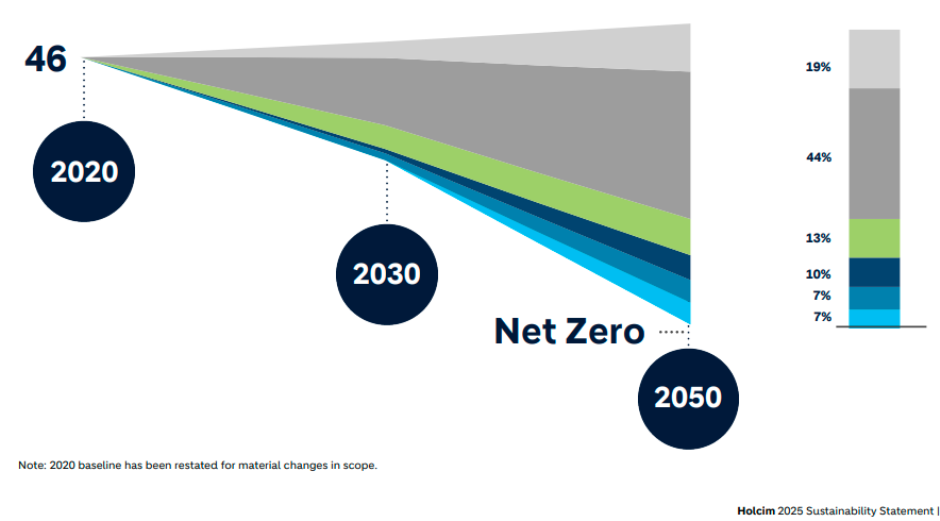
Holcim strengthened its sustainability performance in 2025 by lowering carbon emissions, expanding low-carbon construction materials, increasing recycling, improving water efficiency and advancing renewable energy and carbon capture projects. The company’s updated Science Based Targets initiative-validated climate commitments support its ambition to achieve net-zero greenhouse gas emissions across its entire value chain by 2050.
The Sustainability Report of Holcim shows that climate action is increasingly integrated into Holcim’s manufacturing operations, product portfolio and growth strategy. The company is combining cleaner energy, alternative fuels, improved cement formulations, circular construction technologies and carbon capture investments to reduce the environmental impact of cement and concrete production.
Holcim Reduces Scope 1 Emissions by 2.6 Percent
Holcim reduced Scope 1 carbon emissions to 502 kilograms of CO₂ per ton of cementitious materials in 2025, down 2.6 percent from 515 kilograms in 2024. Scope 1 emissions were also 11 percent below the restated 2020 baseline.
The reduction was supported by improved cement formulations, operational efficiency, cleaner production technologies, alternative fuels, renewable electricity and changes to the company’s energy mix.
Holcim aims to reduce Scope 1 emissions to below 400 kilograms of CO₂ per ton of cementitious materials by 2030. Reaching this target would represent a 30 percent reduction compared with the 2020 baseline.
Scope 2 emissions decreased 4.2 percent from 2024 and were 26 percent lower than the 2020 baseline. Holcim said its energy procurement strategy and transition toward cleaner electricity sources supported the reduction.
The company has also committed to reducing gross Scope 3 greenhouse gas emissions by 25.1 percent per ton of purchased clinker and cement and per ton of cementitious materials from investments by 2030. These targets currently cover 67.2 percent of Holcim’s base-year Scope 3 emissions.
Under its SBTi-validated long-term climate strategy, Holcim plans to achieve net-zero greenhouse gas emissions across its value chain by 2050. The target includes a 90 percent absolute reduction in Scope 3 emissions compared with the 2020 baseline.
Eight EU Grants Support Holcim Carbon Capture Projects
Carbon capture, utilization and storage remains a central part of Holcim’s decarbonization strategy. The company secured eight European Union Innovation Fund grants for CCUS projects in 2025, compared with seven grants in 2024.
One of Holcim’s major developments is the OLYMPUS carbon capture project in Milaki, Greece. The project is designed to support the production of 2 million tons of near-zero cement annually.
Holcim is also progressing with a carbon capture project in Campulung, Romania. These investments complement the company’s efforts to increase renewable electricity, expand alternative fuel use and improve thermal and electrical energy efficiency across its cement manufacturing network.
ECOPact Reaches 31 Percent of Ready-Mix Concrete Sales
Customer demand for Holcim’s low-carbon construction materials continued to grow in 2025. ECOPact low-carbon concrete accounted for 31 percent of total ready-mix concrete net sales, increasing by 5 percentage points from 26 percent in 2024.
ECOPlanet low-carbon cement represented 36 percent of total cement net sales, up 2 percentage points from 34 percent in the previous year.
ECOPact and ECOPlanet products are designed to deliver at least 30 percent lower CO₂ emissions than conventional cement and concrete alternatives while maintaining required performance and quality standards.
Holcim aims for ECOPact to generate more than 50 percent of ready-mix concrete net sales by 2030. It is targeting the same level for ECOPlanet, which is expected to contribute more than 50 percent of cement net sales by the end of the decade.
Construction Material Recycling Rises 23 Percent to 8 Million Tons
Holcim recycled 8 million tons of construction and demolition materials in 2025, an increase of approximately 23 percent from 6.5 million tons in 2024.
The expansion was driven by acquisitions, additional circular construction hubs and the continued deployment of Holcim’s ECOCycle technology.
Products using ECOCycle technology contain at least 10 percent recycled construction and demolition materials. The approach enables Holcim to reuse materials from old buildings, reduce construction waste and limit the extraction of virgin natural resources.
Holcim aims to recycle more than 20 million tons of construction and demolition materials annually by 2030. Achieving the target would require the company to increase annual recycling volumes by more than 12 million tons from the 2025 level.
Freshwater Withdrawal Falls to 179 Liters Per Ton
Holcim reduced freshwater withdrawal to 179 liters per ton of cementitious materials in 2025, down 6.3 percent from 191 liters in 2024.
Freshwater withdrawal was 25 percent below the 2020 baseline. The company is targeting a 33 percent reduction by 2030 through improved water efficiency, rainwater harvesting, recycled water use and responsible management of water resources.
Holcim also established three Science Based Targets Network-aligned freshwater targets covering water basins in Belgium, Greece and Spain.
Holcim Plans 31 MW Floating Solar Project in Belgium
Holcim is working with TotalEnergies to develop what the company describes as Europe’s largest floating solar power plant at its Obourg facility in Belgium.
The renewable energy installation will include 55,000 solar panels and provide a generating capacity of 31 megawatts. It is expected to meet up to 15 percent of the electricity demand of Holcim’s GO4ZERO plant by 2030.
The project is projected to generate electricity equivalent to the annual consumption of approximately 8,500 homes. It is also expected to prevent 110,000 tons of CO₂ emissions over its operating lifetime.
The renewable energy project forms part of Holcim’s broader strategy to reduce Scope 2 emissions, expand renewable electricity procurement and improve energy efficiency. The company is also increasing the use of alternative fuels through its Geocycle operations.
Holcim Earns Strong Climate and ESG Ratings
Holcim received an A rating from CDP for Climate Change and an A rating for Water Security in recognition of its environmental disclosure and performance.
Sustainalytics assigned the company an ESG Risk Rating of 16.4, placing Holcim in the low-risk category and ranking it first within the construction materials industry.
Holcim maintained an AAA MSCI ESG Rating as of March 2026. It also received a score of 4.1 out of 5 from FTSE4Good, placing the company among the top 8 percent of its industry.
ISS ESG awarded Holcim a B- Prime rating, positioning it within the top 10 percent of companies in the construction materials sector.
Safety Performance Improves Across Holcim Sites
Holcim reported a lost-time injury frequency rate of 0.36 in 2025. The company said 99 percent of its operating sites recorded zero lost-time injuries, while 60 percent of the countries in which it operates reported no lost-time injuries.
The safety performance reflects Holcim’s focus on operational discipline, employee wellbeing, risk prevention and its long-term objective of becoming a zero-harm business.
Holcim’s sustainability transformation is overseen by Carmen Diaz, Chief People and Sustainability Officer. The company proactively updated its SBTi-validated CO₂ targets for 2030 and 2050 in February 2025, reinforcing its strategy to make low-carbon and circular construction a central driver of long-term growth.
With Scope 1 emissions reduced to 502 kilograms per ton, Scope 2 emissions down 26 percent from 2020, recycling reaching 8 million tons and low-carbon products accounting for a growing share of sales, Holcim is advancing toward its 2030 sustainability targets and its goal of net-zero emissions by 2050.
SHAFANA FAZAL