


Henkel has strengthened its position as a sustainability leader with the release of its Sustainability Report 2025, highlighting significant progress in climate action, renewable energy, circular economy, resource efficiency, diversity, and ESG governance.
Henkel reaffirmed its commitment to achieve net-zero greenhouse gas emissions across its entire value chain by 2045. The company targets a 90 percent reduction in absolute Scope 1, Scope 2, and Scope 3 greenhouse gas emissions by 2045 compared with the 2021 baseline. Its interim targets include reducing absolute Scope 1 and Scope 2 emissions by 42 percent and Scope 3 emissions by 30 percent by 2030, while sourcing 100 percent of its electricity from renewable energy by 2030. These targets are aligned with the Science Based Targets initiative (SBTi) Corporate Net-Zero Standard and the 1.5°C climate pathway, Henkel Sustainability Report indicated.
“2030+ Sustainability Ambition Framework is our compass. In our anniversary year, we sharpened this strategic approach by including new targets and commitments,” Sylvie Nicol, Executive Vice President Human Resources, Infrastructure and Sustainability at Henkel, said.
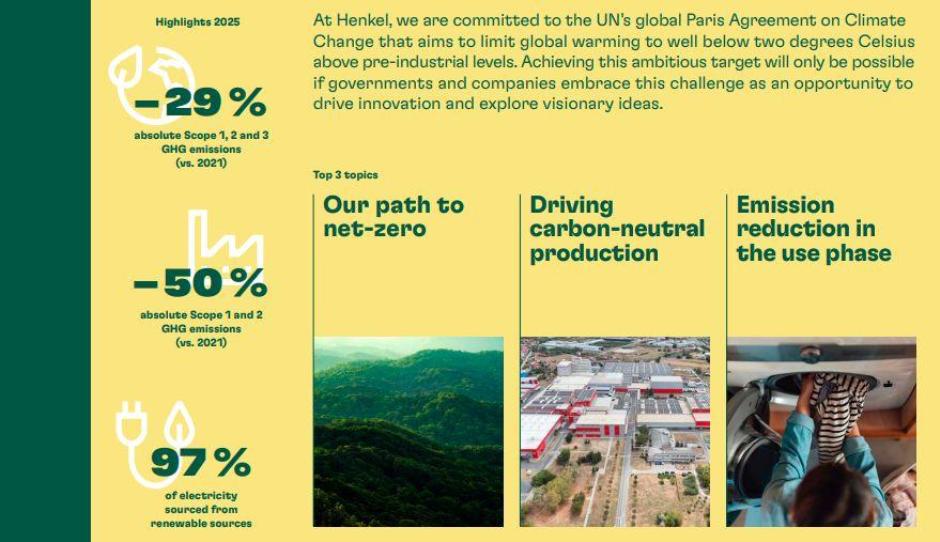
Henkel delivered measurable progress during 2025, reducing absolute Scope 1, Scope 2, and Scope 3 greenhouse gas emissions by 29 percent compared with the 2021 baseline. Between 2021 and 2025, the company cut CO₂ emissions by 5.4 million tons, reflecting steady progress toward its long-term decarbonization roadmap. Scope 1 and Scope 2 emissions declined by 28 percent versus the 2021 baseline, while renewable electricity accounted for 97 percent of electricity consumed across Henkel’s global operations during the year.
Renewable energy remains central to Henkel’s climate strategy. The company plans to increase renewable electricity usage from 97 percent in 2025 to 100 percent by 2030. Henkel also confirmed that its net-zero strategy focuses on reducing emissions throughout its operations and value chain before neutralizing the remaining 10 percent of unavoidable emissions through high-quality carbon removal projects. In parallel, the company is expanding Beyond Value Chain Mitigation (BVCM) initiatives by investing in both nature-based and technology-driven carbon removal solutions to support broader global decarbonization efforts.
Henkel is also advancing sustainable manufacturing through its ambition to achieve 100 percent carbon-neutral production. The company is deploying smart energy management systems, electrifying production sites, and expanding large-scale solar installations to reduce operational emissions while improving manufacturing efficiency and energy resilience.
Sustainability governance continues to be led by Sylvie Nicol, Executive Vice President for Human Resources, Infrastructure, and Sustainability, while Ulla Hueppe oversees sustainability initiatives within the Adhesive Technologies business. Commenting on the integrated reporting approach, Sylvie Nicol said the 2025 Annual Report combines financial and sustainability key performance indicators in a single report under the CSRD framework, reinforcing that sustainability is embedded across Henkel’s organization as a key driver of long-term growth.
Henkel’s new sustainability framework for 2026-2030 introduces 12 strategic targets and 15 commitments designed to accelerate emissions reductions, expand circular economy initiatives, improve supply chain transparency, increase renewable and sustainable raw materials, and replace fossil-based feedstocks with lower-impact alternatives. The roadmap also strengthens ESG integration across supply chain management, pension asset management, and raw material traceability while maintaining the company’s long-term ambition of reducing absolute greenhouse gas emissions by 90 percent by 2045.
Through its integrated sustainability strategy, ambitious climate targets, 97 percent renewable electricity usage, 29 percent reduction in total greenhouse gas emissions, 5.4 million tons of CO₂ reductions since 2021, and continued investments in carbon-neutral production and renewable energy, Henkel is reinforcing its commitment to delivering sustainable business growth while creating long-term environmental and economic value.
SHAFANA FAZAL