


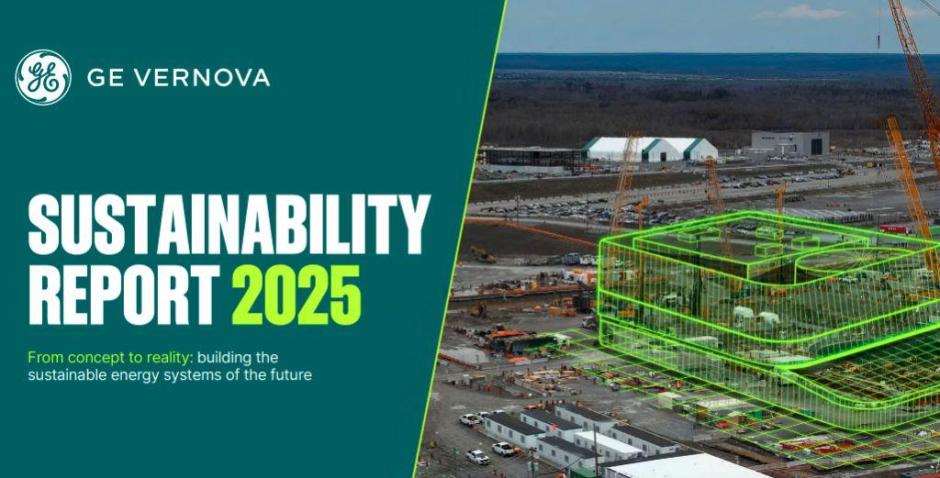
GE Vernova has outlined roadmap to accelerate the global energy transition, with its 2025 Sustainability Report highlighting major progress in clean energy deployment, emissions reduction, grid modernization and advanced energy technologies. Guided by its sustainability pillars — Electrify, Decarbonize & Conserve, and Thrive — the company is expanding access to reliable electricity while advancing its long-term net zero strategy.
Roger Martella, Chief Corporate Officer and Chief Sustainability Officer, said: “The story of GE Vernova is one of an unrelenting focus on delivering the technologies the world needs not just today, but importantly for the decades ahead. I have never been more optimistic about our ability to help meet not only the needs of today, but of the generations that follow.”
GE Vernova Advances Toward Net Zero Targets
GE Vernova Sustainability Report 2025 indicated that it aims to achieve carbon neutrality for Scope 1 and Scope 2 greenhouse gas emissions by 2030 while targeting net zero Scope 3 emissions from the use of sold products by 2050. The company also plans to deliver 150 GW of new power generation and grid capacity by 2030, ensure 90 percent of its top products follow the 4R circularity framework, and support 30,000 students and learners through workforce development initiatives by the end of the decade.
$11 Billion Investment to Expand Clean Energy Manufacturing
To accelerate innovation, GE Vernova plans to invest $11 billion in capital expenditure and research and development through 2028. The investment includes $1.25 billion for expanding manufacturing facilities in the United States and is expected to create around 1,800 new manufacturing jobs. During 2025 alone, the company created more than 1,500 jobs in the U.S. while building stronger domestic clean energy supply chains.
Significant Emissions Reductions Strengthen Climate Progress
GE Vernova has reduced Scope 1 and Scope 2 greenhouse gas emissions by 64 percent since 2019, improving from a 38 percent reduction in 2023 and 51 percent in 2024. During 2025, operational emissions declined by 27 percent year over year through energy efficiency improvements, facility upgrades and operational optimization.
The company also reported a cumulative 61 percent reduction in gross lifetime Scope 3 emissions compared with 2019 following its strategic exit from new steam turbine projects for coal-fired power plants.
Electricity generated using GE Vernova technologies recorded an average carbon intensity of 309 grams of carbon dioxide per kilowatt-hour, approximately 31 percent lower than the global electricity sector average of 446 grams per kilowatt-hour. New generating units installed during 2025 are expected to avoid 22 million metric tons of carbon dioxide emissions during their first full year of operation.
Renewable Energy, Wind and Grid Expansion
GE Vernova continued expanding renewable energy infrastructure across global markets. The company completed installation of Dogger Bank A, the first phase of the world’s largest offshore wind farm, which is expected to power approximately 6 million homes annually once fully operational.
The company secured 1.1 GW of onshore wind repowering orders in the United States and introduced its advanced 3.8 MW wind turbine platform through a 100 MW wind project in Gujarat, India. It also expanded robotic crawler technology for wind turbine inspections, improving safety and reducing maintenance downtime.
Grid modernization remained a major focus. During 2025, GE Vernova added 26 GW of new power generation capacity and energized 68 GW of transformer capacity worldwide. Approximately 47 percent of new generation capacity and 33 percent of new grid infrastructure were deployed across developing and emerging economies. Since 2024, the company has deployed 57 GW of generation capacity, achieving approximately 38 percent of its 150 GW target.
GE Vernova also deployed approximately 6 GW of solar inverter capacity, supporting the integration of utility-scale solar projects into electricity grids.
Circular Economy and Sustainable Products
The company’s circular economy strategy continued to advance through its 4R framework—Rethink, Reduce, Reuse and Recycle. Circular design principles were incorporated into 53 percent of leading products during 2025, up from 38 percent in the previous year, keeping the company on track to reach 90 percent coverage by 2030.
Environmental transparency also improved, with 76 percent of major products now covered by Life Cycle Assessments or Environmental Product Declarations.
Nuclear, Hydrogen and Carbon Capture Technologies
GE Vernova strengthened its portfolio of next-generation clean energy technologies during 2025.
Construction began on Canada’s first commercial Small Modular Reactor project at Ontario Power Generation’s Darlington site. The project includes up to four BWRX-300 reactors, each capable of generating approximately 300 MW of carbon-free electricity.
The company also started construction of the Net Zero Teesside Power project in the United Kingdom, expected to become the world’s first commercial-scale gas-fired power plant equipped with carbon capture and storage while generating more than 740 MW of electricity.
Innovation also extended to hydrogen and carbon removal technologies. GE Vernova successfully validated a Dry Low NOx combustor capable of operating on up to 100 percent hydrogen fuel while maintaining emissions below 25 ppm NOx. Its Direct Air Capture pilot facility in New York became fully operational and captures 10 tons of carbon dioxide annually to support future carbon removal research.
Workforce Development and Energy Transition
Through its Thrive sustainability pillar, GE Vernova engaged approximately 10,700 students and learners in technical education, STEM and clean energy training during 2025, advancing toward its target of supporting 30,000 learners by 2030.
The company also reported an electrification backlog of $35 billion, reflecting growing global demand for transmission infrastructure, renewable energy integration and grid modernization technologies.
Outlook
GE Vernova’s 2025 Sustainability Report demonstrates substantial progress in clean energy deployment, emissions reduction, renewable energy, circular economy, nuclear innovation and advanced grid technologies. Backed by an $11 billion investment program and ambitious climate targets extending to 2050, the company is strengthening its position as a leading provider of technologies that support global decarbonization, energy security and sustainable economic growth.
SHAFANA FAZAL