


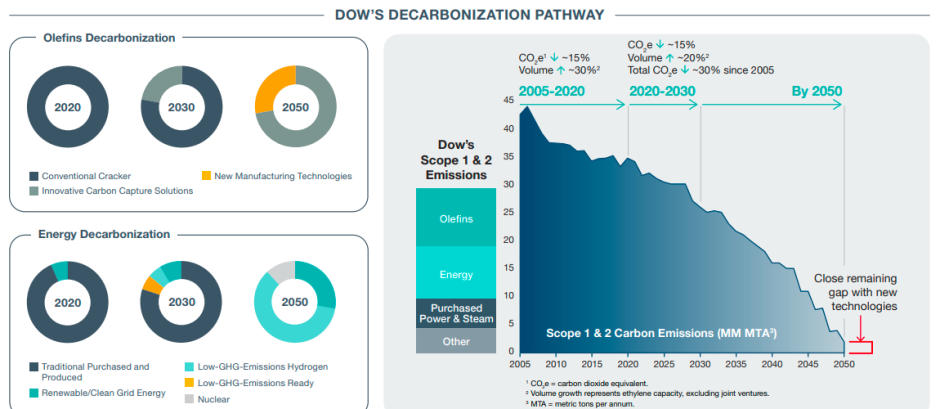
Dow’s 2025 sustainability progress highlights measurable advances in net zero, renewable energy, emissions reduction, circular economy, water resilience and climate-focused innovation. The company has set a long-term goal to become carbon neutral by 2050 across Scopes 1, 2 and 3 plus product benefits, supported by a 2030 target to reduce net annual carbon emissions by 5 million metric tons, or about 15 percent, from its 2020 baseline of 35 million metric tons of carbon dioxide equivalent.
Dow, which reported $39.96 billion in sales revenue, has achieved its 2025 emissions target by reducing annual carbon emissions by 2 million metric tons against the 2020 baseline. The company also aims to cut Scope 1 and Scope 2 emissions by 30 percent from 2005 levels by 2050 while expanding production volumes, Dow sustainability report 2025 indicated.
Jim Fitterling, Chair and Chief Executive Officer of Dow, said: “Collaborated with companies to reduce GHG emissions across the value chain using a Carbon Footprint Ledger methodology.”
Andre Argenton, Chief Technology and Sustainability Officer of Dow, said: “Our targets are pragmatic, credible and financially grounded, reflecting current market realities and a disciplined approach to capital allocation.”
Renewable energy is central to Dow’s decarbonization strategy. The company sources more than 50 percent of purchased electricity from renewables through over 1,000 MW of installed renewable capacity worldwide. Dow also exceeded its earlier target to secure 750 MW of renewable power demand three years ahead of schedule.
In Brazil, all 9 Dow sites now run on 100 percent renewable electricity, supported by long-term wind and solar power purchase agreements and self-generation. These efforts have contributed to a 50 percent reduction in Scope 2 market-based emissions, which declined to 3,110 kilotons of carbon dioxide equivalent from 6,220 kilotons in 2020.
Scope 3 emissions remain Dow’s largest climate challenge, representing more than 70 percent of total greenhouse gas emissions. Upstream emissions from purchased goods and services are approximately 40,000 kilotons of carbon dioxide equivalent, while downstream end-of-life treatment emissions are around 20,830 kilotons. Total Scope 3 emissions declined by 6 percent to 11 percent compared with the 2020 baseline of 82,200 kilotons of carbon dioxide equivalent.
Dow is strengthening value chain emissions tracking through a product carbon footprint ledger, enabling standardized measurement across materials, products and supply chain activities. A long-term agreement with Procter & Gamble aims to reduce several million metric tons of greenhouse gas emissions over the next decade. Low-carbon materials supplied to Henkel have reduced product carbon footprints by 20 percent to 40 percent, depending on the product line.
Circular economy targets remain another major part of Dow’s ESG strategy. The company is committed to commercializing 3 million metric tons of circular and renewable solutions annually, with an interim 2030 target of 500 kilotons annually. Dow also works with Google X through the Materra project to improve sorting of complex plastic waste using artificial intelligence.
Dow’s product innovation is also reducing emissions intensity. The company introduced an 18 percent lower-carbon WALOCEL product family and launched carbon-neutral silicone elastomer blends. At its Songjiang, China site, new technology cut hourly nitrogen oxide concentration by approximately 6 percent.
Major sustainability investments include the world’s first net-zero Scope 1 and Scope 2 integrated ethylene cracker and derivatives facility in Alberta, Canada, with Phase 1 expected by end-2029 and Phase 2 by end-2030. Dow is also investing in small modular nuclear technology at Seadrift, Texas, to provide reliable low-emissions power and steam.
Water resilience is another priority. Dow began construction of a 16 billion U.S. gallon off-channel reservoir and pump station in Freeport, Texas, to improve water security for industrial operations and surrounding communities. The company also delivered $1.2 billion in net present value from nature-enhancing business projects and aims to conserve 50,000 acres of habitat by 2050.
By 2030, Dow plans water stewardship plans at its top 20 water-dependent sites, with 10 becoming water resilient. By 2035, all Dow sites are expected to have water stewardship plans.
Dow also reported broad sustainability achievements from its decade-long goals. It achieved 6 of 7 sustainability goals ahead of schedule, aligned more than 90 percent of its R&D portfolio with sustainability outcomes against a goal of 85 percent, reduced Level 1 and Level 2 Process Safety and Containment Events by 79 percent, achieved a 20 percent reduction in waste intensity, cut high-priority health risks by 40 percent, improved the Transportation Stewardship Index by 50 percent and maintained more than 70 percent employee volunteer participation.
Dow’s 2025 sustainability performance shows measurable ESG progress across net zero, renewable electricity, Scope 2 emissions reduction, Scope 3 value chain engagement, circular economy development and climate resilience infrastructure. Independent assurance by Deloitte under Greenhouse Gas Protocol and Global Reporting Initiative standards further strengthens the credibility of Dow’s reported sustainability data.
SHAFANA FAZAL