


Coway is accelerating its sustainability transformation with measurable progress across climate action, renewable energy, circular economy, ESG governance, and cybersecurity, reinforcing its commitment to achieve Net Zero carbon emissions and 100 percent renewable energy by 2050.
The company’s latest Sustainability Report highlights major advances in greenhouse gas reduction, solar power expansion, recycled material adoption, resource efficiency, and governance, supported by record business growth and continued investment in research and development.
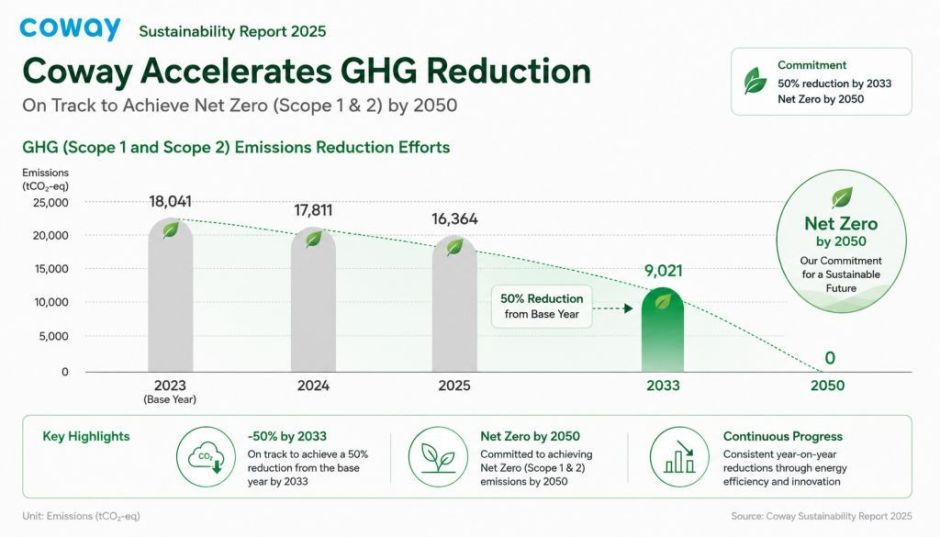
Coway, under the leadership of Jangwon Seo, has set an interim target to reduce Scope 1 and Scope 2 greenhouse gas emissions by 50 percent from the 2023 baseline by 2033, while maintaining its long-term 2050 Net Zero and renewable electricity commitments.
Coway recorded 16,364 tons of CO2 equivalent in Scope 1 and Scope 2 emissions, with an emissions intensity of 0.472 tCO2eq per KRW 100 million, while expanding climate management through its proprietary Coway Climate Change Management System and increasing eco-friendly vehicles to 4 percent of its operational fleet, Coway Sustainability Report 2025 indicated.
Renewable energy investment continues to expand through the completion of Coway’s third on-site solar power plant at its Yugu manufacturing facility, adding 532 kWp of installed solar capacity. The company plans to increase annual solar electricity generation by approximately 29 percent, from 2,310 MWh in 2025 to 2,990 MWh by 2027, while renewable energy currently accounts for 2.9 percent of total electricity consumption. These investments support Coway’s long-term transition toward fully renewable operations.
Coway’s renewable energy use reached 2,310 MWh in 2025 as compared with 2,366 MWh in 2024 and 2,178 MWh in 2023. Coway’s retirement of RECs for Renewable Energy Claim has reached 2,124 MWh in 2025 as compared with 2,181 MWh in 2024 and 1,993 MWh in 2023.
Coway accelerated its greenhouse gas (GHG) reduction efforts by replacing service vehicles with high-efficiency leased models certified at 11.6 km/L, up from approximately 9.3 km/L for previously used personal vehicles. The transition significantly improved fuel efficiency and lowered emissions on an equivalent mileage basis.
As a result, GHG emissions per service fell by 19.5 percent, declining from 2.84 kgCO₂e in 2024 to 2.29 kgCO₂e in 2025, even as service volumes increased alongside revenue growth. Coway plans to expand the rollout of high-efficiency business vehicles to further reduce emissions across its logistics and service operations while advancing its medium- and long-term climate targets.
Coway is strengthening its circular economy strategy by increasing recycled material use and improving resource recovery. The company utilized 2,030 tons of recycled ABS resin during the reporting period, exceeding its annual recovery target by 27 percent. Recycled plastics now represent 17 percent of total plastic consumption across manufacturing operations.
Coway maintained a 100 percent waste recycling and resource recovery rate, ensured that more than 75 percent of its products remain recyclable, and achieved a 90 percent environmental charge reduction rate, reflecting continued improvements in sustainable manufacturing and product lifecycle management.
Product sustainability also advanced through greater adoption of environmentally friendly technologies. Ninety-six percent of applicable products now use eco-friendly refrigerants, while innovations such as the Smart Moving Faucet integrated into the Icon Water Purifier series improve water efficiency and hygiene.
On the governance front, Coway strengthened shareholder value and corporate accountability by increasing its shareholder return target from 20 percent to 40 percent under its Corporate Value-Up Plan. The company also reinforced governance through dedicated board committees and invested KRW 3.49 billion in information security, representing 4.6 percent of its total IT budget.
With emissions reduction targets, expanding renewable energy capacity, stronger Scope 3 emissions management, increased recycled material use, enhanced governance, and continued ESG investment, Coway is positioning itself as a global sustainability leader while building a resilient, low-carbon business for long-term growth.
SHAFANA FAZAL