


Citi accelerated its sustainability and climate initiatives in 2025, taking cumulative sustainable finance to $647.2 billion since 2020 while cutting operational greenhouse gas emissions 58 percent from its 2010 baseline.
Citi sustainability report 2025 indicated that the bank mobilized $91.3 billion in sustainable finance during 2025, including $35.1 billion for environmental finance, as it advances toward its $1 trillion sustainable finance target by 2030. Renewable energy accounted for $18.4 billion of environmental finance during the year.
Citi estimates that its sustainable-finance activities since 2020 have been associated with approximately 8.8 million metric tons of avoided GHG emissions, supported more than 4.4 million jobs and impacted approximately 67 million people.
Citi Operational GHG Emissions Fall 58%
Citi achieved a 58 percent reduction in combined Scope 1 and Scope 2 location-based GHG emissions compared with its 2010 baseline.
Combined Scope 1 and Scope 2 location-based emissions totaled 370,030 metric tons of CO2e in 2025. This included 50,790 metric tons of Scope 1 emissions and 319,240 metric tons of Scope 2 location-based emissions.
On a market-based basis, combined Scope 1 and Scope 2 emissions were substantially lower at 86,640 metric tons of CO2e.
The reduction supports Citi’s target of achieving net-zero emissions from its own operations by 2030.
Business Travel Emissions Drop 20%
Citi also reduced disclosed Scope 3 Category 6 business-travel emissions to 55,435 metric tons of CO2e in 2025, compared with 69,468 metric tons in 2024, an approximately 20 percent year-over-year decline.
Air travel generated 55,359 metric tons of CO2e, while train travel accounted for just 76 metric tons.
The figures relate specifically to Scope 3 Category 6 business travel rather than Citi’s entire Scope 3 emissions footprint.
Citi Targets Net-Zero Operations by 2030 and Net Zero by 2050
Citi has established two major net-zero milestones: net-zero emissions from its own operations by 2030 and a broader net-zero emissions target for 2050.
The bank has also established interim 2030 financed-emissions targets covering 10 carbon-intensive sectors: aluminum, auto manufacturing, aviation, cement, commercial real estate, energy, power, shipping, steel and thermal coal mining.
Its 58 percent operational Scope 1 and Scope 2 location-based emissions reduction since 2010 provides an important benchmark for progress toward the 2030 operational target.
Citi Sources 100% Renewable Electricity
Renewable energy is playing a central role in reducing Citi’s operational carbon footprint. The bank sourced 100 percent renewable electricity for its operations in 2025, while renewable energy represented 77 percent of total direct and indirect energy consumption.
Total energy consumption declined to 1,082,478 MWh in 2025, approximately 43 percent below the 2010 baseline of 1,898,880 MWh.
Energy use has continued to decline in recent years, falling from 1,151,732 MWh in 2023 to 1,113,053 MWh in 2024 and 1,082,478 MWh in 2025.
Direct energy consumption totaled 228,736 MWh, while indirect energy consumption reached 853,742 MWh.
Natural gas represented 211,251 MWh of direct energy consumption, while diesel accounted for another 15,016 MWh.
Renewable Energy Finance Reaches $90.1 Billion
Citi provided $18.4 billion in renewable-energy finance during 2025, taking cumulative renewable-energy financing to $90.1 billion since 2020.
Renewable energy represented more than half of the bank’s $35.1 billion in environmental finance during 2025.
The $90.1 billion figure covers Citi’s broader renewable-energy financing category and is not exclusively solar or wind financing.
Citi Expands Solar to 1.8 MW Across 17 Sites
Citi is also expanding renewable-energy generation at its own facilities.
The bank operated on-site solar installations at 17 active sites, providing approximately 1.8 MW of installed capacity in 2025.
Self-generated renewable electricity increased to 2,390 MWh in 2025, up from 1,779 MWh in 2024 and 780 MWh in 2023. This means Citi’s self-generated renewable electricity has more than tripled in two years.
The bank expanded or installed solar generation at facilities in Belfast, Hong Kong, Libreville, London and Tunis, while also piloting battery storage at selected locations.
Citi Uses 85 Million Gallons of Reclaimed Water
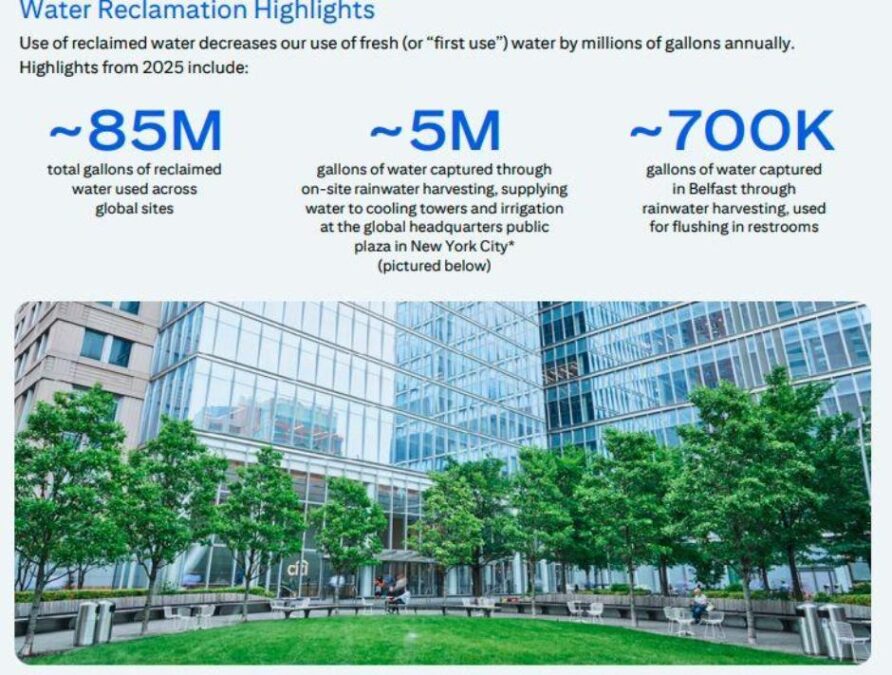
Citi’s environmental strategy extends beyond energy and carbon emissions. The bank captured or sourced approximately 85 million gallons of reclaimed water during 2025.
Facility water consumption was 37 percent below its 2010 baseline, with reclaimed sources representing 10 percent of facility water consumption.
Citi also maintained 302 sustainable building certifications and achieved six of eight operational footprint goals covering areas including GHG emissions, energy, water, waste and sustainable buildings.
Citi Sustainability Strategy Combines Finance and Operational Decarbonization
Chief Sustainability Officer Val Smith leads Citi’s sustainability agenda, which combines capital deployment with reductions in the environmental footprint of the bank’s global operations.
Citi’s 2025 performance highlights the scale of that strategy: $647.2 billion in cumulative sustainable finance since 2020, $91.3 billion mobilized during 2025, $35.1 billion in environmental finance and $90.1 billion in cumulative renewable-energy finance.
At the operational level, Citi has achieved a 58 percent reduction in Scope 1 and Scope 2 location-based GHG emissions from its 2010 baseline, sourced 100 percent renewable electricity, reduced energy consumption 43 percent and expanded on-site solar capacity to 1.8 MW across 17 locations.
With a $1 trillion sustainable finance target for 2030, net-zero operations targeted for 2030 and a broader 2050 net-zero goal, Citi’s 2025 figures show measurable progress across sustainable finance, renewable energy, emissions, energy efficiency and resource management.
SHAFANA FAZAL