


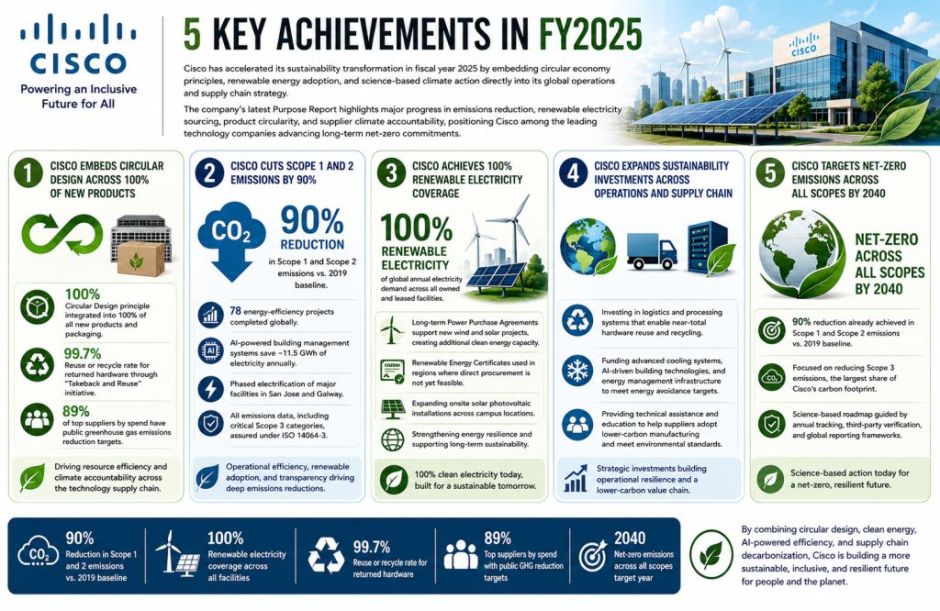
Cisco has accelerated its sustainability transformation in fiscal year 2025 by embedding circular economy principles, renewable energy adoption, and science-based climate action directly into its global operations and supply chain strategy.
The company’s latest Purpose Report highlights major progress in emissions reduction, renewable electricity sourcing, product circularity, and supplier climate accountability, positioning Cisco among the leading technology companies advancing long-term net-zero commitments.
Cisco Embeds Circular Design Across 100 Percent of New Products
Cisco’s sustainability strategy is increasingly centered on circular economy principles aimed at reducing waste, extending product lifecycles, and improving material reuse across global operations.
In fiscal year 2025, Cisco confirmed that its “Circular Design” principle has been integrated into 100 percent of all new products and packaging. The company’s logistics and hardware recovery operations also delivered strong results through its “Takeback and Reuse” initiative.
Cisco achieved a 99.7 percent reuse or recycle rate for returned hardware during fiscal year 2025, reflecting the company’s growing focus on resource efficiency and responsible product lifecycle management.
The company is also extending sustainability standards across its broader supplier ecosystem. Cisco reported that 89 percent of its top suppliers by spend have established public greenhouse gas emissions reduction targets, helping drive climate accountability throughout the technology supply chain.
Cisco Cuts Scope 1 and 2 Emissions by 90 Percent
Cisco reached one of its most significant climate milestones in fiscal year 2025 by achieving an absolute 90 percent reduction in Scope 1 and Scope 2 greenhouse gas emissions compared with its 2019 baseline.
The reduction was driven through a combination of operational efficiency improvements, renewable energy adoption, building modernization, and electrification programs.
During fiscal year 2025, Cisco completed 78 energy-efficiency projects globally. The company utilized AI-powered building management systems that now save approximately 11.5 gigawatt-hours of electricity annually.
Cisco has also started the phased electrification of major facilities in San Jose and Galway as part of its broader strategy to eliminate dependence on fossil fuel-based infrastructure.
To strengthen transparency and reporting integrity, Cisco subjects all emissions data, including critical Scope 3 categories, to independent limited third-party assurance aligned with ISO 14064-3 reporting standards.
Cisco Achieves 100 Percent Renewable Electricity Coverage
Fiscal year 2025 marked a major milestone in Cisco’s clean energy transition strategy.
The company officially achieved renewable electricity sourcing equivalent to 100 percent of its global annual electricity demand across all owned and leased facilities worldwide.
Cisco accomplished this target through a diversified renewable procurement strategy that includes long-term Power Purchase Agreements supporting new wind and solar energy projects. These agreements help create additional renewable energy capacity while providing long-term energy market stability.
In regions where direct renewable procurement is not yet feasible, Cisco uses Renewable Energy Certificates to maintain full renewable electricity coverage.
The company also continues expanding onsite solar photovoltaic installations across campus locations to improve local energy resilience and operational sustainability.
Cisco Expands Sustainability Investments Across Operations and Supply Chain
Cisco’s sustainability investments increasingly focus on operational resilience, logistics optimization, low-carbon infrastructure, and supplier decarbonization.
The company continues investing heavily in logistics and processing systems that support its near-total hardware reuse and recycling performance.
Additional capital is being allocated toward advanced cooling systems, AI-driven building technologies, and energy management infrastructure designed to support year-over-year energy avoidance targets.
Cisco is also funding technical assistance and educational programs that help suppliers transition toward lower-carbon manufacturing processes and meet evolving environmental standards.
Cisco Targets Net-Zero Emissions Across All Scopes by 2040
Cisco’s long-term climate strategy centers on achieving net-zero greenhouse gas emissions across all scopes by 2040.
Having already achieved a 90 percent reduction in Scope 1 and Scope 2 emissions, the company is now intensifying efforts to address Scope 3 emissions, which represent the largest share of its overall carbon footprint.
Cisco said its net-zero roadmap is guided by science-based methodologies, annual performance tracking, third-party verification, and alignment with international climate reporting frameworks.
By combining circular product design, 100 percent renewable electricity sourcing, AI-powered energy management, and supply chain decarbonization, Cisco is positioning sustainability as a core pillar of long-term business resilience and operational transformation.
FASNA SHABEER