


City Developments Limited (CDL) has strengthened its leadership in sustainable real estate with ambitious net-zero targets, more than S$11 billion in sustainable financing, 130 BCA Green Mark certifications, and significant progress in reducing carbon emissions, energy use, water consumption, and waste.
The Singapore-based property developer outlined its latest environmental achievements and long-term decarbonisation strategy in its Integrated Sustainability Report 2026. CDL continues to align its business with the World Green Building Council (WorldGBC) Net Zero Carbon Buildings Commitment, signed in 2021, while pursuing science-based climate targets.
The company aims to reduce carbon emissions intensity by 63 percent by 2030 from 2016 levels and has already achieved a 30 percent reduction by 2025. CDL also targets a 63 percent reduction in corporate office energy use intensity and a 55.7 percent reduction in Asset Management energy use intensity by 2030, Sherman Kwek, CDL Group Chief Executive Officer, said.
Additional 2030 sustainability goals include reducing office and industrial water use intensity by 9.5 percent, retail water use intensity by 10.8 percent, office and industrial waste intensity by 8 percent, and retail waste intensity by 5 percent, CDL Sustainable Report 2025 said.
In 2025, CDL reduced corporate office energy intensity by 20 percent, Asset Management energy intensity by 22.3 percent, office and industrial water intensity by 28.6 percent, retail water intensity by 39.9 percent, office and industrial waste intensity by 13 percent, while retail assets achieved the 5 percent waste reduction target.
Sustainable finance continues to play a central role in CDL’s climate strategy. Since 2017, the company has secured more than S$11 billion in sustainable financing and saved over S$375,000 by meeting sustainability-linked loan performance targets across three sustainability-linked loans since 2019. Energy-efficiency initiatives implemented between 2012 and 2025 have generated approximately S$47.5 million in energy cost savings through retrofitting and operational improvements across its commercial property portfolio.
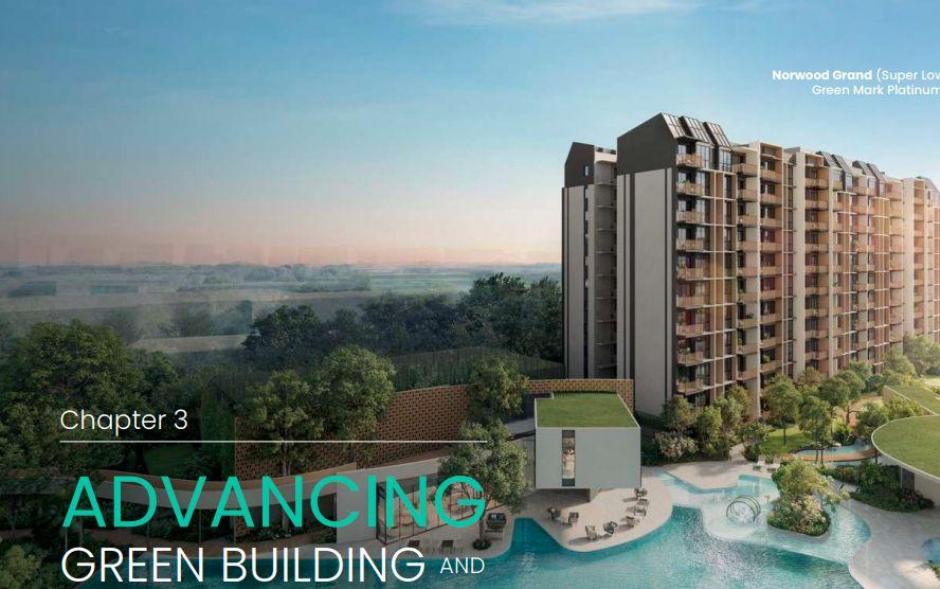
Green buildings remain one of CDL’s biggest sustainability achievements. The company now holds 130 BCA Green Mark certifications, making it one of Singapore’s leading private developers with the largest portfolio of Green Mark Platinum-certified developments. In 2025, the Zyon Grand project received the 12th BCA Green Mark Platinum Super Low Energy (SLE) Award, together with Health & Wellbeing, Maintainability, and Whole Life Carbon badges. CDL also maintained the internationally recognised WELL Health-Safety Rating across nine Singapore properties. The percentage of CDL-owned and managed buildings certified under the BCA Green Mark scheme reached 100 percent in 2025, up from 85 percent in 2021.
The company is also investing in climate resilience and biodiversity. During 2025, CDL established the 2,800-square-foot CDL MicroForest, a regenerative tropical microforest designed to mitigate urban heat and improve biodiversity. It also introduced Singapore’s first repurposed SMRT train cabin, known as CDL EcoTrain, to support sustainability education and launched its sixth climate exhibition, Melting Ice, Sinking Cities – The Arctic Impact, highlighting the effects of climate change.
CDL reported continued progress in environmental management across its operations. In 2025, managed buildings generated 3,088 tonnes of waste for disposal while recycling 519 tonnes. Construction sites disposed of 4,143 tonnes of waste and recycled 8,080 tonnes, demonstrating continued emphasis on circular economy practices and resource recovery.
The company’s greenhouse gas emissions also highlight its focus on emissions management. Corporate office emissions stood at 0 tonnes CO₂e (Scope 1), 127 tonnes CO₂e (Scope 2) and 383 tonnes CO₂e (Scope 3). Managed buildings reported 98 tonnes CO₂e (Scope 1), 10,357 tonnes CO₂e (Scope 2) and 1,601 tonnes CO₂e (Scope 3). Overseas assets generated 2,020 tonnes CO₂e (Scope 1) and 11,586 tonnes CO₂e (Scope 2), while subsidiary CBM recorded 4,258 tonnes CO₂e (Scope 1), 1,337 tonnes CO₂e (Scope 2) and 330 tonnes CO₂e (Scope 3).
Within the hospitality business, Millennium & Copthorne Hotels recorded 27,549 tonnes CO₂e of Scope 1 emissions, 98,587 tonnes CO₂e of Scope 2 emissions and 36,145 tonnes CO₂e of Scope 3 emissions during 2025, reflecting CDL’s ongoing efforts to improve sustainability across its global hotel portfolio.
CDL’s sustainability strategy extends across 167 locations in 28 countries and regions, with more than 60 years of real estate experience. The group has developed over 55,000 homes, owns approximately 23 million square feet of residential, commercial and hospitality assets, operates more than 160 hotels, and generated S$3.6 billion in revenue during 2025. Its continued investment in decarbonisation, green finance, energy efficiency, low-carbon buildings and biodiversity reinforces CDL’s long-term commitment to achieving net zero while creating sustainable value for investors, customers and communities.
SHAFANA FAZAL