


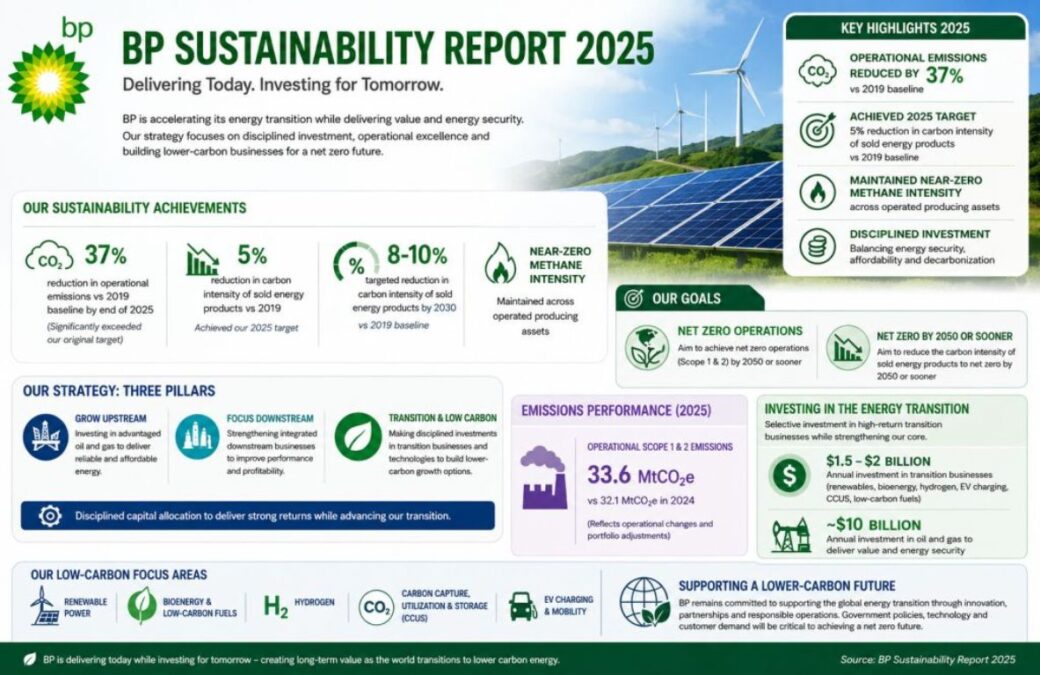
BP has accelerated its sustainability and energy transition strategy with progress in emissions reduction, renewable energy deployment, methane management, and disciplined low-carbon investments, according to its latest Sustainability Report 2025. The company said it reduced operational emissions by 37 percent against its 2019 baseline by the end of 2025, significantly outperforming its original target.
BP’s long-term sustainability strategy continues to focus on achieving net zero operations and reducing the lifecycle carbon intensity of the energy products it sells by 2050 or sooner. The company aims to cut the carbon intensity of sold energy products by 8-10 percent by 2030 compared with the 2019 baseline after already achieving its earlier 2025 target of a 5 percent reduction.
The sustainability roadmap is built around three strategic pillars – growing upstream operations, focusing downstream businesses, and making disciplined investments in transition and renewable energy projects. BP said in its Sustainability Report 2025 it is prioritizing capital allocation toward projects that deliver shareholder returns while supporting decarbonization goals.
BP also reported that operational Scope 1 and Scope 2 emissions reached 33.6 million tonnes of CO2 equivalent in 2025 compared with 32.1 million tonnes in the previous reporting period, reflecting operational changes and portfolio adjustments.
Raffael Winter, SVP strategy & sustainability at BP, said: “We continue to collaborate with others in the industry on methane, including to promote the use of innovative methane measurement technologies.”
BP’s sustainability investments include renewable power, bioenergy, EV charging, hydrogen, carbon capture, and low-carbon fuels. The company said it refined its low-carbon portfolio in 2025 by focusing on projects capable of generating stronger financial returns and long-term scalability.
The company highlighted significant progress in methane emissions management, maintaining near-zero methane intensity across operated producing assets. Methane reduction remains central to BP’s operational sustainability strategy because methane is one of the most potent greenhouse gases impacting climate change.
Renewable energy and transition spending remain key elements of BP’s sustainability program despite the company recalibrating its broader energy transition strategy. BP announced plans to selectively invest between $1.5 billion and $2 billion annually in transition businesses while increasing oil and gas investments to approximately $10 billion annually as part of its revised capital allocation framework.
BP’s revised sustainability strategy emphasizes balancing energy security, affordability, and decarbonization. CEO Murray Auchincloss said the company intends to focus on “high-margin energy” production while remaining selective in low-carbon investments that can deliver competitive returns.
The report also reinforces BP’s commitment to supporting the global energy transition through renewable electricity, lower-carbon fuels, hydrogen, carbon capture utilization and storage (CCUS), and electric vehicle charging infrastructure. The company continues to position sustainability initiatives as a long-term value creation strategy tied to energy demand transformation and global decarbonization trends.
BP said supportive government policies, technology innovation, and customer demand for cleaner energy will remain critical factors influencing the pace of global net zero progress and renewable energy adoption over the coming decades.
SHAFANA FAZAL