


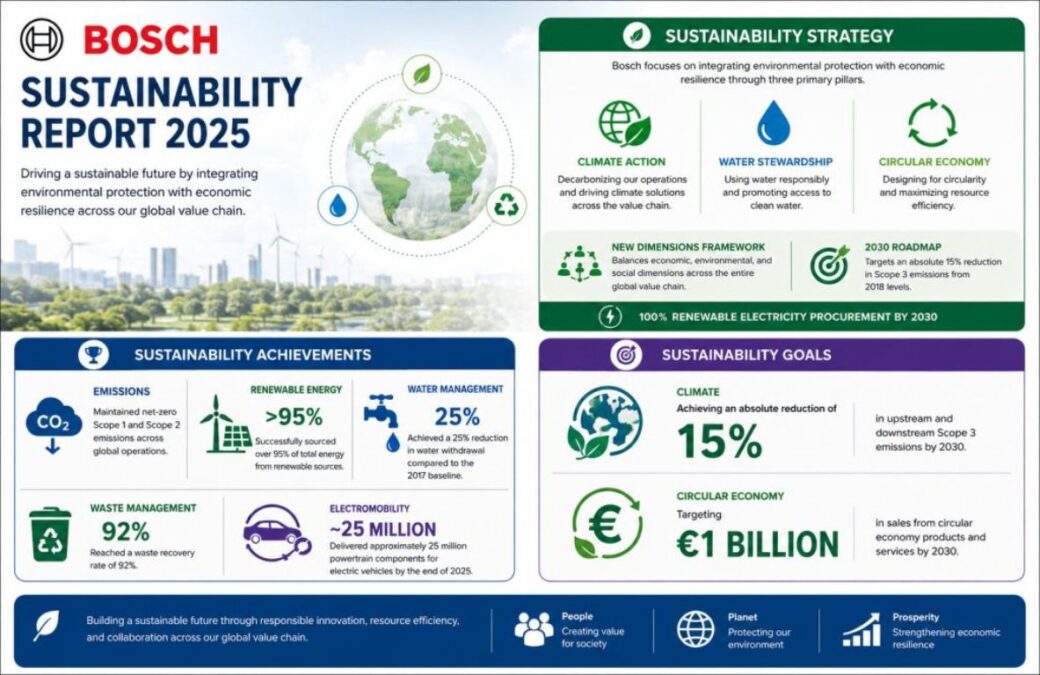
The 2025 sustainability report from Bosch highlights a structured commitment to environmental responsibility, industrial decarbonization, and long-term climate resilience. As global industries face increasing pressure to reduce emissions and transition toward low-carbon operations, Bosch continues to strengthen its position as a leading sustainable technology company by integrating environmental goals directly into its core business strategy.
At the center of Bosch’s sustainability approach is its “New Dimensions” framework, which aligns economic performance with environmental protection and social responsibility. This model ensures that sustainability is not treated as a standalone initiative but is embedded across product development, manufacturing operations, supply chain management, and corporate governance. The framework focuses on three main pillars: climate action, water stewardship, and circular economy principles, all of which support Bosch’s broader ambition of achieving long-term carbon neutrality and resource efficiency.
Strong Climate Action and Emissions Performance
A key highlight of the 2025 report is Bosch’s continued success in maintaining net-zero Scope 1 and Scope 2 emissions across its global operations. This achievement reflects the company’s ability to fully neutralize direct emissions from its facilities and indirect emissions from purchased electricity through renewable energy sourcing and efficiency improvements, Stefan Grosch, Director of Industrial Relations and Member of the Board of Management responsible for sustainability at Bosch, said.
Bosch has also made significant progress in renewable energy adoption, sourcing more than 95 percent of its total energy consumption from renewable sources. This milestone demonstrates the scale of its transition toward clean energy across manufacturing plants, offices, and logistics operations worldwide. The company continues to invest in long-term renewable energy procurement agreements to support its goal of achieving 100 percent renewable electricity use by 2030.
Bosch significantly expanded its renewable energy sourcing strategy in 2025, with green electricity accounting for approximately 98.5 percent of the Bosch Group’s global electricity demand, including the HC acquisition.
Excluding the HC acquisition, Bosch said the share of green electricity usage reached 99.8 percent across its operations. The company sources renewable electricity from existing facilities supported by guarantees of origin as part of its long-term sustainability and climate strategy.
Bosch aims to transition fully to green electricity procurement across all operations by 2030. To achieve this goal, the company is increasingly relying on long-term Power Purchase Agreements (PPAs) with energy suppliers to secure renewable energy capacity and improve energy stability.
During 2025, Bosch purchased around 590 GWh of electricity through PPAs, strengthening its renewable energy portfolio and supporting its broader net-zero and decarbonization objectives.
Water conservation remains another important focus area. Compared to its 2017 baseline, Bosch has reduced water withdrawal by 25 percent, achieved through improved process optimization, recycling systems, and better resource management across water-intensive production sites. This reduction is particularly important in regions where water scarcity is becoming a critical environmental and operational risk.
In waste management, Bosch has achieved a 92 percent waste recovery rate, reflecting its strong commitment to circular economy practices. Instead of relying on disposal methods, the company increasingly focuses on recycling, reuse, and material recovery across its operations, reducing environmental impact while improving resource efficiency.
Electrification and Mobility Transformation
Bosch continues to play a major role in the global transition toward electric mobility. By the end of 2025, the company had delivered approximately 25 million electric vehicle (EV) powertrain components. These components are essential for supporting the automotive industry’s shift from internal combustion engines to electric drivetrains.
This large-scale contribution reinforces Bosch’s position as a key enabler of global electromobility. The company is also expanding its portfolio in hydrogen-based mobility solutions, including fuel cell systems and electrolyzer technologies. These investments support a multi-technology approach to decarbonizing transportation, where both battery-electric and hydrogen-powered systems are expected to play complementary roles in the future.
2030 Sustainability Targets and Strategic Roadmap
Bosch has outlined clear and measurable sustainability targets for 2030, with a strong focus on reducing indirect emissions and expanding circular economy activities. One of the most significant goals is an absolute 15 percent reduction in Scope 3 emissions compared to 2018 levels. Scope 3 emissions include those generated throughout the value chain, such as supplier activities, logistics, and product use. Addressing these emissions is critical, as they typically account for the majority of a company’s total carbon footprint.
Another major target is achieving 100percent renewable electricity procurement by 2030. This commitment reflects Bosch’s long-term strategy to eliminate reliance on fossil-fuel-based electricity entirely, further strengthening its operational sustainability footprint.
In addition to climate goals, Bosch is expanding its circular economy strategy with the ambition of generating €1 billion in revenue from circular economy products and services by 2030. This includes designing products with longer lifecycles, increasing recyclability, and developing business models centered on refurbishment, reuse, and material recovery.
Investments in Clean Technology and Innovation
To support its sustainability transformation, Bosch is making significant investments in clean technology development. A major focus area is hydrogen technology, particularly in electrolyzers used for green hydrogen production and fuel cell systems for industrial and mobility applications. These technologies are expected to play a crucial role in decarbonizing heavy industry and long-distance transport.
Bosch is also modernizing its manufacturing infrastructure to improve energy efficiency and reduce emissions. This includes upgrading production facilities, deploying digital energy management systems, and integrating smart manufacturing technologies that optimize resource consumption and reduce waste.
Human capital development is another key pillar of Bosch’s strategy. The company is investing in workforce upskilling programs, particularly in electromobility, digital engineering, and sustainability-related technologies. This ensures that employees are equipped with the skills needed to support the transition to a low-carbon economy.
Supply Chain Decarbonization and Regulatory Readiness
Bosch is extending its sustainability efforts beyond its own operations by actively engaging suppliers in decarbonization initiatives. Through financial incentives and collaborative programs, the company is encouraging partners to adopt cleaner production methods and reduce emissions across the supply chain. This approach is essential for addressing Scope 3 emissions and achieving broader industry transformation.
At the regulatory level, Bosch is preparing for mandatory EU Taxonomy reporting requirements expected to be fully implemented by the 2027 fiscal year. This involves enhancing transparency in environmental reporting and aligning sustainability disclosures with evolving European standards.
Conclusion
The 2025 sustainability report from Bosch demonstrates a mature, scalable, and highly structured approach to sustainability transformation. Through strong progress in renewable energy adoption, emissions reduction, circular economy expansion, and clean technology innovation, Bosch is steadily advancing toward its long-term climate goals. With clear 2030 targets and sustained investment in hydrogen, electrification, and supply chain decarbonization, the company continues to set a benchmark for sustainable industrial development in the global engineering and manufacturing sector.
SHAFANA FAZAL