


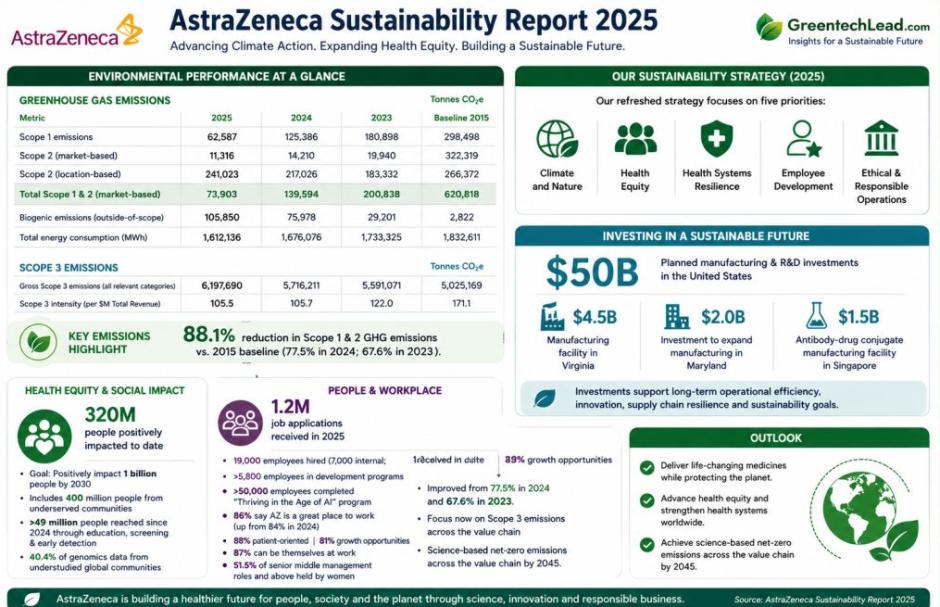
AstraZeneca delivered significant sustainability progress in 2025, advancing climate action, health equity, employee development, and responsible governance while reinforcing its long-term commitment to net-zero emissions. The company’s refreshed sustainability strategy focuses on climate and nature, health equity, health systems resilience, people development, and ethical business practices, making sustainability one of AstraZeneca’s three core strategic priorities alongside Science & Innovation and Growth & Therapy Area Leadership.
AstraZeneca Cuts Emissions by 88.1% as Net-Zero Strategy Accelerates
AstraZeneca reported an 88.1 percent reduction in Scope 1 and Scope 2 greenhouse gas emissions compared with its 2015 baseline under its Ambition Zero Carbon program. The emissions reduction improved steadily from 67.6 percent in 2023 and 77.5 percent in 2024, making the 88.1 percent decline one of the company’s most significant sustainability achievements, AstraZeneca Sustainability Report 2025 indicated.
Pam Cheng, Chief Sustainability Officer of AstraZeneca, said: “We are creating a culture where colleagues bring a sustainability-focused mindset to everything they do. This ensures that our actions today not only uphold the highest standards but also pave the way for a sustainable legacy for future generations.”
The company is now concentrating on Scope 3 emissions, which account for the largest share of its carbon footprint across suppliers, logistics, manufacturing, and product distribution activities. AstraZeneca aims to achieve science-based net-zero greenhouse gas emissions across its entire value chain by 2045.
Renewable electricity procurement, clean energy adoption, and energy-transition initiatives have played a major role in delivering operational decarbonization. Climate action remains central to AstraZeneca’s long-term sustainability roadmap.
Health Equity Initiatives Support One Billion People Ambition
AstraZeneca has established a goal to positively impact 1 billion people by 2030, including 400 million people from underserved communities.
The company reported that 320 million people have already been positively impacted through medicines, awareness campaigns, screening initiatives, healthcare worker training, and health system support programs.
More than 49 million people have been reached since 2024 through health education, screening, and early detection programs. AstraZeneca also achieved its target of ensuring that 40.4 percent of genomics data used in research comes from understudied global communities, helping improve representation in healthcare innovation and medical research.
Workforce Growth and Employee Engagement Remain Strong
AstraZeneca received 1.2 million job applications during 2025 and hired 19,000 employees globally, including 7,000 internal hires and 12,000 external recruits.
More than 5,800 employees participated in professional development programs during the year. The company also expanded digital skills training, with more than 50,000 employees taking part in its “Thriving in the Age of AI” initiative.
Employee engagement metrics remained strong across the organization. Around 86 percent of employees believe AstraZeneca is a great place to work, up from 84 percent in 2024. Additionally, 88 percent of employees believe the company is patient-oriented, 81 percent report having opportunities for personal development and growth, and 87 percent feel they can be themselves at work without concerns about acceptance.
Gender diversity also continued to improve, with women holding 51.5 percent of senior middle management positions and above.
Major Investments Support Sustainable Manufacturing and Innovation
AstraZeneca continues to invest heavily in sustainable infrastructure, manufacturing capacity, and research facilities to support long-term growth and climate objectives.
The company announced plans to invest $50 billion in manufacturing and research and development operations in the United States. Key projects include a $4.5 billion manufacturing facility in Virginia and an additional $2 billion investment to expand manufacturing operations in Maryland.
Outside the United States, AstraZeneca is progressing with a $1.5 billion antibody-drug conjugate manufacturing facility in Singapore, supporting future innovation and operational resilience.
Sustainability Strategy Built on Climate, Equity and Resilience
The refreshed sustainability framework launched in 2025 focuses on five key pillars:
Climate and nature
Health equity
Health systems resilience
Employee development
Ethical and responsible operations with robust governance
The strategy aligns environmental performance with healthcare access, workforce development, and long-term business resilience.
Outlook
AstraZeneca’s 2025 sustainability performance demonstrates measurable progress across environmental and social priorities. The company achieved an 88.1 percent reduction in Scope 1 and Scope 2 emissions from its 2015 baseline, improved from 77.5 percent in 2024 and 67.6 percent in 2023, while advancing toward its science-based net-zero target for 2045.
With a goal to positively impact 1 billion people by 2030, including 400 million from underserved communities, AstraZeneca has already reached 320 million people and more than 49 million individuals through health-equity initiatives since 2024. Combined with 1.2 million job applications, 19,000 new hires, 5,800 employees in development programs, over 50,000 participants in AI training, and major investments totaling $50 billion in the U.S., $4.5 billion in Virginia, $2 billion in Maryland, and $1.5 billion in Singapore, AstraZeneca is positioning sustainability, innovation, and healthcare access as key drivers of future growth.
SHAFANA FAZAL