


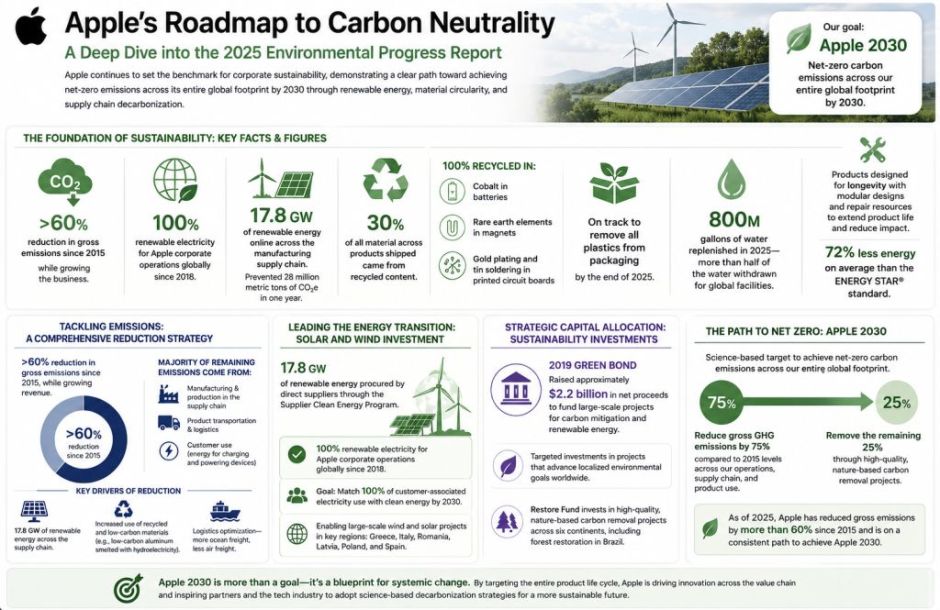
Apple continues to set the benchmark for corporate sustainability, demonstrating a clear path toward achieving net-zero emissions across its entire global footprint by 2030.
Through a combination of aggressive renewable energy procurement, material circularity, and systemic supply chain decarbonization, the company has successfully decoupled its business growth from its carbon output. This analysis outlines the critical data points and strategic pillars defining Apple’s environmental trajectory as reported in its 2025 progress documentation.
“Since 2018, we’ve powered every Apple facility with renewable energy — including our offices, retail stores, and data centers. That progress is making its way across our global supply chain, and today, our suppliers now support more than 17.8 gigawatts of clean energy around the world,” Lisa Jackson, VP, Environment, Policy and Social Initiatives, Apple, said.
The Foundation of Sustainability: Key Facts and Figures
Apple in its Sustainability Report said that it has achieved a significant milestone in its environmental strategy, reaching carbon neutrality for its corporate operations globally. This accomplishment is supported by a reduction of more than 60 percent in comprehensive emissions since 2015. To sustain this trajectory, the company continues to prioritize its transition to 100 percent renewable energy across its manufacturing supply chain, with 17.8 gigawatts of clean energy now online globally.
Material efficiency and circularity remain central to the company’s environmental goals. In 2025, 30 percent of all material across products shipped came from recycled content. Furthermore, the company has achieved 100 percent recycled cobalt in batteries, 100 percent recycled rare earth elements in magnets, and 100 percent recycled gold plating and tin soldering in printed circuit boards. The company has also made substantial progress in reducing plastic usage, with a stated objective to remove all plastics from packaging by the end of 2025.
Water stewardship is another critical performance metric; in 2025, Apple replenished 800 million gallons of water, representing more than half of the water it withdrew for global facilities. Furthermore, the company continues to emphasize product longevity. By prioritizing modular designs and providing repair resources, the company seeks to extend the operational life of its hardware, thereby reducing the environmental impact associated with raw material extraction. Energy efficiency in hardware design is equally critical, with the current product lineup using 72 percent less energy on average than the requirements defined by the ENERGY STAR standard.
Tackling Emissions: A Comprehensive Reduction Strategy
Apple reports a comprehensive reduction in its total carbon footprint, achieving a decrease of more than 60 percent in gross emissions since 2015. This reduction occurred while the company continued to grow its revenue, illustrating a successful decoupling of business expansion from carbon output. The majority of the company’s remaining emissions are attributed to the manufacturing and production stages within the supply chain, as well as product transportation and the energy consumed by customers during product use.
A core driver of these emission reductions is the transition of manufacturing partners to clean energy. As of the latest reporting period, 17.8 gigawatts of renewable energy are operational across the supply chain, which prevented an estimated 28 million metric tons of carbon emissions in a single year. Product design and material sourcing strategies also play a pivotal role in lowering emissions.
By increasing the use of recycled and renewable materials, such as low-carbon aluminum smelted using hydroelectricity, the company significantly lowers the embedded carbon footprint of its hardware. These material choices are paired with logistics optimizations, including an increased reliance on ocean freight—which generates lower emissions per unit—over air transport for product distribution.
Leading the Energy Transition: Solar and Wind Investment
Apple has significantly scaled its renewable energy initiatives, focusing on both internal operations and the broader manufacturing supply chain. As of the 2025 reporting period, Apple’s direct suppliers procured 17.8 gigawatts of renewable energy through the Supplier Clean Energy Program.
To support its own corporate footprint, Apple has maintained 100 percent renewable electricity usage globally since 2018. Beyond immediate operations, Apple is actively investing in new renewable energy projects to address the energy consumed by customers while charging and powering their devices.
The company’s goal is to match 100 percent of this customer-associated electricity use with clean energy by 2030. To reach this objective, Apple is enabling large-scale wind and solar projects worldwide, prioritizing regions such as Greece, Italy, Romania, Latvia, Poland, and Spain to maximize carbon avoidance on local electrical grids.
Strategic Capital Allocation: Sustainability Investments
Apple’s sustainability investment strategy centers on capital allocation through its Green Bond program and targeted environmental initiatives. As of the 2025 reporting period, the company has utilized its 2019 Green Bond proceeds to fund large-scale projects aimed at carbon mitigation and renewable energy deployment.
The 2019 Green Bond, which raised approximately $2.2 billion in net proceeds, remains a primary financial vehicle. Beyond global bond-funded projects, Apple is increasingly deploying targeted capital to meet localized sustainability goals. Additionally, Apple leverages its “Restore Fund” to finance high-quality, nature-based carbon removal projects, with initiatives spanning six continents, including forest restoration efforts in Brazil.
The Path to Net Zero: Apple 2030
Apple’s primary climate objective is “Apple 2030,” an ambitious, science-based target to achieve net-zero carbon emissions across its entire global footprint. This goal encompasses the company’s direct operations, its vast manufacturing supply chain, and the energy consumed by customers during the use phase of its devices.
The company uses 2015 as its baseline for greenhouse gas emissions and aims to reduce its gross greenhouse gas emissions by 75 percent compared to those levels. For the remaining 25 percent of emissions — those that are considered difficult to eliminate with currently available technologies — the company plans to utilize high-quality, nature-based carbon removal projects.
As of the 2025 reporting period, Apple has demonstrated a consistent trajectory toward this goal, having achieved an overall reduction of more than 60 percent in its gross emissions since 2015. By targeting the entire product lifecycle, Apple is positioning its 2030 roadmap as a framework for systemic industrial change, encouraging its partners and the broader tech industry to adopt similar science-based decarbonization strategies.
FASNA SHABEER