


Amazon has expanded renewable energy, electric transportation, battery storage and resource-efficiency programmes in 2025, but rapid growth in artificial intelligence, data centres and global operations pushed its absolute greenhouse gas emissions higher.
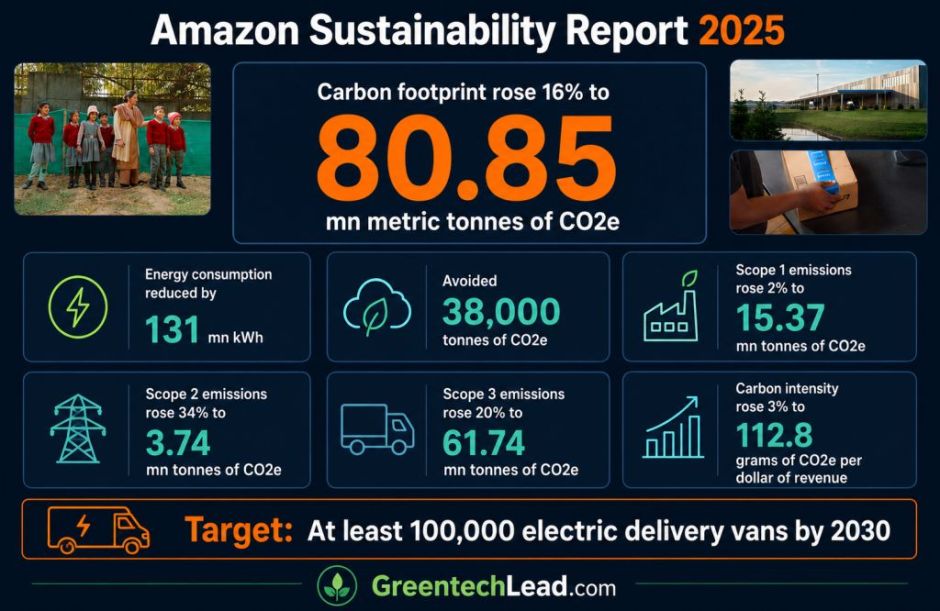
The Amazon Sustainability Report 2025 shows that the company’s carbon footprint increased 16 percent to 80.85 million metric tonnes of CO2e, from 69.55 million tonnes in 2024 and 65.28 million tonnes in 2023. However, carbon intensity remained 38 percent below its 2019 level, while revenue grew 156 percent over the same period.
Amazon continues to target net-zero carbon emissions across its global operations by 2040.
Scope 3 emissions rise 20 percent
Scope 1 emissions increased 2 percent to 15.37 million tonnes of CO2e, from 15.13 million tonnes in 2024. This included 15 million tonnes from fossil fuels and 0.37 million tonnes from refrigerants.
Scope 2 emissions from purchased electricity rose 34 percent to 3.74 million tonnes, compared with 2.80 million tonnes in 2024. They represented approximately 5 percent of Amazon’s carbon footprint.
Scope 3 emissions increased 20 percent to 61.74 million tonnes of CO2e, from 51.62 million tonnes, and accounted for 76 percent of the total footprint.
Purchased goods and services generated 18.63 million tonnes of CO2e, an increase of 11 percent, while capital goods emissions surged 43 percent to 16.96 million tonnes. Upstream transportation and distribution emissions rose 13 percent to 10.87 million tonnes.
Fuel and energy-related activities produced 5.70 million tonnes, up 25 percent, while downstream transportation and distribution generated 4.01 million tonnes, an increase of 8 percent. Employee commuting emissions rose 8 percent to 2.98 million tonnes, Amazon Devices’ use-phase emissions increased 6 percent to 1.52 million tonnes, and business travel emissions grew 6 percent to 1.04 million tonnes.
Amazon’s environmental attribute certificates delivered a net emissions reduction of 199,400 tonnes of CO2e during 2025, Kara Hurst, Chief Sustainability Officer at Amazon, said.
Amazon carbon intensity increases 3 percent
Amazon’s carbon intensity increased 3 percent to 112.8 grams of CO2e per dollar of revenue, from 109 grams in 2024. Despite the annual increase, the metric remained 38 percent lower than in 2019.
Emissions per shipped unit declined 7 percent from 2024 and 39 percent from 2019, indicating improved carbon efficiency across the company’s fulfilment and delivery operations.
Amazon said 62 percent of its top suppliers had credible decarbonisation plans by the end of 2025. These suppliers represented approximately 70 percent of its supply-chain emissions.
The Climate Pledge had attracted 656 signatories, up from 549 in 2024, extending Amazon’s 2040 net-zero commitment across a broader group of companies.
Clean energy portfolio reaches 41,670 MW
Amazon matched 100 percent of the electricity consumed by its global operations with renewable energy for the third consecutive year.
As of January 2026, its portfolio comprised 712 renewable energy projects across 30 countries, with expected capacity of 41,670 MW, or approximately 42 GW.
The portfolio is expected to produce 131,000 GWh of carbon-free energy annually. Once fully operational, the projects could supply electricity equivalent to the annual requirements of approximately 13 million US homes and avoid 48 million tonnes of CO2e annually.
Amazon had 375 utility-scale projects, comprising 264 solar, 109 wind and two nuclear projects. The company also installed 18 additional rooftop solar projects, taking the global total to 337 installations with combined capacity of 42 MW.
These rooftop projects are expected to generate 454,000 MWh annually and avoid approximately 150,000 tonnes of CO2e.
Amazon also matched 100 percent of the electricity used by active Echo, Fire TV and Ring devices with operational wind and solar capacity for the second consecutive year.
Battery-backed solar capacity rises to 2.3 GW
Amazon operated 15 solar projects paired with battery energy storage systems, representing 2.3 GW of capacity, up from 2.1 GW in 2024.
The company is also expanding nuclear energy procurement. Its agreement with Talen Energy will provide 1,900 MW of carbon-free nuclear power through 2042.
Amazon’s investment in X-energy supports plans to bring 5 GW of new nuclear capacity to the US grid by 2039, strengthening the company’s strategy to secure continuous carbon-free electricity for data centres and AI infrastructure.
Data centre PUE improves to 1.14
Amazon’s global data centres achieved a Power Usage Effectiveness of 1.14 in 2025. This was nearly 9 percent better than the public-cloud industry average of 1.25 and 30 percent better than the on-premises enterprise data-centre average of 1.63.
Energy-efficiency projects reduced electricity consumption across Amazon’s operational buildings by 131 million kWh and avoided 38,000 tonnes of CO2e during 2025.
Its North American lighting programme has saved more than 1.6 billion kWh and avoided nearly 1.2 million tonnes of CO2e since 2016. Improvements at 32 sites saved another 10 million kWh and avoided 7,000 tonnes of CO2e in 2025.
By year-end, 820 Amazon buildings were using artificial intelligence to monitor HVAC and water utilities, while 81 buildings employed AI tools to monitor refrigeration systems.
Electric delivery fleet exceeds 52,700 vehicles
Amazon’s electric delivery fleet surpassed 52,700 vehicles globally in 2025, including 37,400 electric vans in the United States, 10,900 in Europe and 4,400 in India.
The fleet delivered 2.4 billion packages during the year. Amazon reported more than 12,700 total EVs in India, a broader figure that also includes vehicle categories beyond delivery vans.
The company had more than 360 electric heavy goods vehicles operating in its middle-mile network. Amazon is working toward deploying at least 100,000 electric delivery vans globally by 2030.
Amazon Day delivery and improved inventory placement helped avoid nearly 500 million delivery trips and 127 million vehicle miles in 2025.
Amazon purchases 61.3 million gallons of lower-carbon fuels
For transportation activities that are harder to electrify, Amazon purchased a combined 61.3 million gallons of lower-carbon fuels during 2025.
This included 3.6 million gallons of renewable diesel, 39.5 million gallons of renewable natural gas and 18.2 million gallons of blended and Book-and-Claim sustainable aviation fuel.
These fuels supplement the company’s vehicle-electrification strategy across road freight, delivery operations and aviation.
Water efficiency improves 52 percent
Amazon’s data-centre Water Use Effectiveness reached 0.12 litres per kWh in 2025, representing a 52 percent improvement since 2021.
The company achieved 75 percent progress toward its objective of becoming water positive across data centres by 2030.
Amazon invested in 45 water-replenishment projects globally, with contracted future replenishment volumes exceeding 18 billion litres annually. Managing water consumption is becoming increasingly important as the company expands data-centre capacity for cloud and AI workloads.
Packaging recyclability reaches 73 percent
Amazon reported that 73 percent of its packaging in North America was recyclable through household recycling streams, up from 63 percent previously.
The deployment of automated paper-based packaging alternatives helped avoid more than 288 million single-use plastic bags in North America.
Rising emissions test Amazon’s 2040 net-zero strategy
Amazon’s sustainability investments delivered measurable progress in renewable energy, battery storage, electric transportation, data-centre efficiency, water stewardship and packaging circularity. Its clean-energy portfolio reached approximately 42 GW, and renewable energy matched 100 percent of operational electricity consumption for the third consecutive year.
However, the 16 percent increase in total emissions to 80.85 million tonnes of CO2e, including a 20 percent rise in Scope 3 emissions and a 34 percent increase in Scope 2 emissions, highlights the challenge created by expanding data centres, AI workloads and supply-chain activity.
Amazon’s progress toward net-zero by 2040 will therefore depend on converting its growing clean-energy and efficiency investments into sustained reductions in absolute Scope 1, Scope 2 and Scope 3 emissions.
SHAFANA FAZAL