


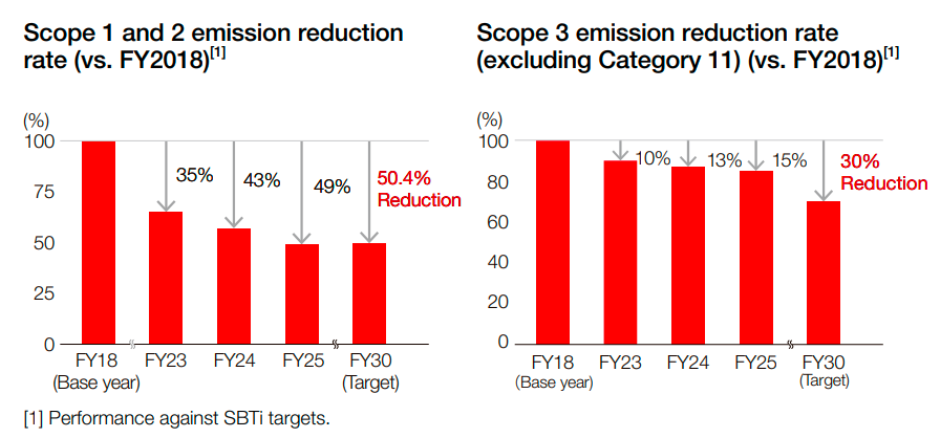
Ajinomoto Group is accelerating its clean-energy and decarbonisation programme, targeting a 50.4 percent absolute reduction in Scope 1 and Scope 2 greenhouse gas emissions by FY2030 compared with FY2018 as renewable energy integration exceeds 43 percent.
Ajinomoto Sustainability Report indicates that the group is targeting a 30 percent reduction in Scope 3 emissions and a 36.4 percent reduction in Scope 3 Forest, Land and Agriculture (FLAG) emissions by FY2030. These commitments are particularly significant for Ajinomoto because approximately 70 percent of its raw materials depend directly on agricultural, livestock and fishery systems.
Ajinomoto decarbonisation programme aims to achieve net-zero GHG emissions across its value chain by FY2050, supported by a transition toward 100 percent renewable electricity, sustainable sourcing and lower agricultural emissions.
Renewable Energy Share Exceeds 43% on Path to 100%
Renewable electricity represents one of Ajinomoto’s most important tools for reducing operational emissions.
Renewable energy integration has already exceeded 43 percent, while the group aims to reach 100 percent renewable energy for global electricity consumption by FY2050.
The shift toward renewable electricity will support Ajinomoto’s target of reducing absolute Scope 1 and Scope 2 emissions by 50.4 percent by FY2030 from FY2018 levels.
The scale of the remaining transition is significant. Moving from more than 43 percent renewable energy to complete renewable electricity coverage will require continued clean-energy procurement and deployment across Ajinomoto’s international manufacturing operations.
As electricity requirements evolve alongside production, increasing renewable-energy penetration while improving energy efficiency will be central to the company’s ability to reduce operational carbon emissions.
Ajinomoto Targets 50.4% Scope 1 and 2 Emissions Cut by 2030
Ajinomoto has established FY2018 as the baseline for its near-term climate targets.
By FY2030, the group plans to reduce absolute Scope 1 and Scope 2 GHG emissions by 50.4 percent.
Scope 1 covers emissions generated directly from company-controlled operations, while Scope 2 includes indirect emissions associated primarily with purchased electricity and energy.
The transition toward renewable electricity can therefore make a direct contribution to achieving the target. Energy-efficiency measures and lower reliance on fossil fuels will also be required to address emissions that cannot be eliminated solely through renewable power procurement.
These operational measures form the first layer of a much wider climate strategy extending into Ajinomoto’s suppliers and agricultural raw-material base.
Scope 3 Emissions Targeted for 30% Reduction
Ajinomoto plans to cut absolute Scope 3 GHG emissions by 30 percent by FY2030 compared with FY2018.
The target is important because the environmental footprint of a global food company extends far beyond electricity consumed at manufacturing facilities.
Raw-material production, agriculture, transportation, packaging, suppliers and other value-chain activities can contribute substantially to overall emissions.
For Ajinomoto, the exposure is particularly significant because approximately 70 percent of its raw materials rely directly on agricultural, livestock and fishery systems.
Decarbonising the supply chain will consequently be essential if the company is to progress from its 2030 targets toward net-zero emissions across its entire value chain by FY2050.
36.4% FLAG Emissions Cut Puts Agriculture at Centre of Climate Strategy
Agricultural decarbonisation receives a dedicated target within Ajinomoto’s climate programme.
The company aims to reduce absolute Scope 3 FLAG emissions by 36.4 percent by FY2030 from the FY2018 baseline.
FLAG emissions cover greenhouse gases associated with forests, land and agriculture. For food companies, these can include emissions linked to agricultural production, livestock and changes in land use.
Ajinomoto’s dependence on agriculture makes the target particularly relevant. Approximately 70 percent of the group’s raw materials are directly dependent on agricultural, livestock and fishery systems.
The 36.4 percent FLAG reduction target means the company’s energy transition cannot be achieved through renewable electricity alone. Changes across agricultural sourcing, supplier practices and land management will also influence its overall decarbonisation performance.
Zero Deforestation and 100% Sustainable Procurement by 2030
Ajinomoto is linking its agricultural climate strategy with sustainable sourcing.
The group is targeting 100 percent sustainable procurement of priority raw materials by FY2030, covering six major categories — paper, palm oil, soybeans, coffee beans, beef and sugarcane.
The commitment is supported by a zero-deforestation objective, connecting supply-chain management directly with forest protection and FLAG emissions reduction.
Preventing deforestation is important because changes in land use can release substantial amounts of stored carbon while reducing natural carbon sinks.
Sustainable sourcing therefore represents an important pathway toward Ajinomoto’s 36.4 percent FLAG emissions reduction target, particularly given the company’s high dependence on agricultural raw materials.
Ajinomoto Targets 50% Reduction in Food Loss and Waste
Reducing food loss is another component of Ajinomoto’s value-chain decarbonisation programme.
The company aims to reduce food loss and waste by 50 percent between raw-material receipt and customer delivery by FY2030 compared with FY2018.
By FY2050, Ajinomoto intends to achieve a 50 percent reduction across the entire product lifecycle.
Food waste has implications for climate and resource efficiency because discarded food also represents wasted agricultural inputs, water, processing energy, transportation and packaging.
Reducing losses across the supply chain can therefore complement Ajinomoto’s Scope 3 and FLAG strategies while improving the efficiency with which agricultural resources are converted into finished products.
Resource Recovery Target Exceeds 99%
Ajinomoto’s circular-economy programme includes a target to maintain a resource recovery rate of at least 99 percent.
The company is also targeting zero waste from plastic packaging and operations by FY2030.
The targets broaden the group’s environmental strategy beyond energy and greenhouse gases into material efficiency.
Reducing packaging waste, increasing recycling and recovering resources can lower demand for virgin materials and potentially reduce emissions embedded in material production and disposal.
For a global food business, packaging circularity also represents an important component of reducing environmental impacts across the product lifecycle.
Water Consumption Targeted to Fall 15%
Ajinomoto aims to reduce water usage intensity or consumption by 15 percent by FY2040 compared with FY2018.
Water efficiency is closely connected with the group’s agricultural strategy because food supply chains depend heavily on access to water as well as land and energy.
The 15 percent target adds another measurable resource-efficiency milestone alongside Ajinomoto’s renewable-energy, carbon, agricultural and circularity commitments.
Renewable Energy and Agriculture Define Ajinomoto’s Net-Zero Challenge
Ajinomoto’s climate strategy illustrates how the energy transition for a global food company extends beyond switching factories to renewable electricity.
The group aims to reduce absolute Scope 1 and Scope 2 emissions by 50.4 percent, Scope 3 emissions by 30 percent and Scope 3 FLAG emissions by 36.4 percent by FY2030, compared with FY2018.
Renewable energy integration has already exceeded 43 percent, with the company ultimately targeting 100 percent renewable electricity and net-zero emissions across its entire value chain by FY2050.
Agriculture will be equally important because approximately 70 percent of Ajinomoto’s raw materials depend on agricultural, livestock and fishery systems. The company is consequently pursuing 100 percent sustainable procurement of six priority raw-material categories by FY2030 alongside its zero-deforestation objective.
Ajinomoto’s wider resource strategy targets a minimum 99 percent resource recovery rate, zero plastic waste by FY2030 and a 15 percent reduction in water use by FY2040. Food loss and waste is targeted to fall 50 percent by FY2030 from raw-material receipt to customer delivery and 50 percent across the entire product lifecycle by FY2050.
The figures show that Ajinomoto’s pathway to net zero will depend on two major transitions: accelerating renewable electricity across its global operations and cutting the carbon footprint of the agricultural supply chains that provide most of its raw materials.
SHAFANA FAZAL