


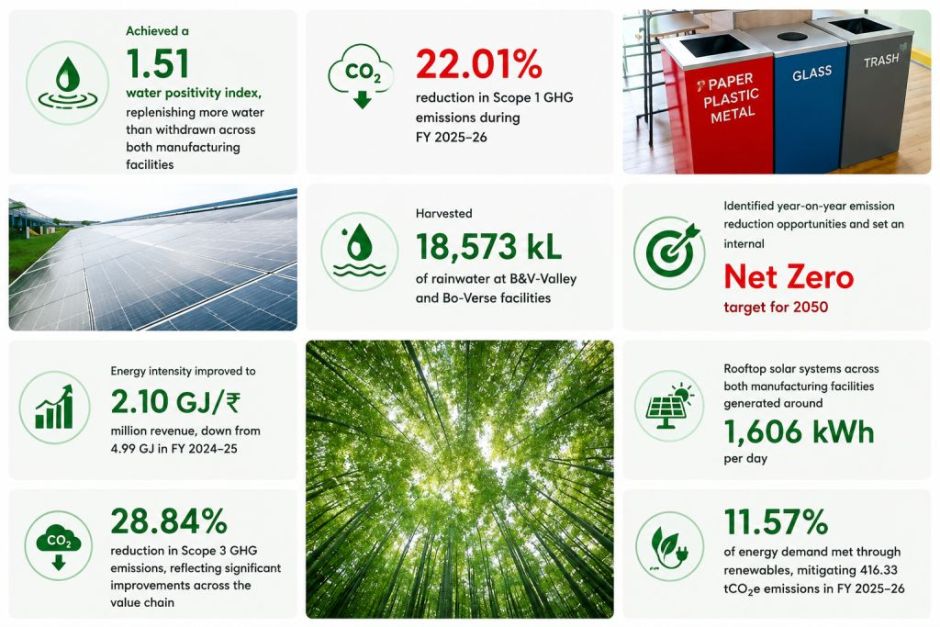
Addverb strengthened its environmental performance in FY 2025-26, cutting total greenhouse gas (GHG) emissions by 28.68 percent while expanding renewable-energy use, reducing water consumption and advancing its long-term Net Zero by 2050 ambition.
Addverb’s sustainability initiatives and Net Zero strategy, disclosed in Addverb’s Sustainability Report 2026, indicate that the warehouse automation and robotics company is increasingly integrating environmental considerations into manufacturing, facility operations, product design and resource management.
The 28.68 percent reduction in total GHG emissions is one of the most significant indicators of Addverb’s sustainability progress during FY 2025-26. It provides a measurable benchmark for assessing the company’s decarbonisation efforts as it works toward its 2050 climate objective.
Addverb says sustainability is being embedded across products, processes and operations rather than managed as a standalone corporate initiative. The strategy combines emissions reduction with renewable-energy adoption, energy-efficient manufacturing, water conservation and circular product design.
For companies operating in energy-intensive manufacturing and technology sectors, demonstrating annual progress is becoming increasingly important as customers, investors and supply-chain partners scrutinise environmental performance. Addverb’s latest results provide several quantitative indicators covering carbon emissions, renewable electricity and water efficiency.
Readers can follow broader developments in corporate climate strategies, renewable energy and environmental performance through GreentechLead sustainability news and analysis.
Renewable Energy Meets 11.57 Percent of Addverb’s Energy Demand
Renewable sources accounted for 11.57 percent of Addverb’s total energy demand in FY 2025-26, making clean-energy adoption another important component of the company’s decarbonisation strategy.
The company is also generating renewable electricity directly at its facilities. Addverb reported that its rooftop solar installations produced approximately 1,606 kWh of electricity per day.
On an indicative annualised basis, maintaining that daily output for 365 days would correspond to roughly 586,190 kWh, or 586 MWh, of solar electricity a year. Actual annual generation will naturally depend on weather, solar irradiation, system availability and other operating conditions.
On-site solar can help Addverb reduce dependence on grid electricity while increasing the proportion of renewable energy supporting its facilities. However, with renewable energy currently supplying 11.57 percent of demand, there remains substantial scope to expand the clean-energy share as the company moves toward Net Zero.
The combination of energy efficiency and renewable electricity will be particularly important because reducing operational emissions generally requires companies to both consume less energy and progressively decarbonise the energy that remains necessary.
Net Zero by 2050 Sets Addverb’s Long-Term Climate Direction
Addverb has established Net Zero by 2050 as the long-term destination for its climate strategy.
The company’s current approach connects that objective with energy-efficient manufacturing, renewable-energy deployment, water conservation and circular product design. This broader framework is important because achieving deep emissions reductions requires changes across facilities, manufacturing processes, electricity sourcing, products and resource consumption.
The 28.68 percent reduction in total GHG emissions during FY 2025-26 therefore represents an important near-term indicator against the much longer 2050 pathway.
The challenge will be sustaining reductions over successive reporting periods while business activity evolves. Future progress will increasingly depend on how rapidly Addverb can increase renewable-energy utilisation, improve energy productivity and address emissions throughout its operating footprint.
Rooftop Solar Supports Addverb’s Clean-Energy Transition
Addverb’s approximately 1,606 kWh per day of rooftop solar generation gives the company’s renewable-energy programme a tangible operational component.
Rooftop solar is particularly relevant for industrial and technology facilities because electricity can be generated at the point of consumption. This can supplement other renewable-energy procurement mechanisms while reducing exposure to conventional grid electricity.
Addverb’s solar installations are contributing to the 11.57 percent renewable-energy share reported for FY 2025-26. Increasing this proportion could become one of the most important levers for the company as it pursues deeper emissions reductions.
The renewable-energy figure is also useful as a benchmark. Future sustainability reports can demonstrate whether the company is expanding the renewable share of its energy mix alongside reductions in absolute GHG emissions.
Water Consumption Drops 31.88 Percent
Addverb also delivered a substantial improvement in water efficiency during FY 2025-26, reporting a 31.88 percent reduction in water consumption.
The company achieved a water positivity index of 1.51, extending its environmental strategy beyond carbon and energy management.
Water conservation is an important part of industrial sustainability because manufacturing facilities can have environmental impacts beyond their direct and indirect carbon emissions. Reducing water requirements can lower pressure on local resources while improving overall operational efficiency.
The combination of a 31.88 percent reduction in water consumption and 28.68 percent reduction in GHG emissions suggests that Addverb’s resource-efficiency initiatives are addressing multiple areas of its environmental footprint simultaneously.
Circular Product Design Broadens Sustainability Strategy
Addverb is also integrating circular product design into its sustainability framework, alongside renewable energy, efficient manufacturing and water conservation.
This is particularly relevant for a company supplying robotics and warehouse automation systems because environmental impact extends beyond the energy consumed at corporate facilities. Product design decisions can influence material requirements, equipment lifespan, maintenance, replacement cycles and end-of-life resource recovery.
Embedding sustainability into products and processes can therefore complement operational decarbonisation. It also potentially helps enterprise customers seeking to improve the environmental performance of their own logistics and warehouse infrastructure.
The strategy reflects a broader shift from sustainability programmes centred primarily on corporate facilities toward environmental management spanning product development, manufacturing and operations.
Addverb Sustainability Performance: Key FY 2025-26 Figures
The Sustainability Report 2026 provides a clear set of metrics for assessing Addverb’s environmental progress. Total GHG emissions fell 28.68 percent, while renewable energy supplied 11.57 percent of energy demand. Rooftop solar installations generated approximately 1,606 kWh per day, and water consumption decreased 31.88 percent. Addverb also reported a water positivity index of 1.51 and continues to target Net Zero by 2050.
These indicators are significant because they establish measurable benchmarks against which Addverb’s future environmental performance can be compared.
The next phase will depend on whether the company can maintain the pace of emissions reduction while expanding renewable-energy penetration beyond the current 11.57 percent. Increasing rooftop and other renewable-energy sources, improving manufacturing efficiency and extending circularity principles across products could help accelerate that transition.
Addverb’s FY 2025-26 results show tangible movement in that direction. A 28.68 percent reduction in GHG emissions, 31.88 percent decline in water consumption, 11.57 percent renewable-energy contribution and 1,606 kWh of daily rooftop solar generation provide measurable evidence of progress rather than relying solely on the distant 2050 target.
SHAFANA FAZAL