


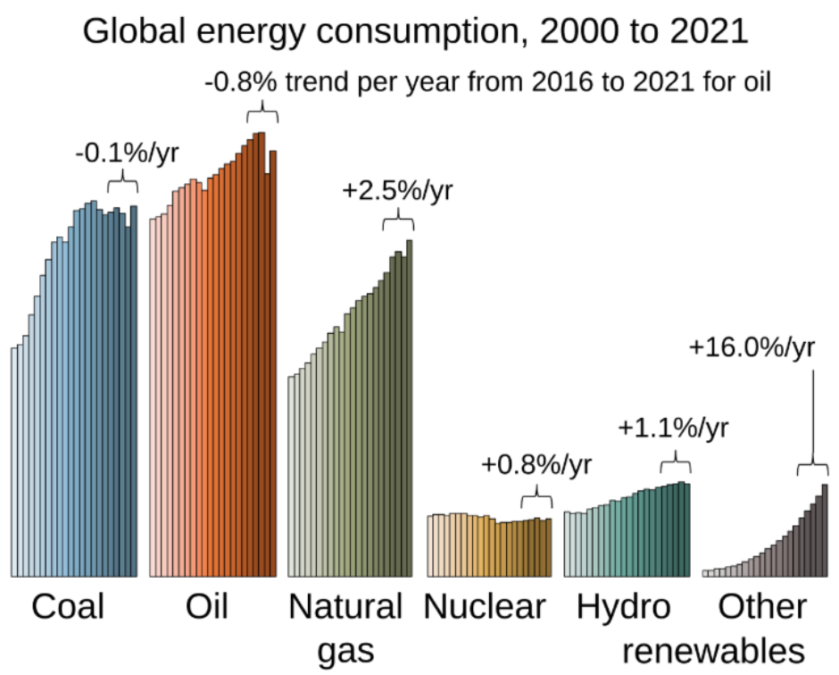
For more than a decade, solar has been widely declared the cheapest source of new electricity on Earth — and by 2024, renewable energy more broadly had firmly earned that title. Utility-scale photovoltaics beat coal and gas. On paper, the case is closed: build more panels and let the fossil-fuel era fade out.
Yet look at any country’s actual electricity mix. Solar is still a minority player. Fossil plants remain the backbone of most grids. The simple story — cheap energy wins — hasn’t played out. It’s not because solar panels don’t work. It’s because the grid works on physics, not headlines.
This is a software engineer’s perspective on why adoption lags, what the “duck curve” really means, and why not only hardware matters but software as well — especially Virtual Power Plants (VPPs).
Solar is Cheap. Timing is Expensive
Electricity is strange from an economics perspective. In most markets, when prices fall, demand rises. But electricity demand barely moves. Whether power is cheap or expensive, people still cook dinner at the same time, charge cars when they get home, and turn on kettles during halftime of a football match. Economists refer to this as “inelastic demand.”
Grid operators live with this reality every day. The grid must stay perfectly balanced: supply = demand, second by second. Too little supply → blackout. Too much supply → also dangerous: oversupply raises system frequency, which can overstress turbines and trigger protective trips — and when generators trip en masse, that can cascade into a blackout.
And here’s the issue: solar does not follow human behaviour. The daily pattern exists because everyday routines map directly onto electricity use:
- Morning bump — People wake up around the same time: lights turn on, kettles boil, showers run, heaters or heat pumps activate, and appliances start up.
- Midday trough — Most people are at work or school. Energy use shifts to shared buildings with efficient, centralized systems, resulting in a drop in individual household demand.
- Evening peak — Everyone comes home and does energy-intensive tasks at once: cooking, running washing machines and dishwashers, heating or cooling the home, watching TV, taking showers, and increasingly, charging EVs.
- Overnight tail — Once people go to sleep, nearly all discretionary use stops. Only background loads remain (fridges, HVAC maintenance cycles, servers), producing a long, low plateau until morning.
Solar’s pattern:
- Ramps up late morning
- Peaks at midday
- Falls to zero right before the evening peak
This mismatch produces the shape every energy engineer knows: the duck curve.
The Duck Curve: When the Sun Goes Down, Everything Else Must Sprint
As solar energy rises, it reduces the need for “dispatchable” energy sources (such as gas, coal, and hydro). Around noon, renewable generation can be so high that energy prices crash — sometimes below zero. That means exactly what it sounds like: the grid is paying you to use electricity, because consuming that excess is cheaper and safer than letting oversupply push the system out of balance. Then the sun sets. Within minutes, solar output collapses. Demand, unfortunately, does not.
From mid-afternoon onward, solar generation drops as daylight fades, and gas-fired power increases to fill the gap. Most other generation sources stay relatively steady. As this shift happens, the carbon-intensity curve closely tracks overall demand, rising when cleaner sources fall, and gas picks up.

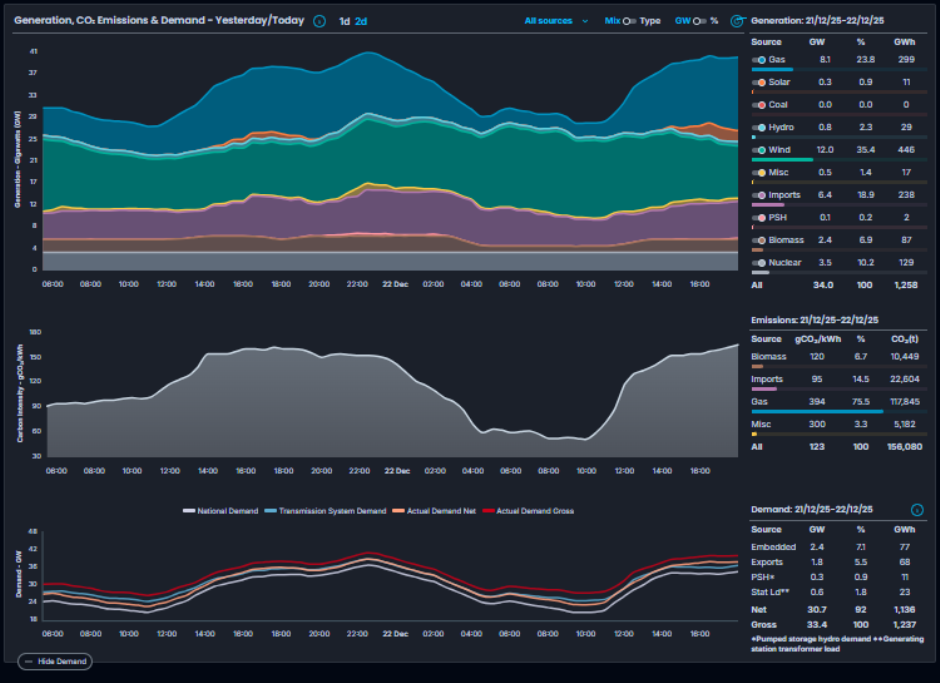
Source: energydashboard.co.uk/live
What fills the gap? Fast-ramping fossil plants.
But the flip side also matters: sometimes there is simply no wind and no sun. Clouds roll in, wind drops, or a weather system stalls — and suddenly the grid has far less renewable energy than forecast. When that happens, prices swing the other way, spiking sharply because there isn’t enough supply. Nuclear plants can’t ramp up quickly — they run at a steady output. Wind is variable. Solar can vanish within minutes. Hydropower helps when geography allows, but in most countries, the only fast-ramping backup is gas turbines. And when renewables unexpectedly dip, and those gas plants are not prepared, the system shifts from oversupply at noon to scarcity in the evening, driving prices to extreme highs.
The sharper the evening ramp, the more fossil power you need standing by. Adding more solar power increases the midday dip and heightens the sunset spike. Engineers refer to it as the “neck of the duck.” Operators call it a headache.
It’s the same principle behind “TV Pickup” in the UK — the famous spike when millions of kettles switch on after a TV program ends. Sudden demand requires instant response. Solar can’t react; it only produces what the sun gives it.
This is why solar hasn’t taken over. Not because of cost but because of timing.
Why Storage isn’t the Silver Bullet (Yet)
The textbook fix is simple: store the excess midday solar energy and use it in the evening.
The real-world version is far from simple.
- Grid batteries are still expensive at the scale required.
- They degrade under heavy cycling.
- Multi-hour, multi-gigawatt storage is hard to build fast.
- Pumped hydro works exceptionally well, but geography limits its potential locations.
You can’t flatten a national duck curve with a few thousand Tesla Powerwalls. To reshape an entire grid, you need storage on the scale of cities, not garages.
Storage isn’t the silver bullet yet, but the picture is getting brighter. Large, multi-hour grid batteries still require enormous space and investment — but for the first time in history, storage is showing up natively in people’s homes and garages. Millions of households are installing batteries alongside rooftop solar, and EVs add even more distributed capacity.This approach, which uses EVs as batteries to send energy back to the grid, is called vehicle-to-grid (V2G), and it genuinely matters. It won’t store energy for days, but it can smooth out local spikes, support neighborhoods during short-term peaks, and absorb excess solar energy when parked. There are still practical limits: not every driver wants to cycle daily, and bidirectional chargers are still relatively new. But the direction is unquestionably positive — more EVs, more home storage, more controllable devices, and far smarter coordination.
Storage will scale. But we don’t need to wait for a perfect, future megabattery to run a renewable grid. The opportunity today is to use the storage we already have — in homes, in garages, in EVs — and connect it through software. Instead of waiting for a single, comprehensive solution, we can orchestrate millions of smaller ones.
So What Else Can We Do Today? Bend Demand Instead of Bending the Sun
If supply can’t match demand, flip the problem: make demand match supply.
This is the principle behind demand-side management. It’s the idea that electricity use doesn’t need to happen exactly when humans currently perform tasks.
Many devices don’t care when they run:
- Water heaters
- Heat pumps
- EV chargers
- Freezers
- Industrial chillers
- Data-center loads
- Home HVAC systems
Shift them by an hour or two, and the grid barely notices; multiply that by millions of devices, and you reshape the entire demand curve.
Instead of a steep evening peak, you get a gentle hill. Instead of midday oversupply, you soak up that cheap solar. Flatten the peaks, and the system becomes far easier to run. That’s where nuclear power really shines: it provides a steady, reliable baseline of power that doesn’t fluctuate with the weather or time of day. On top of that stable line, variable renewables — such as solar and wind — and storage can flexibly fill in gaps, adjusting to moments when demand and supply don’t naturally align. Small amounts of storage allow the grid to soak up cheap solar energy during the day, reduce evening spikes, and make every kilowatt count. Without that steady backbone from nuclear, renewables alone struggle to keep the lights on reliably. Investing in nuclear energy isn’t just about generating more clean power — it’s about providing the system with the stability it needs to let solar, wind, and storage reach their full potential.
This is where Virtual Power Plants come into play.
Virtual Power Plants: The Grid’s New “Control Layer”
A Virtual Power Plant, or VPP, isn’t a traditional power plant. It doesn’t have turbines or smokestacks. Instead, it’s a coordination system — software that connects and orchestrates many smaller energy sources. By linking thousands — sometimes millions — of distributed devices, a VPP can act like a single, flexible power plant, even though each device on its own seems small and unremarkable. Common types of devices that a VPP can manage include:
- Home batteries
- EV chargers
- Air conditioners
- Smart thermostats
- Industrial equipment
- Rooftop solar inverters
A VPP tells them when to consume power, when to pause, when to store energy, and when to discharge it.
Imagine:
- Your EV charges at 1 AM instead of 6 PM.
- Your home is preheated at 3 PM when solar is abundant.
- Your water heater turns on when the grid has excess.
- A neighbourhood’s batteries discharge for a 15-minute evening spike.
- A thousand freezers run slightly colder during the day so they can coast through the peak.
No lifestyle change. Just smarter timing. The effect is enormous: you transform millions of small, passive devices into a single, coordinated asset.
Why VPP Software is Brutally Hard to Build
From a distance, a VPP sounds like “control a bunch of devices intelligently.” From up close, it feels like running air traffic control for a city in the middle of a storm.
A proper VPP must:
- interpret real-time grid signals
- respond to price swings
- adjust for human behaviour
- predict weather
- forecast solar
- coordinate thousands of assets simultaneously
- manage utility billing
- handle payments to device owners
- enforce cybersecurity
- stay online even in adverse conditions
- make decisions within seconds (often milliseconds)
If the software glitches, people don’t lose a playlist — they lose electricity. This is why the most important part of the energy transition isn’t more panels, more turbines, or even more batteries. It’s the digital infrastructure that can turn the existing hardware into a coordinated system. Most grids today have the sensors, data sources, and hardware to start this transition. They don’t yet have the orchestration layer.
The Path Forward: Baseload + Renewables + Flexibility
A stable future grid will likely look like this:
| Component | Description |
| Baseload (nuclear, hydro, geothermal) | A steady background output that doesn’t chase demand. |
| Variable renewables (solar, wind) | Cheap, clean, but unpredictable. |
| Storage | Enough for multi-hour shifts, not entire seasons. |
| Flexible demand through VPPs | The layer that shapes human energy use to match the renewable supply. |
Flatten the peaks, and the system becomes far easier to run. Flatten the peaks, and renewables stop needing fossil-fuel babysitting. Flatten the peaks, and the cheapest energy finally becomes the dominant energy.
The Final Obstacle isn’t Physics — It’s Coordination
We already know how to build solar farms faster than coal plants. We already know how to electrify transport and heating. We already know how to store some energy and shift some loads.
What we don’t have — at scale — is the software that ties all of it together. Solar isn’t everywhere yet because the grid wasn’t designed to accommodate timing issues. The next decade of climate tech will be defined by the companies that rewrite that timing. If the 2010s were about cheap panels, the 2020s and 2030s will be about control systems.
VPPs won’t eliminate fossil fuels overnight, but they will let renewables compete on the metric that matters most: reliability. And once that happens, the cheapest energy will finally become the dominant energy.
By Dmitrii Iniutin
Founding Engineer
Seamflow
Dmitrii is currently a Founding Engineer at Seamflow and previously spent more than three years as a Lead Software Engineer at Fuse Energy in London, where he was a founding engineer at a renewable energy unicorn. His work there included building the trading desk, billing engine, APIs, and core infrastructure that supported the company’s rapid scale-up, giving him hands-on exposure to grid operations, real-time energy markets, and the software constraints behind renewable integration.