


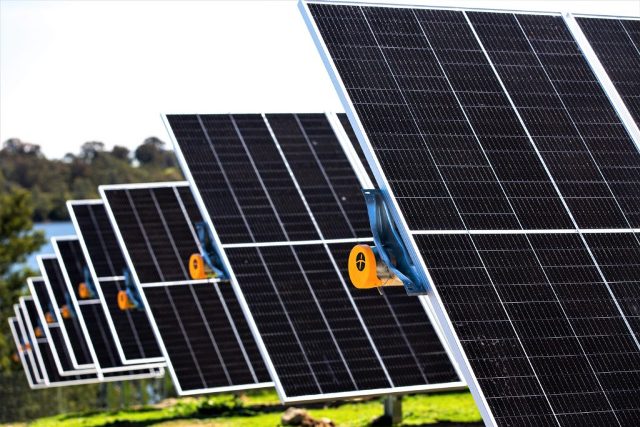
Asia-Pacific has emerged as the dominant global solar PV market, accounting for about 68 percent of total installations by the mid-2020s, according to GlobalData. The region’s growth is led by China, which added 278.9 GW of solar capacity in 2025 alone, setting the global pace. India contributed around 31 GW, reinforcing its position as one of the world’s largest solar markets, while Japan added 6.5 GW and Australia installed 4.6 GW, driven largely by rooftop solar adoption.
Expansion across South Korea and Southeast Asia, particularly Vietnam, has further accelerated regional capacity growth. Declining solar equipment costs, supported by strong supply chains, have made solar one of the cheapest power sources. Government policies, including renewable targets, incentives, and auctions, continue to underpin deployment.
China’s dominance in solar manufacturing provides scale advantages, ensuring cost efficiency and reliable supply. Increasing investor confidence and access to capital are enabling larger projects and sustained expansion. Looking ahead, APAC is expected to maintain leadership through the late 2020s, with China remaining the top contributor and India advancing toward ambitious 2030 renewable targets despite challenges such as grid integration and land availability.
Leading Solar PV Companies in Asia-Pacific
LONGi Green Energy
LONGi Green Energy remains the world’s largest monocrystalline wafer producer with massive scale. In 2025, it reported revenue of 70.35 billion yuan, though profitability was impacted by pricing pressure. The company shipped 111.56 GW of silicon wafers and 86.58 GW of modules in 2025, underlining its global dominance. In Q1 2026, module shipments reached 12.62 GW. LONGi continues investing in high-efficiency BC and TOPCon technologies and expanding overseas sales as export demand rises. However, it posted a quarterly net loss of 1.92 billion yuan, reflecting industry-wide overcapacity challenges.
Trina Solar
Trina Solar generated about $11.27 billion in revenue (2024), highlighting its scale in global markets. In 2026, Trina is focusing on integrated solar-plus-storage solutions and smart energy systems. It reported reduced losses of 234 million yuan in Q1 2026, supported by strong growth in energy storage revenue. The company continues to expand manufacturing capacity and sign large utility-scale contracts across Asia and global markets. With over 30,000 employees and strong downstream project capabilities, Trina is positioning itself as a full energy solutions provider beyond modules.
JinkoSolar
JinkoSolar remains the world’s largest module shipper, with shipments of 61.9 GW in the first three quarters of 2025 and full-year guidance of 85–100 GW. The company generated revenue of about 65.49 billion yuan in 2025. In Q1 2026, its net loss narrowed significantly to 463 million yuan from 1.32 billion yuan a year earlier, reflecting improving module pricing and strong energy storage demand. Jinko continues to secure large-scale supply contracts across APAC and invest in N-type technology to maintain efficiency leadership.
Adani Green Energy
Adani Green Energy is one of India’s largest renewable companies, with over 10 GW of operational solar capacity and a pipeline of large-scale solar parks. The company continues to secure long-term PPAs backed by government tenders, ensuring predictable cash flows. In 2026, Adani is expanding integrated solar manufacturing and project development as India scales toward 500 GW renewable capacity by 2030. The group is also investing in domestic cell and module manufacturing capacity to comply with localization policies, strengthening its role in India’s solar supply chain.
Tata Power Solar
Tata Power Solar is a key EPC and manufacturing player in India’s solar ecosystem. The company operates across modules, cells, and large-scale project execution. It has achieved over 1 GW of module shipments historically and continues to win EPC contracts across utility and rooftop segments. In 2026, Tata Power Solar is scaling domestic manufacturing, supported by a 4.3 GW solar cell plant commissioned in southern India. The company is also benefiting from rooftop solar growth under government subsidy schemes and expanding its distributed solar portfolio.
Canadian Solar
Canadian Solar reported revenue of $7.61 billion and net income of $363.6 million (2023), reflecting strong global operations. The company operates in more than 20 countries and is expanding solar and battery storage projects across Asia-Pacific. In 2026, it continues to secure utility-scale project contracts and invest in hybrid solar-plus-storage systems, particularly in Japan and Australia. Its dual strategy of manufacturing and project development enables recurring revenue streams and strengthens its role in large-scale solar deployment.
TotalEnergies
TotalEnergies is scaling its solar presence in Asia through large investments and joint ventures. In 2026, it partnered with Masdar in a $2.2 billion renewable energy joint venture targeting solar and storage projects across Asia. The company is also investing hundreds of millions of dollars in solar projects in markets such as the Philippines, focusing on long-term contracts with utilities and industrial customers. This reflects the growing role of global oil majors in the solar PV market, diversifying into clean energy infrastructure.
Cleantech Solar
Cleantech Solar focuses on commercial and industrial (C&I) solar across Asia. The company has built a strong portfolio of long-term PPAs with multinational corporations, enabling stable recurring revenue. In 2026, it continues expanding across India and Southeast Asia, signing multiple contracts for on-site solar installations. Its asset ownership model allows it to finance, build, and operate solar systems for clients, reducing upfront costs for businesses while accelerating adoption of distributed solar solutions.
Overall, these companies collectively represent the backbone of Asia-Pacific’s solar PV expansion, combining massive manufacturing scale, multi-gigawatt shipments, and billions of dollars in investments and contracts, even as the industry navigates pricing pressure and overcapacity challenges.
BABURAJAN KIZHAKEDATH