


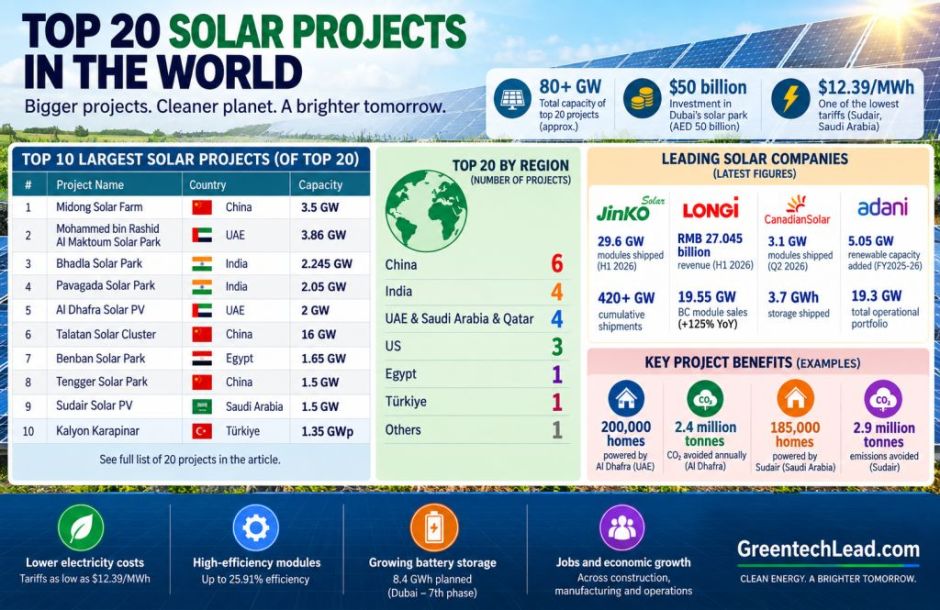
The world’s largest solar projects are moving beyond massive collections of photovoltaic panels to become integrated energy platforms combining multi-gigawatt solar capacity, battery storage, high-efficiency modules, trackers and dedicated transmission.
China dominates by scale, while India has built some of the largest solar parks and the Middle East is setting global benchmarks for low-cost electricity. Module prices of around $0.12/W in 2026 are also improving utility-scale solar economics, although complete project costs remain considerably higher.
The rapid expansion of these projects is part of a wider surge in global renewable energy investment, as utilities, governments and private developers compete to secure low-cost clean electricity and energy storage.
Capacity comparisons require caution because some developments are multi-project parks while others are individual plants, and reported ratings can use either AC or DC/GWp capacity.
Top 20 Largest Solar Projects
1. Midong Solar Farm, China — 3.5 GW
Xinjiang’s Midong Solar Farm has approximately 3.5 GW of capacity and ranks among the world’s largest individual PV installations. The wider Midong renewable-energy development is considerably larger, reflecting China’s strategy of building enormous clean-energy bases in western regions.
2. Mohammed bin Rashid Al Maktoum Solar Park, UAE — 3.86 GW
Dubai’s flagship solar park has reached 3.86 GW of commissioned capacity and is targeted to exceed 8 GW by 2030. DEWA has reported total investment of approximately AED 50 billion.
Its sixth phase comprises 1.8 GW and achieved an LCOE of around $16.22/MWh. The seventh phase will add 2 GW of PV plus 1.4 GW/8.4 GWh of battery storage, highlighting the transition toward dispatchable solar power.
3. Bhadla Solar Park, India — 2.245 GW
Rajasthan’s Bhadla Solar Park has approximately 2.245 GW of installed capacity across about 56 sq km. Reported investment is approximately $2.175 billion, making it a leading example of India’s shared-infrastructure solar park model.
Bhadla is also an important part of India’s rapidly expanding solar energy market, where utility projects, rooftop installations, manufacturing and storage are driving renewable capacity additions.
4. Pavagada Solar Park, India — 2.05 GW
Karnataka’s Pavagada, or Shakti Sthala, operates around 2.05 GW across approximately 13,000 acres. Reported investment ranges from ₹14,425 crore to ₹14,800 crore.
5. Al Dhafra Solar PV, UAE — 2 GW
Abu Dhabi’s 2 GW Al Dhafra project uses nearly 4 million bifacial panels and involves Masdar, TAQA, EDF Renewables and JinkoPower.
Its tariff is approximately $13.2/MWh. The plant can supply around 200,000 homes while avoiding approximately 2.4 million tonnes of CO2 annually.
6. Talatan Solar Cluster, China — Around 16 GW
Talatan in Qinghai is a solar cluster rather than one conventional plant. Reported capacity within commonly used park boundaries has reached approximately 16 GW, demonstrating how China coordinates generation, transmission and infrastructure across multiple projects.
7. Huanghe Hainan Renewable Energy Base, China
The Qinghai development combines large-scale solar with hydropower and grid infrastructure. Hydroelectric resources can help balance variable PV output, increasing flexibility across the renewable-energy system.
8. Benban Solar Park, Egypt — 1.65 GW
Egypt’s Benban Solar Park has approximately 1.65 GW spread across dozens of individual projects. Billions of dollars of investment and development-finance support helped establish Benban as one of Africa’s most important renewable-energy platforms.
9. Tengger Solar Park, China — 1.5 GW
Ningxia’s Tengger Solar Park is associated with approximately 1.5 GW of capacity and became an early model for China’s desert-based mega solar developments.
10. Sudair Solar PV, Saudi Arabia — 1.5 GW
Sudair has 1.5 GW of capacity and a reported cost of approximately $924 million, equivalent to roughly $616,000/MW. ACWA Power owns 35 percent.
Its 25-year PPA carries a tariff of approximately $12.39/MWh. Sudair can supply power equivalent to about 185,000 homes and avoid nearly 2.9 million tonnes of emissions annually.
11. Kalyon Karapinar, Türkiye — 1.35 GWp
Karapinar has approximately 1.35 GWp of capacity. Its combination of large-scale generation and domestic panel manufacturing demonstrates how mega-projects can support industrial localization.
12. Noor Abu Dhabi, UAE — 1.18 GW
The approximately 1.18 GW Noor Abu Dhabi project helped establish the UAE as one of the world’s most competitive markets for large-scale PV and laid the groundwork for subsequent mega-projects.
13. Jichuan Solar Development, China
Jichuan forms part of China’s expanding western renewable-energy ecosystem, benefiting from large-scale domestic manufacturing, centralized grid infrastructure, high-power modules and digital monitoring.
14. Al Kharsaah, Qatar — 800 MWp
Qatar’s Al Kharsaah project has approximately 800 MWp across around 1,000 hectares. It is designed to generate almost 2 million MWh in its first year, supply power equivalent to approximately 55,000 households and avoid around 26 million tonnes of CO2 over its lifetime.
15. Copper Mountain Solar, US — Around 800 MW
Nevada’s Copper Mountain complex has expanded to nearly 800 MW, benefiting from desert land, strong irradiation and utility-scale infrastructure.
16. Mount Signal Solar, US — 794 MWp
California’s Mount Signal complex totals approximately 794 MWp across multiple phases. Its DC rating also illustrates why global project comparisons need consistent capacity definitions.
17. Longyangxia Solar-Hydro, China — 850 MW Solar
Approximately 850 MW of solar capacity is associated with Longyangxia. Integration with hydropower helps compensate for variable solar production and improves system flexibility.
18. Rewa Ultra Mega Solar, India — 750 MW
India’s Rewa project has 750 MW of capacity and became a landmark for competitive solar procurement and long-term PPAs capable of attracting institutional investment.
19. Kamuthi Solar, India — 648 MW
Adani Green Energy’s Kamuthi project in Tamil Nadu has 648 MW of capacity and helped establish the company as a major Indian renewable-energy developer.
20. Solar Star, US — 579 MW AC
California’s Solar Star has approximately 579 MW AC and substantially greater DC module capacity, reinforcing the need to distinguish AC export capacity from installed DC capacity when ranking solar projects.
Solar Project Costs: $12.39/MWh Tariffs Change the Economics
Solar economics have changed dramatically as module prices have fallen to around $0.12/W in 2026. But module prices represent only one component of a project.
Trackers, inverters, structures, cables, land, engineering, labor, transmission, grid connection and financing increase total capital expenditure.
Sudair illustrates the difference. Its $924 million investment for 1.5 GW translates into approximately $616,000/MW, while its electricity tariff is just $12.39/MWh.
Al Dhafra achieved around $13.2/MWh, while Dubai’s sixth solar phase reached approximately $16.22/MWh. Differences in financing, capacity factors, project scope and contracts mean these tariffs should not be treated as directly comparable.
JinkoSolar, LONGi and Canadian Solar Scale Technology and Storage
Manufacturers are simultaneously pushing module efficiency, scale and energy storage.
JinkoSolar shipped 29.6 GW of modules during H1 2026, with around 70 percent exported. Cumulative shipments exceeded 420 GW, including more than 250 GW of Tiger Neo modules.
Its Tiger Neo 5.0 technology exceeds 700 W and reaches efficiency of up to 25.91 percent. JinkoSolar expects 60-70 GW of module shipments during 2026 and is expanding integrated production capacity toward approximately 100 GW.
LONGi generated RMB 27.045 billion of operating revenue in H1 2026. Sales of its back-contact modules jumped 125 percent year over year to 19.55 GW. LONGi also secured more than 10 GW of BC module awards in Chinese utility tenders and signed storage orders exceeding 3 GWh.
Canadian Solar shipped 3.1 GW of modules and 3.7 GWh of storage during Q2 2026 on revenue of approximately $1.2 billion. Its e-STORAGE contracted backlog reached about $3.5 billion, while its development pipeline stood at approximately 21.7 GWp of solar and 84.1 GWh of BESS.
Adani Green Energy added approximately 5.05 GW of renewable capacity in FY2025-26, including more than 3.4 GW of solar, increasing its operational portfolio to around 19.3 GW.
JinkoSolar, LONGi, Trina Solar and JA Solar remain leading global module manufacturers, while Masdar and ACWA Power are expanding multi-gigawatt renewable-energy development platforms.
Solar Technology Shifts Toward Higher Efficiency and Storage
TOPCon has become an important utility-scale technology, while back-contact and HJT modules are gaining attention as developers seek greater output from available land.
Bifacial modules capture reflected light, while single-axis trackers increase generation by following the sun. Higher-power modules can also reduce the number of panels, structures, cables and installation activities required per MW.
Storage represents the next major change. Dubai’s planned 8.4 GWh battery system illustrates how mega solar projects are evolving from daytime generators into energy platforms capable of supplying electricity beyond sunshine hours.
This trend is accelerating investment in battery energy storage systems and BESS projects, particularly in markets where rapid solar growth is increasing the need for grid flexibility and evening power supply.
Jobs and ROI: What Determines Solar Project Returns?
Large solar developments generate jobs across construction, manufacturing, engineering, logistics, electrical installation and operations. However, project-level employment figures are not disclosed consistently enough to create a reliable global jobs ranking.
Economic benefits increasingly extend beyond project sites into solar-cell and module factories, battery manufacturing, ports, transmission networks and engineering services.
For investors, solar ROI ultimately depends on capex per MW, PPA tariff, annual generation, capacity factor, financing cost, degradation, operating expenses, curtailment and grid availability.
Long-term contracts such as Sudair’s 25-year PPA can provide revenue visibility, while high irradiation improves generation per installed MW. Batteries can add value by shifting electricity into higher-value periods and reducing curtailment, although degradation and replacement costs must be considered.
The strongest projects therefore combine low capex, high energy yield, secure long-term offtake, low-cost financing and reliable grid access.
Solar Mega-Projects Are Becoming Energy Platforms
The next generation of solar projects will be defined less by headline GW capacity alone and more by the combination of solar, storage, transmission, efficiency and project economics.
China remains dominant in PV manufacturing and mega-project development. India is expanding solar parks and domestic manufacturing, while the Middle East is setting benchmarks for ultra-low tariffs and large-scale solar-plus-storage projects. The US remains a major utility-scale market, although transmission and policy conditions strongly influence development.
The global solar race is therefore shifting from “Who can build the biggest solar farm?” to “Who can deliver the most reliable low-cost renewable electricity?”
For developers and investors, that makes capex per MW, PPA duration, tariff, storage economics, capacity factor and grid access increasingly more important than project size alone.
SHAFANA FAZAL