


The global utility-scale solar engineering, procurement and construction (EPC) market is expanding beyond conventional solar installations as renewable energy developers invest in battery energy storage systems (BESS), high-voltage substations, transmission infrastructure and hybrid power projects.
Leading solar EPC companies, including SOLV Energy, Larsen & Toubro (L&T), Sterling and Wilson Renewable Energy, Tata Power, McCarthy Building Companies and PowerChina, are competing for large-scale renewable energy contracts that increasingly combine solar generation with storage and grid connectivity.
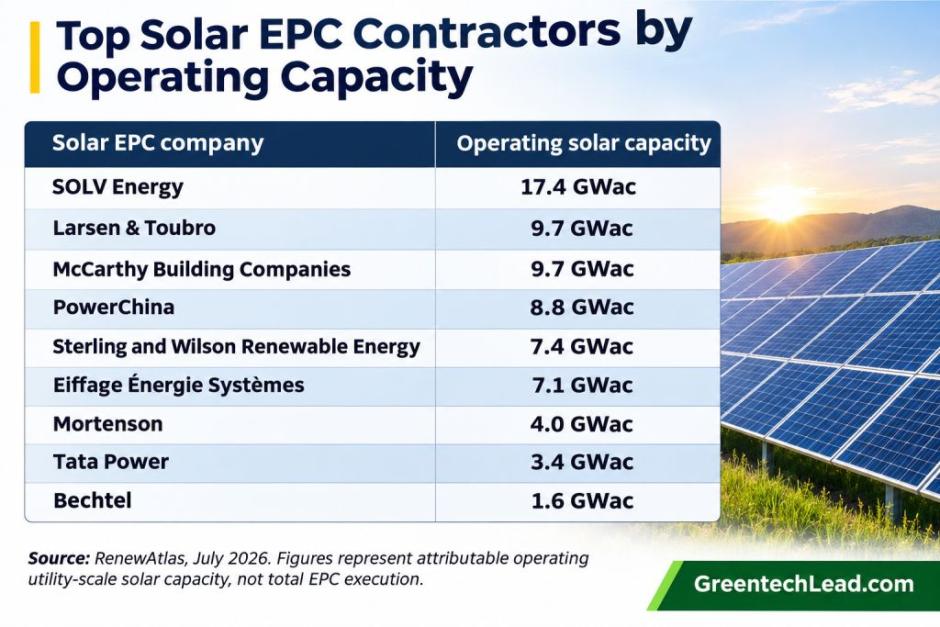
According to the RenewAtlas global solar EPC contractor ranking, SOLV Energy leads with 17.4 GWac of attributable operating utility-scale solar capacity as of July 2026, followed by L&T and McCarthy Building Companies at 9.7 GWac each.
The ranking covers operating solar projects of at least 3.5 MWac. It differs from companies’ reported cumulative construction experience, contracted pipelines and storage portfolios.
Top 12 Solar EPC Companies and Major Renewable Energy Projects
1. Sterling and Wilson Renewable Energy
Sterling and Wilson Renewable Energy (SWREL) is a major Indian solar EPC contractor with international projects covering solar generation, battery storage and operations and maintenance.
Its project portfolio includes a 1,000 MW solar installation with 600 MWh battery storage in Egypt and an 875 MWac solar EPC contract from Coal India valued at approximately ₹3,490 crore, including taxes and O&M.
The company also secured South African battery storage contracts totalling 616 MWh. Its September 2026 unexecuted order book reached ₹12,481 crore, representing 34 percent annual growth, while its O&M portfolio stood at 18.9 GW.
2. Tata Power Solar
Tata Power Solar, operating within the Tata Power renewable energy business, benefits from integrated solar EPC, manufacturing, storage and power infrastructure capabilities.
Tata Power Renewable Energy reported 10 GW of cumulative EPC execution in January 2026, including 9.7 GW of solar and 290 MW of wind.
Major hybrid projects include Rajnandgaon, combining 100 MW solar with 120 MWh storage, and Kalasar, integrating 227.5 MW solar with 101.2 MWh BESS.
The wider renewable energy portfolio reached 12.4 GW in October 2026, including 7.1 GW operational and 5.3 GW under implementation.
3. Larsen & Toubro
Larsen & Toubro is positioned among the largest renewable EPC contractors through its engineering, power transmission and energy storage capabilities.
L&T reports 25.2 GWp of solar PV project experience and 12.8 GWh of BESS experience.
Its major international references include a 2.5 GWp solar project integrated with 10 GWh of storage in the UAE, a 3.5 GWp solar development in Saudi Arabia and a 1.2 GWp solar-plus-storage project in the CIS region.
These projects demonstrate L&T’s participation in large renewable energy infrastructure programmes requiring substantial grid integration.
4. Bechtel
Bechtel provides engineering, procurement, construction management and project delivery services for major energy infrastructure developments.
Its renewable energy development references include the 200 MW Goldfinch solar project in Iowa and the 128 MW Sandpiper project in Illinois, both sold to new owners in 2026.
These development transactions should be distinguished from verified solar EPC construction experience when comparing contractors.
5. SOLV Energy
SOLV Energy leads the RenewAtlas operating-capacity ranking with 17.4 GWac and reports more than 22 GW of installed solar capacity across its business.
Its capabilities include utility-scale solar construction, BESS integration, commissioning, O&M and high-voltage electrical infrastructure.
The company also undertakes substation work at voltages reaching 500 kV, supporting developers requiring coordinated solar generation and grid interconnection.
6. McCarthy Building Companies
McCarthy Building Companies reports more than 17 GW of installed utility-scale solar capacity across over 114 projects, alongside more than 9 GWh of battery storage experience.
Its Bright Arrow project combines 390 MWdc solar with a 100 MWac/200 MWh BESS installation.
Other major references include Arrow Canyon, featuring 275 MWdc solar and 375 MWh storage, and the 800 MWdc Double Black Diamond solar project.
7. PowerChina
PowerChina combines renewable energy EPC with transmission, substations and international power infrastructure development.
RenewAtlas attributes 8.8 GWac of operating solar EPC capacity to the contractor, although incomplete Chinese project attribution may understate its global position.
Its 96.9 MW Wayra Solar project in Peru reached full-capacity grid generation in September 2026. The development includes more than 136,000 solar modules, 2,345 trackers and a 220 kV grid connection, with estimated annual generation of 250 million kWh.
8. Eiffage Énergie Systèmes
Eiffage Énergie Systèmes is executing Morocco’s 225 MWp NOOR Atlas solar programme across four power plants.
Construction began in early 2026, with delivery scheduled for mid-2027.
The contract covers engineering, equipment procurement, construction, commissioning and seven years of O&M, providing an example of integrated project delivery and lifecycle services.
9. Mortenson
Mortenson reports more than 7 GW of solar construction experience and over 28 GWh of storage engineering experience.
Its Darden Solar and Storage project in California combines 1,500 MWdc solar capacity, equivalent to 1,150 MWac, with 4,600 MWh of battery storage.
The project also includes a 500 kV substation and approximately 15 miles of 500 kV transmission infrastructure. Mortenson serves as the full EPC contractor, with completion targeted for March 2028.
10. JAKSON Green
JAKSON Green reports a renewable EPC portfolio of 6,389 MWp and 983 MWp of renewable energy assets under development.
Its Bikaner renewable energy programme includes an 840 MWp partnership with Blueleaf Energy supported by long-term power purchase agreements.
The company’s solar EPC activities are complemented by renewable energy development and wider group infrastructure capabilities.
11. JUWI
JUWI provides renewable project development, solar EPC and O&M services across international markets.
Its completed 204 MW Kozani Solar Park in Greece uses bifacial solar modules and is expected to generate approximately 320 million kWh annually.
JUWI is also responsible for EPC delivery and subsequent O&M of the 156 MW Clover solar portfolio in Greece, which was sold to infrastructure investor Mirova.
12. TBEA Sunoasis
TBEA Sunoasis combines solar engineering with electrical equipment, substations, transformers and energy management technology.
The wider TBEA group reports cumulative construction capacity of 29.5 GW. This group-level figure should not be interpreted as independently verified commissioned solar EPC capacity attributable to Sunoasis.
Its integrated electrical infrastructure capabilities are relevant to solar projects requiring complex power evacuation and grid connections.
Solar EPC Project Costs, Grid Integration and Investment Outlook
Utility-scale solar EPC pricing depends on equipment selection, construction conditions, storage duration, transmission requirements and contract scope.
The Lawrence Berkeley National Laboratory’s Utility-Scale Solar 2026 report examines 1,989 US solar projects installed through 2025, including standalone solar and solar-plus-storage developments. Its project-level analysis covers capital costs, operating expenses, performance and power purchase agreements.
The National Laboratory’s solar-plus-battery cost benchmarks also provide a framework for comparing hybrid project economics, including battery replacement and O&M costs.
Major Projects Driving Solar EPC Demand
Two projects demonstrate the increasing importance of storage and transmission engineering.
Abu Dhabi solar-plus-storage megaproject: Masdar’s 5.2 GWdc solar and 19 GWh battery project is designed to deliver up to 1 GW of continuous power. L&T was selected as a preferred EPC contractor for its northern site, comprising approximately 2.6 GW of solar and 9.5 GWh of storage.
L&T
California Darden Solar and Storage: Mortenson’s EPC contract covers 1,150 MWac solar, 4,600 MWh storage, a 500 kV substation and 15 miles of transmission infrastructure, with estimated completion in March 2028.
Mortenson
In India, the government’s Green Energy Corridor Phase III programme has an approved outlay of ₹1,86,405 crore. It targets transmission infrastructure supporting up to 135 GW of renewable energy and deployment of 50 GWh of battery storage by FY2032–33.
Which Solar EPC Company Should Developers Select?
For Indian utility-scale solar and storage projects, Tata Power, Sterling and Wilson, L&T and JAKSON Green offer relevant capabilities.
For North American solar-plus-storage developments, SOLV Energy, McCarthy and Mortenson have substantial construction experience. PowerChina and L&T are relevant for international megaprojects, while JUWI and Eiffage provide European and international project references.
The most important selection criteria are verified commissioned capacity, EPC contract scope, project completion performance, financial strength, grid integration experience and long-term operational guarantees.
As renewable energy projects become larger and more complex, solar EPC contractors capable of integrating generation, battery storage and high-voltage infrastructure will be better positioned to compete for major utility-scale renewable energy contracts.
SHAFANA FAZAL