
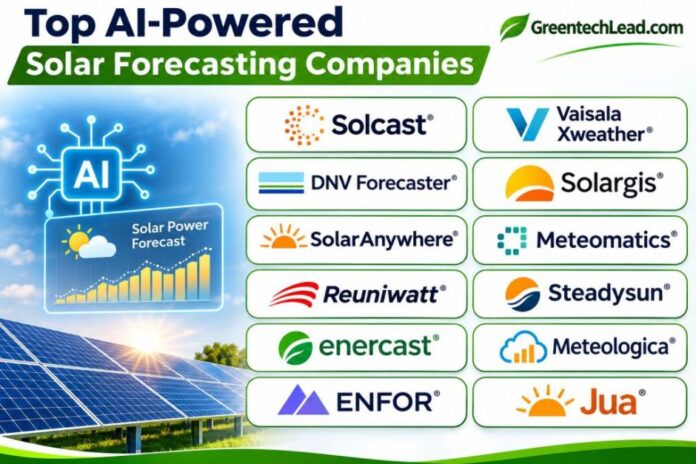
The global solar power forecasting market is entering 2027 with growing demand for artificial intelligence (AI), satellite-based weather intelligence, machine learning and predictive analytics to improve electricity generation forecasts, reduce scheduling errors and optimize battery energy storage systems (BESS).
Solcast, Vaisala Xweather, DNV Forecaster, Solargis, SolarAnywhere, Meteomatics, Reuniwatt, Steadysun, enercast, Meteologica, ENFOR and Jua are among the technology providers competing for solar developers, utilities, grid operators and electricity trading companies.
Their customer-winning strategies focus on forecast accuracy, real-time weather monitoring, API integration, plant-specific AI models and measurable reductions in electricity imbalance costs.
Solar forecasting providers differ in their services. Some deliver direct photovoltaic generation forecasts, while others specialize in weather data, satellite irradiance, probabilistic modelling or electricity market analytics.
Top 12 Solar Forecasting Companies: Technology, Achievements and Customer Strategies
1. Solcast: Satellite Solar Forecasting and 5.9% Historical Forecast Error
Solcast, acquired by DNV in 2023, provides satellite-based solar irradiance and photovoltaic power forecasting.
Its technology combines satellite observations, weather models and solar generation simulations to deliver forecasts through APIs.
Solcast’s published validation covering April 2020–March 2021 reported 5.9 percent average day-ahead daily-energy mean absolute percentage error (MAPE) across 33 solar sites. The comparable figures were 7.7 percent for the Global Forecast System and 13.2 percent for smart persistence.
These historical results are not a current independent performance ranking.
Solcast’s customer strategy focuses on scalable APIs, satellite coverage and forecasting services for developers managing geographically distributed solar assets.
Its solar forecasting accuracy assessment provides details of the methodology.
2. Vaisala Xweather: Weather Intelligence for Solar Operators
Vaisala Xweather combines meteorological intelligence, weather data and renewable energy forecasting capabilities.
Its technology supports assessment of cloud conditions, atmospheric changes and expected solar generation.
Vaisala’s customer-winning strategy emphasizes established weather measurement expertise, weather intelligence and operational decision support.
Its solutions are relevant to utilities and solar operators seeking weather information for generation scheduling, plant operations and grid management.
Customers should confirm whether their subscription includes plant-level AC power forecasts or only meteorological inputs.
3. DNV Forecaster: AI-Based Solar Power Predictions
DNV Forecaster provides site-specific renewable generation forecasts using physical models, statistical techniques and machine learning.
Its services incorporate weather forecasts and plant operating information to improve predictions.
DNV’s competitive advantage includes renewable energy engineering expertise and its broader forecasting capabilities, including Solcast.
Its customer acquisition strategy focuses on plant-specific model calibration, forecast delivery integration and operational support for renewable portfolios.
Buyers should evaluate DNV Forecaster and Solcast as related offerings within the same corporate group, rather than independent competitors.
4. Solargis: Satellite Irradiance and Solar Generation Forecasting
Solargis combines satellite observations, numerical weather prediction and physical photovoltaic models.
Its forecasting services support solar resource monitoring, operational planning and expected electricity generation estimates.
Solargis competes through solar resource modelling, historical weather information and operational forecasting products.
Its customer strategy targets developers, asset owners and engineering companies seeking consistent solar data across project development and operation.
The Solargis forecasting portfolio provides information about available products.
5. SolarAnywhere: Cloud-Based Solar Forecasting and Probabilistic Analytics
SolarAnywhere, developed by Clean Power Research, provides satellite-derived solar information and photovoltaic power forecasts.
Its technology combines satellite imagery, cloud-motion analysis and weather model blending.
SolarAnywhere offers deterministic and probabilistic forecasting capabilities relevant to utilities, grid operators and solar-plus-storage developers.
Its customer-winning strategy emphasizes data integration, forecast uncertainty information and cloud-based delivery.
The SolarAnywhere forecasting specifications describe its technical services and forecasting options.
6. Meteomatics: High-Resolution Weather APIs and Solar Forecasts
Meteomatics provides weather intelligence through APIs and site-specific solar power forecasting services.
Its technology supports localized weather assessment and photovoltaic production estimates.
Meteomatics competes through weather data delivery, geographic coverage and customizable forecasting services.
Its customer strategy targets renewable energy portfolio managers, electricity traders and utilities seeking weather information integrated into operating systems.
Customers should verify forecast refresh intervals, historical data access, model customization and integration costs.
7. Reuniwatt: Satellite and Sky-Camera Solar Forecasting
France-based Reuniwatt specializes in solar irradiance forecasting using satellite observations and ground-based sky cameras.
Its Sky InSight technology monitors cloud movement to support short-term solar generation predictions.
Reuniwatt’s customer-winning strategy emphasizes rapid cloud detection and short-horizon forecasting for solar installations exposed to changing weather.
Its solutions are relevant to utilities, microgrids and battery operators requiring early warnings of sudden solar generation changes.
Camera maintenance, visibility limitations and installation costs should be included in procurement assessments.
8. Steadysun: Site-Specific Solar Generation Forecasting
Steadysun provides renewable energy forecasting services for photovoltaic operators and electricity market participants.
Its services support short-term and day-ahead generation planning.
Steadysun’s customer strategy focuses on customized forecasts, site-level performance and integration into energy management workflows.
Developers should compare forecast accuracy, delivery reliability and historical performance against competing providers using identical plant data.
9. enercast: AI-Based Renewable Energy Forecasting
Germany-based enercast provides renewable electricity forecasting using weather information, physical modelling and AI-based techniques.
Its technology supports forecasts for individual renewable assets and larger portfolios.
enercast’s customer-winning strategy focuses on helping utilities, aggregators and electricity traders improve generation scheduling and portfolio management.
Its commercial value depends on forecast accuracy, software integration and measurable reductions in scheduling and imbalance exposure.
10. Meteologica: Forecasting for Electricity Trading
Meteologica provides renewable generation and electricity market forecasting services.
Its solutions support electricity traders, utilities and renewable portfolio operators seeking generation forecasts for commercial decisions.
Meteologica’s customer acquisition strategy emphasizes the relationship between renewable forecasting, electricity market operations and portfolio scheduling.
Customers should assess forecast horizons, geographical coverage, market integration and performance during rapidly changing weather.
11. ENFOR: Renewable Forecasting and Energy Optimization
Denmark-based ENFOR combines renewable energy forecasting with energy-system optimization.
Its solutions help utilities and energy companies connect generation predictions with operational decisions.
ENFOR’s competitive strategy focuses on forecasting, energy management and optimization rather than weather data alone.
Its services are relevant to customers managing renewable generation, electricity demand and energy storage.
Buyers should evaluate integration requirements, forecasting performance and optimization results using real operating data.
12. Jua: AI Weather Modelling and Power Forecasting
Jua develops AI-based weather models and forecasting solutions for energy applications.
Its technology aims to use machine learning to improve weather predictions and support electricity market decisions.
Jua’s customer-winning strategy focuses on AI-driven forecasting and applications for energy traders and renewable operators.
Customers should independently verify forecast performance, geographic coverage, product maturity and service guarantees before committing to commercial deployment.
Solar Forecasting Accuracy: Key Data Points
Forecast accuracy directly affects electricity scheduling, trading and battery dispatch. Buyers should compare results using consistent forecast horizons and operating conditions.
| Forecasting metric | Evaluation requirement |
| Day-ahead forecast | Next-day hourly generation |
| Intraday forecast | Updated generation estimates |
| Nowcasting | Minutes to hours ahead |
| MAPE | Percentage forecast error |
| RMSE | Magnitude of forecast errors |
| P10/P50/P90 | Probabilistic generation estimates |
AI models can improve predictions through weather-data blending, historical plant performance and continuous model calibration. However, accuracy must be validated against real generation records.
Solar Forecasting ROI: Potential Savings for a 100 MW Project
Consider a hypothetical 100 MW solar project generating 180,000 MWh annually at ₹4/kWh.
₹72 crore
Annual electricity revenue
₹72 lakh
Assumed annual forecast-related exposure
₹21.6 lakh
Savings from 30% exposure reduction
170%
Subscription-only ROI at ₹8 lakh cost
Illustrative calculations, not measured vendor results. ROI excludes implementation, integration and additional support expenses.
Solar Forecasting Market Outlook for 2027
The competitive advantage of solar forecasting companies will depend on verified forecast accuracy, AI model performance, probabilistic analytics, integration with BESS and measurable customer savings.
Solcast and Solargis emphasize satellite-based forecasting; Vaisala and Meteomatics offer weather intelligence; DNV, enercast and ENFOR combine forecasting with operational applications; while Reuniwatt specializes in short-term cloud monitoring.
For utilities, developers and electricity traders, the preferred platform will be the one demonstrating lower forecast errors, reliable data delivery and financial benefits after subscription and integration costs.
SHAFANA FAZAL
