


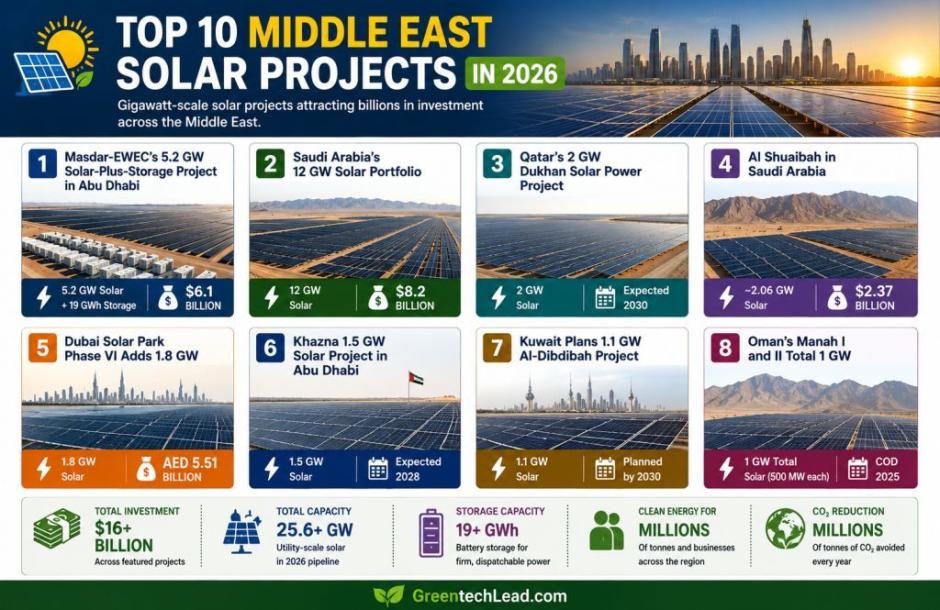
The Middle East is entering a major solar investment cycle, with Saudi Arabia and the UAE leading a wave of gigawatt-scale projects while Qatar, Oman and Kuwait expand their utility-scale renewable portfolios. Developers are increasingly combining solar PV with battery storage, while long-term PPAs and competitive auctions are driving some of the world’s lowest solar tariffs.
Abu Dhabi 5.2 GW Solar-Plus-Storage Project
The Masdar-EWEC development in Abu Dhabi is the largest project on the list, combining 5.2 GW of solar PV with 19 GWh of battery storage and representing total investment of US$6.1 billion.
Financial close was achieved in July 2026, backed by US$5.1 billion in financing from 13 banks, while Masdar is contributing US$1 billion in equity. The project is designed to provide 1 GW of continuous clean electricity and is expected to begin operations in 2027.
JinkoSolar is the preferred module supplier, L&T and PowerChina are preferred EPC contractors, and CATL is supplying battery technology. The tariff has not been disclosed. The US$6.1 billion Abu Dhabi solar and storage project highlights the Gulf’s shift toward firm renewable power.
Saudi Arabia’s 12 GW Solar Portfolio
Saudi Arabia’s latest procurement wave includes five solar plants totaling 12 GW. Bisha and Humaij are 3 GW each, while Khulis, Afif1 and Afif2 are 2 GW each.
The projects form part of a wider 15 GW renewable portfolio that also includes two wind farms. Total investment is US$8.2 billion, supported by US$5.9 billion in senior debt. Operations are expected between the second half of 2027 and first half of 2028.
Solar tariffs range from roughly 1.26 to 1.36 US cents per kWh, among the lowest levels globally. ACWA Power says the projects could create thousands of jobs and support domestic supply chains, though detailed employment numbers have not been disclosed. The Saudi 15 GW renewable investment programme demonstrates the scale of the kingdom’s solar ambitions.
Qatar’s 2 GW Dukhan Solar Project
Qatar’s 2 GW Dukhan Solar Power Project is its largest solar development. Samsung C&T secured the EPC contract from QatarEnergy for KRW1.46 trillion.
The project will cover approximately 27 square kilometres and deploy 2.74 million solar panels. It is expected to supply electricity equivalent to around 750,000 households, with completion targeted for 2030.
The Dukhan solar EPC project will use solar tracking systems and advanced inverters. The PPA tariff, overall project investment and panel supplier have not been disclosed.
Al Shuaibah 2 Adds 2.06 GW in Saudi Arabia
Al Shuaibah 2 adds approximately 2.06 GW of solar capacity in Saudi Arabia’s Makkah region. Together, Al Shuaibah 1 and 2 exceed 2.6 GW and represent combined investment of around US$2.37 billion.
Developed by ACWA Power and Badeel under a long-term PPA with Saudi Power Procurement Company, the project reinforces Saudi Arabia’s strategy of using privately financed utility-scale solar to expand low-cost generation.
Dubai Solar Park Phase VI Adds 1.8 GW
Phase VI of the Mohammed bin Rashid Al Maktoum Solar Park in Dubai will add 1.8 GW of PV capacity with investment of up to AED5.51 billion.
Masdar was selected as preferred bidder, with bifacial modules and single-axis tracking. The awarded levelized electricity cost was approximately 1.6215 US cents per kWh.
The project is expected to supply around 540,000 residences and avoid 2.36 million tonnes of carbon emissions annually. The wider solar park is targeted to exceed 5 GW by 2030, with total investment of approximately AED50 billion.
Khazna 1.5 GW Solar Project in Abu Dhabi
The 1.5 GW Khazna Solar PV project is being developed by ENGIE and Masdar under a 30-year PPA with Emirates Water and Electricity Company.
Financial close was achieved in January 2026. The project is expected to supply power equivalent to approximately 160,000 homes and avoid more than 2.4 million tonnes of CO2 annually.
SEPCOIII is the EPC contractor, LONGi is linked to PV supply, and nearly 3 million panels are expected. A reported tariff of around 1.459 US cents per kWh would make Khazna one of the UAE’s lowest-cost solar plants. Operations are expected in 2028.
Al Henakiyah: 1.1 GW With Local-Content Commitments
Saudi Arabia’s 1.1 GW Al Henakiyah project is being developed by Masdar, EDF Renewables and Nesma under a 25-year PPA.
The winning bid was US$16.84 per MWh, equivalent to 1.684 US cents per kWh, while project value is estimated at approximately US$1 billion.
The project is expected to supply more than 190,000 homes and avoid over 1.8 million tonnes of CO2 annually. At least 19 percent of construction equipment, materials and services are expected from Saudi companies. Saudi nationals are targeted to represent 50 percent of the workforce during the first five operational years and 75 percent over the project’s operating life.
Kuwait Plans 1.1 GW Al-Dibdibah Project
Kuwait’s 1.1 GW Al-Dibdibah Solar Project is being developed as part of the Al-Shagaya Phase III Zone 1 programme and is structured as a public-private partnership.
The project is expected to operate under a 30-year PPA and support Kuwait’s goal of obtaining 15 percent of its energy needs from diverse sources by 2030.
Investment, tariff, developer, EPC contractor, panel supplier and construction-job numbers remain undisclosed.
Oman’s Manah I and II Total 1 GW
Oman’s Manah I and Manah II projects provide a combined 1 GW of solar capacity, with each plant rated at 500 MW.
Manah I is backed by EDF Renewables and Korea Western Power, while Manah II involves Sembcorp Utilities and Jinko Power. Oman is targeting a 30 percent renewable-energy share by 2030.
Nama Power and Water Procurement lists commercial operation dates in 2025 for both projects.
Ibri III Combines 500 MW Solar With 100 MWh Battery
Ibri III stands out for integrating 500 MW of solar capacity with a 100 MWh battery energy storage system.
Masdar, Al Khadra Partners, Korea Midland Power and OQ Alternative Energy reached financial close in January 2026. Total project cost is approximately US$300 million, financed by Natixis and First Abu Dhabi Bank.
The project is expected to provide electricity equivalent to around 33,000 homes and avoid approximately 505,000 tonnes of carbon emissions annually. The Ibri III solar-plus-storage project also shows how batteries are becoming part of new Gulf utility-scale solar developments.
Middle East Solar Investment Race Accelerates
The region is developing three distinct models. Saudi Arabia is leading on ultra-low solar pricing, with tariffs around 1.3 US cents per kWh. The UAE is combining low-cost solar with large-scale battery storage, while Qatar, Oman and Kuwait are expanding through long-term PPAs and public-private structures.
The next phase of Middle East solar investment will increasingly be defined by storage capacity, financing scale, local manufacturing, employment and the ability to deliver power beyond daylight hours.
For developers, EPC contractors, module manufacturers and battery suppliers, these projects represent a multibillion-dollar pipeline extending far beyond conventional solar farms.
SHAFANA FAZAL