


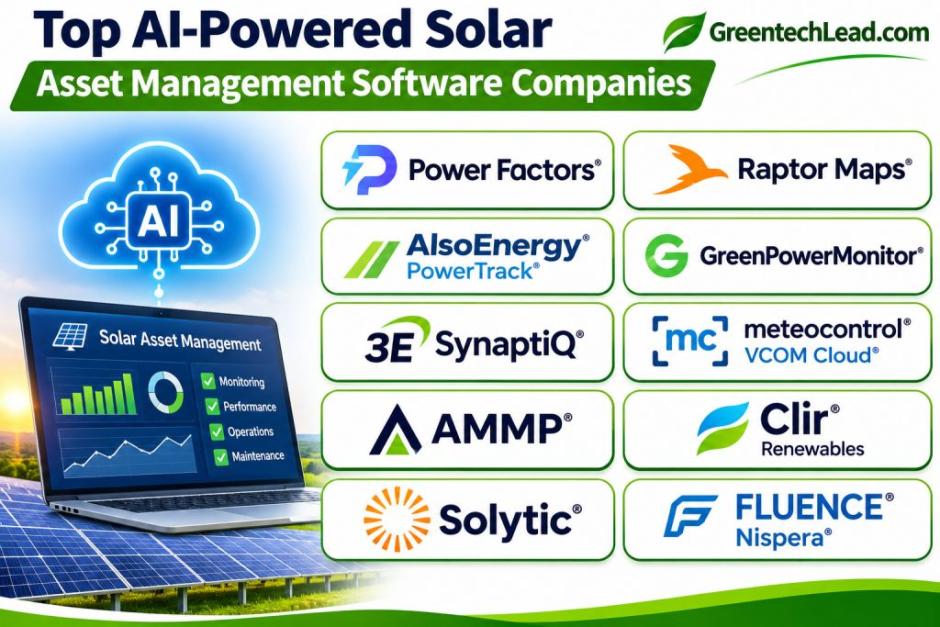
The global solar asset management software market is entering 2027 with growing demand for artificial intelligence (AI), predictive maintenance, digital twins, automated performance monitoring and renewable energy portfolio optimization. Solar developers, utilities and independent power producers are investing in software to reduce equipment downtime, improve electricity generation, manage maintenance costs and protect project revenue.
Power Factors, Raptor Maps, AlsoEnergy, GreenPowerMonitor, 3E, meteocontrol, AMMP, Clir Renewables, Solytic and Fluence are among the prominent technology providers competing for solar asset owners and operators.
Their customer-winning strategies focus on measurable generation recovery, AI-powered fault detection, multi-site monitoring, automated reporting and integration with battery energy storage systems (BESS).
Unlike basic solar monitoring platforms, advanced asset management solutions combine operational data with maintenance workflows, financial performance and equipment-level analytics.
Top 10 Solar Asset Management Software Platforms: AI Capabilities, Achievements and Customer Strategies
1. Power Factors: AI Intelligence Trained on 310 GW of Renewable Assets
Power Factors provides the Unity renewable energy management platform, combining monitoring, asset performance management and commercial workflows.
In April 2026, the company introduced Unity REMI, an AI-powered renewable energy management intelligence solution trained on data from more than 310 GW of renewable assets, according to Power Factors.
REMI was initially available to Unity Asset Performance Management customers, with broader availability planned during 2026.
Power Factors’ customer strategy emphasizes a unified software environment for renewable portfolios, reducing reliance on disconnected monitoring, maintenance and reporting systems.
Its Unity platform targets utilities, independent power producers and asset managers seeking integrated operational intelligence.
2. Raptor Maps: Digital Twins and AI-Powered Solar Inspections
Raptor Maps specializes in solar asset intelligence, digital twins and automated inspection analysis.
Its platform combines drone imagery, geospatial information, equipment records and historical inspections to identify defective modules, prioritize repairs and support warranty claims.
Raptor Maps’ competitive advantage is linking physical equipment defects to asset-level operational and financial decisions.
Its customer acquisition strategy targets utility-scale solar owners seeking improved inspection efficiency, traceable maintenance records and faster remediation.
The Raptor Maps platform supports solar asset lifecycle management, including equipment-level documentation and defect tracking.
3. AlsoEnergy PowerTrack: Solar and Storage Portfolio Monitoring
AlsoEnergy, associated with Stem, offers PowerTrack monitoring and control technology for solar and energy storage portfolios.
PowerTrack supports data acquisition, performance monitoring, reporting and integration with plant equipment.
Its competitive strength comes from combining renewable energy monitoring with broader energy technology capabilities.
Its customer-winning strategy focuses on centralized portfolio visibility, operational reporting and support for solar-plus-storage installations.
Customers should verify the current product offering, hardware compatibility, support arrangements and contractual responsibilities.
4. GreenPowerMonitor: DNV-Backed Solar Monitoring and SCADA
GreenPowerMonitor, part of DNV, provides renewable energy monitoring, SCADA and analytics solutions.
Its Horizon platform supports portfolio-level monitoring, while its plant-level technologies address data acquisition, control and operational performance.
GreenPowerMonitor’s competitive advantage includes integration with DNV’s renewable energy engineering and technical advisory capabilities.
Its customer strategy emphasizes centralized monitoring, equipment integration and operational visibility across geographically distributed renewable assets.
Utilities and developers should compare cloud software subscriptions separately from SCADA hardware, controllers and installation services.
5. 3E SynaptiQ: Physics-Based Digital Twins and Solar Performance Analytics
Belgium-based 3E offers SynaptiQ, a renewable energy asset management platform combining monitoring, digital twins and performance analytics.
Its technology uses physics-based modelling to evaluate expected generation and identify production losses.
SynaptiQ’s competitive strength lies in distinguishing equipment underperformance from weather-related generation changes.
Its customer-winning strategy targets renewable portfolio owners seeking actionable performance analysis, automated reporting and better maintenance prioritization.
Customers should validate model accuracy using their own plant data, particularly for solar-plus-storage portfolios.
6. meteocontrol VCOM Cloud: Solar Monitoring, Maintenance and Forecasting
Germany-based meteocontrol provides VCOM Cloud for photovoltaic and battery storage monitoring.
Its capabilities include performance dashboards, alarms, ticket management, computerized maintenance management and portfolio reporting.
Forecasting is available as a separately licensed module.
meteocontrol’s customer strategy emphasizes integration with multiple equipment manufacturers, standardized monitoring and operational workflows.
The platform is relevant to commercial rooftop solar operators and utility-scale developers managing assets across different locations.
Buyers should include data loggers, integration, forecasting and optional modules when comparing costs.
7. AMMP: AI Coworker Ray for Renewable Asset Operations
AMMP offers AMMP OS and AMMP AI for solar, storage and hybrid renewable energy portfolios.
Its platform supports monitoring, alert management, maintenance ticketing, reporting and commercial workflows.
The company’s AI coworker, Ray, analyzes portfolio information, investigates operational issues, answers questions using supporting evidence and assists with report preparation.
AMMP’s customer-winning strategy emphasizes reducing manual analysis and administrative workloads for distributed energy operators.
Its modular commercial model allows customers to evaluate operating software and AI functionality separately or together.
8. Clir Renewables: AI Analytics for Portfolio Financial Performance
Clir Renewables provides AI-powered asset performance and portfolio intelligence software.
Its Clir Portfolio solution supports performance benchmarking, contractual availability reconciliation, investor reporting and budget reforecasting.
Clir’s competitive advantage is connecting technical performance data with financial analysis and contractual obligations.
Its customer acquisition strategy targets renewable asset owners, investors and portfolio managers seeking better visibility into generation shortfalls and operating budgets.
Customers should assess its capabilities for validating equipment manufacturer calculations and explaining performance variance.
9. Solytic: Hardware-Independent Solar Portfolio Monitoring
Germany-based Solytic offers photovoltaic monitoring software designed to integrate installations using equipment from different manufacturers.
Its platform provides centralized monitoring, portfolio dashboards and white-label reporting capabilities.
Solytic’s competitive advantage is hardware independence, which can reduce monitoring complexity across mixed-inverter fleets.
Its customer-winning strategy targets solar installers, operations and maintenance providers and distributed asset owners.
Enterprise customers should confirm pricing, integration capabilities, data ownership and production-level service commitments.
10. Fluence Nispera: AI Analytics Across 15.5 GW of Renewable Assets
Fluence offers Nispera, an asset performance management platform supporting solar, wind, hydro and energy storage portfolios.
Fluence reports more than 15.5 GW of renewable assets across the Nispera portfolio.
Its software combines real-time monitoring, automated reporting and AI-powered analytics to identify underperformance and reduce operational downtime.
Fluence’s customer strategy emphasizes multi-technology portfolio management and the combination of software analytics with its broader energy storage expertise.
Customers should verify solar equipment compatibility, data integration requirements and regional technical support.
Latest Solar Asset Performance Data: Why AI Monitoring Matters
The National Renewable Energy Laboratory’s PV Fleet research found a median annual performance loss of 0.75 percent across 4,915 inverter-level observations. The research also identified considerable differences between individual installations.
Power Factors’ April 2026 announcement provides another indicator of software adoption. The company reported more than 310 GW of assets across over 600 customers and 18,000 sites in more than 70 countries. Its REMI intelligence was already active across more than 30 GW at launch.
These figures demonstrate the scale of renewable asset data being used for performance analytics, although software coverage does not establish a measured improvement in electricity generation.
Solar Asset Management Software Pricing and ROI
Enterprise software prices vary by installed capacity, number of sites, data integrations, AI functionality and maintenance requirements.
For a hypothetical 100 MW solar project generating 180,000 MWh annually at $50/MWh, annual electricity revenue reaches $9 million.
$45,000
Revenue from 0.5% generation recovery
$90,000
Revenue from 1% recovery
$135,000
Revenue from 1.5% recovery
$50,000
Assumed annual software cost
Illustrative financial scenarios, not reported software vendor results.
If software helps recover 1 percent of generation and produces another $25,000 in independently verified maintenance savings, annual benefits would reach $115,000.
After $50,000 in annual software fees and $20,000 in first-year implementation expenses, the project would generate $45,000 in first-year net benefit.
Over five years, the same assumptions produce an estimated net present value of approximately $226,000 at a 10 percent discount rate.
AI, Predictive Maintenance and Battery Storage Integration
AI-powered solar software is used to detect inverter failures, module underperformance, soiling, tracker faults and abnormal equipment temperatures.
Power Factors REMI and AMMP Ray emphasize AI-assisted operational workflows. Raptor Maps focuses on equipment-level visual analytics, while 3E SynaptiQ uses physics-based modelling to identify generation losses.
Fluence Nispera and GreenPowerMonitor support broader renewable portfolios, including assets that require integration with storage and plant-control systems.
Software buyers should evaluate fault-detection accuracy, false alarms, data completeness, maintenance response times and recovered electricity generation rather than relying on AI marketing claims.
Solar Asset Management Software Outlook for 2027
Competition among solar asset management companies will depend on AI capabilities, predictive maintenance accuracy, multi-technology integration, software costs and demonstrated customer returns.
Power Factors and Fluence compete through renewable portfolio scale; Raptor Maps and 3E emphasize detailed asset analytics; meteocontrol, AlsoEnergy and Solytic support monitoring and operations; while AMMP and Clir focus on AI-assisted workflows and portfolio intelligence.
For solar developers, utilities and independent power producers, the most valuable software will be the platform that demonstrates measurable generation recovery, lower maintenance costs and dependable financial reporting over the operating life of renewable assets.
SHAFANA FAZAL