


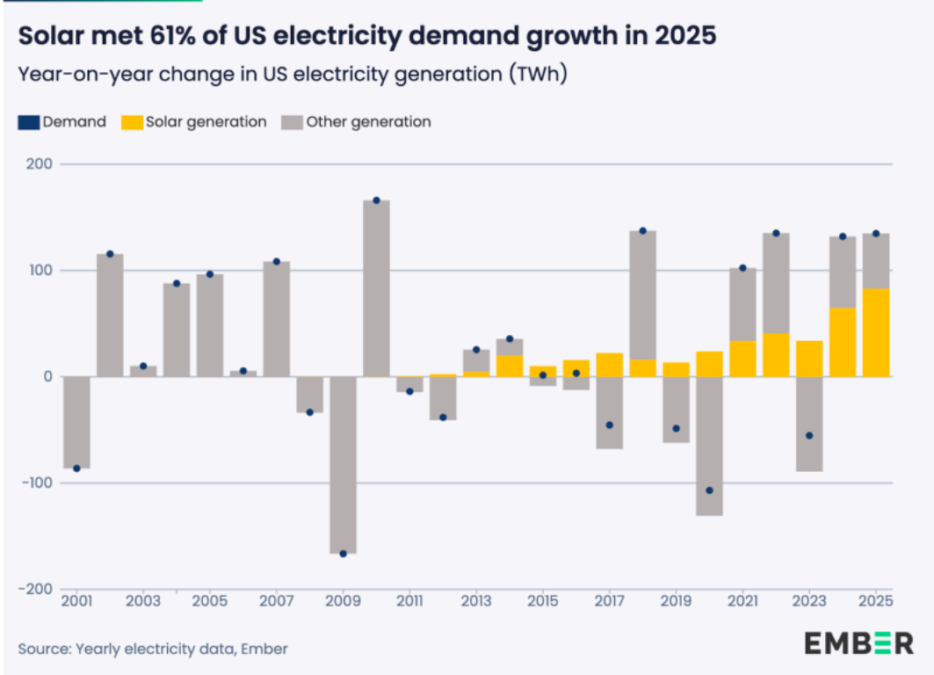
Solar power played a decisive role in meeting rising US electricity demand in 2025, accounting for 61 percent of the overall increase. Its impact was strongest in regions with the fastest demand growth. Texas, the Midwest, and the Mid-Atlantic recorded the largest increases in solar generation and electricity demand, with solar meeting 81 percent of demand growth in Texas and the Midwest, and 33 percent in the Mid-Atlantic.
Solar met the entire increase in daytime electricity demand and, with growing support from battery storage, also covered a significant share of rising evening demand. According to Ember Chief Analyst Dave Jones, solar growth was essential in meeting rapidly increasing US electricity demand in 2025, as it generated power where it was needed and, increasingly with the expansion of batteries, when it was needed, Ember report authored by Dave Jones, Kostantsa Rangelova, and Nicolas Fulghum indicated.
US solar power generation recorded a historic increase in 2025, rising by a record 83 TWh, or 27 percent, to reach 387 TWh, according to Ember. This growth lifted solar’s share of total US electricity generation to 8.5 percent. The expansion was driven primarily by utility-scale solar projects, with minimal contribution from behind-the-meter systems, while weather conditions had no impact as solar insolation remained unchanged from 2024.
US electricity demand increased by 3.1 percent, or 135 TWh, marking the fourth-largest annual demand rise in the past decade. Solar alone accounted for 61 percent of this overall demand growth, highlighting its central role in meeting rising power needs.
Solar generation expanded fastest in regions with the strongest growth in electricity demand. Texas and the Midwest saw the largest increases in utility-scale solar generation, with solar meeting 81 percent of demand growth in both regions. The Mid-Atlantic recorded the biggest rise in grid demand, with solar contributing 33 percent of the increase. In Florida, solar growth exceeded demand growth, leading to a decline in fossil fuel generation. Across the Southwest, Northwest, Southeast, and California, solar generation met nearly all of the increase in electricity demand.

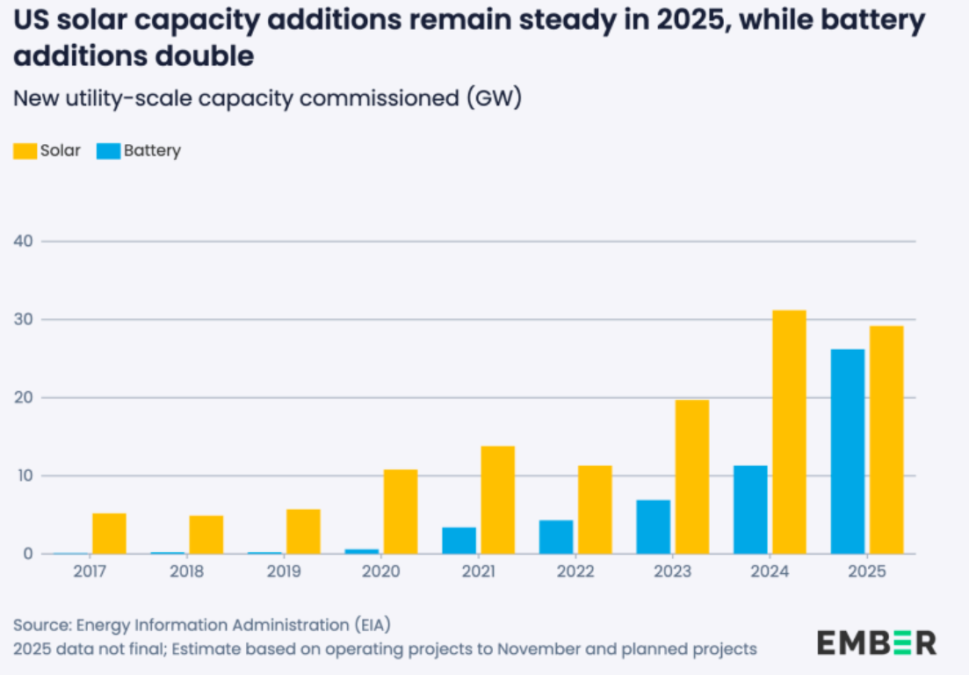
Provisional data for 2025 shows US utility-scale solar capacity additions declined by 6 percent compared with 2024, reflecting project delays caused by uncertainty over tariffs on imported solar panels and persistent bottlenecks in securing grid connections, even as electricity demand continued to rise. Utility-scale solar remained the dominant segment of the market, a trend reinforced by changes to net metering rules in California, the largest US residential solar market. In contrast, battery storage saw rapid expansion, with capacity additions surging 133 percent year-on-year to 26 GW in 2025.
Solar power in the US still has significant room to grow, supported by multiple pathways including battery storage, low solar penetration in many states, and the absence of a national duck curve. While solar’s share remains modest across much of the country, its potential extends well beyond daytime generation.
The rapid expansion of battery storage is transforming solar into a dispatchable, all-day electricity source. In California, utility-scale solar and battery generation has increased 58 percent over the past six years, with most of the additional output delivered during evening hours. In contrast, generation at the sunniest midday hour rose by just 8 percent. Since 2021, California has added more battery capacity than solar, enabling continued solar growth without significant curtailment and reshaping the grid around solar and storage.
Solar adoption has also accelerated quickly in some states. Six states recorded increases of more than five percentage points in solar’s share of electricity in the 24 months to October 2025. New Mexico saw the fastest growth, with solar’s share rising from 7 percent to 17 percent, while California and Nevada now lead the nation with solar shares of 37 percent and 34 percent respectively. However, 37 states still have solar shares below 10 percent, underscoring the large untapped potential nationwide.
Despite the benefits of batteries, solar does not yet depend on storage for further growth. Even during the sunniest hours, there remains substantial fossil fuel generation that solar could displace in most states. As a result, the US has not yet experienced a duck curve at the national level, indicating ample headroom for additional solar deployment.
BABURAJAN KIZHAKEDATH