


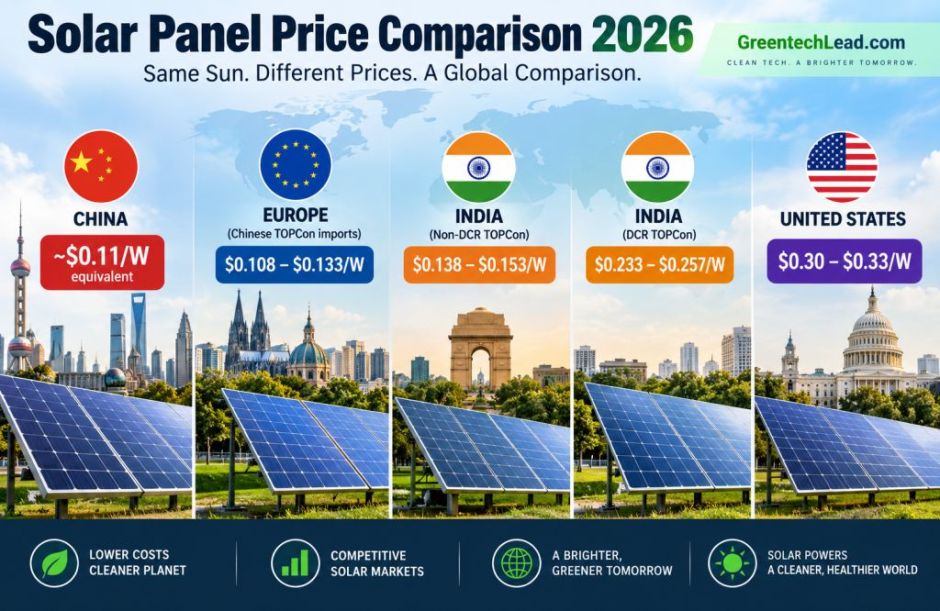
Solar panel prices in 2026 show a huge divide between China, India, Europe and the United States, with Chinese modules available around $0.11 per watt compared with $0.14-$0.25/W in India and roughly $0.30-$0.33/W in the US. At manufacturer level, competition is also producing sharp retail price reductions, including cuts of more than 13 percent on some Waaree solar modules in India.
China remains the world’s solar manufacturing cost benchmark because of its enormous production scale, integrated supply chain and dominance in polysilicon, wafers, cells and modules. The latest IEA assessment of the global clean energy technology supply chain shows that China accounts for around 85 percent of solar supply-chain production capacity, including about 95 percent of PV wafer capacity.
India is rapidly expanding manufacturing but remains more expensive, particularly for domestic-content products, while the US carries the largest price premium because of tariffs, trade restrictions and higher domestic production costs.
The comparison also shows that the era of continuously falling solar prices may be changing. Chinese module prices, after reaching extraordinarily low levels, increased from around $0.09/W at the end of December 2025 to $0.114/W by mid-April 2026 as China moved to curb destructive price competition.
China Solar Panel Prices Around $0.11/W
China continues to offer the world’s cheapest mainstream solar modules.
Chinese TOPCon module prices are approximately RMB 0.65-0.73/W for ground-mounted projects and RMB 0.68-0.76/W for distributed projects.
International TOPCon prices outside China are around $0.114/W, illustrating the enormous cost advantage created by China’s solar manufacturing ecosystem.
The cost advantage is structural. The IEA’s 2026 analysis of solar PV manufacturing costs highlights the cost differences between China and competing manufacturing regions. Scale, manufacturing efficiency, integrated supply chains, energy and labour costs all contribute to China’s position.
However, 2026 has brought an important reversal.
Solar module prices increased from approximately $0.09/W in December 2025 to $0.114/W by April 15, 2026, a rise of roughly 27 percent. Higher silver prices contributed, but China’s efforts to reduce excessive competition and industry losses have also played an important role.
JinkoSolar, LONGi and other major manufacturers had been selling into a market where prices fell below profitable levels. Chinese solar companies accumulated around $5 billion in net losses from the beginning of 2024, according to IEA figures cited by the Financial Times. LONGi recorded approximately $2 billion of losses across 2024 and 2025, while JinkoSolar lost roughly $450 million in 2025.
The improvement in pricing is already visible in corporate performance. JinkoSolar’s net loss narrowed to approximately RMB463 million ($67.2 million) in Q1 2026, from around RMB1.32 billion a year earlier, with the company citing improved module pricing. Trina Solar’s loss narrowed to RMB234 million from RMB1.61 billion.
China therefore remains the cheapest market, but the price war appears to be easing.
India Solar Prices: $0.14/W Non-DCR vs $0.25/W DCR
India’s solar manufacturing expansion has been dramatic.
Module manufacturing capacity reached approximately 173 GW by March 2026, but domestic solar-cell capacity was only around 30 GW. The imbalance matters because solar cells account for roughly 60 percent of module manufacturing costs.
Indian cell manufacturing is estimated to be almost 40 percent more expensive than Chinese production, with capital expenditure around 109 percent higher and silver-paste costs approximately 24 percent higher.
That cost difference is clearly reflected in module prices.
Non-DCR TOPCon modules: approximately $0.138-$0.153/W
DCR TOPCon modules: approximately $0.233-$0.257/W
The average DCR price is around $0.245/W, compared with approximately $0.146/W at the midpoint of the non-DCR range.
That means an Indian DCR module can carry a premium of roughly 68 percent over a comparable non-DCR market benchmark.
India nevertheless has the potential to become a much larger global manufacturing centre. The IEA’s Energy Technology Perspectives 2026 projects India’s share of global clean-energy technology production rising significantly and expects the country to become a net exporter of solar modules by 2030.
Waaree Cuts 540W DCR Panel Price by ₹1,400
Manufacturer-level retail pricing provides another indication of competitive pressure.
Waaree Energies has cut the price of its 540Wp Mono PERC DCR solar panel from ₹16,599 to ₹15,199, representing a ₹1,400 reduction, or approximately 8.4 percent.
The Waaree 540Wp Mono PERC DCR solar panel is listed by the company’s official online store against an MRP of ₹20,717.81, making the current selling price roughly 27 percent below MRP.
Waaree has also reduced its 535W DCR Mono solar panel from ₹15,299 to ₹14,799, a ₹500 reduction.
These reductions matter because DCR modules remain one of the more expensive segments of India’s solar market.
Waaree 585W Panel Sees Price Cuts of Up to 13.4%
Waaree’s higher-power N-type modules provide an even clearer example of price volatility.
Price-tracking data for a pack of two Waaree 585W N-type bifacial modules, totaling 1,170W, recorded several significant reductions during 2026.
The price dropped from ₹25,209 to ₹23,599 on January 31, a 6.39 percent decline.
On March 3, it fell from ₹23,599 to ₹21,799, down another 7.63 percent.
The largest recorded 2026 reduction came on May 8, when the price dropped from ₹23,098 to ₹19,999, a 13.42 percent cut.
On May 27, another movement took the price from ₹21,999 to ₹19,999, a reduction of 9.09 percent. On August 7, it declined 5 percent from ₹20,299 to ₹19,284.
The tracked product was priced at ₹20,699 in early September 2026, compared with an average tracked price of approximately ₹22,851.
These are retail-market prices rather than utility-scale procurement contracts, but they demonstrate how quickly individual module prices can change as manufacturers, distributors and online retailers compete.
Waaree’s own store currently lists a single 585Wp N-type dual-glass bifacial non-DCR module at ₹12,199.01, against an MRP of ₹16,874.07.
Europe Solar Modules Average Around $0.119/W
Europe remains much closer to China than either India DCR or the United States because European developers can continue sourcing competitively priced Chinese modules.
China-made TOPCon modules for European projects are approximately $0.108-$0.133/W FOB, with an average around $0.119/W.
The price is only slightly above China’s underlying export benchmark before freight, logistics, taxes and compliance costs.
This creates a difficult equation for European manufacturers. Developers benefit from cheap imported modules, but local manufacturers must compete against Chinese companies operating with much greater scale and deeper upstream supply chains.
The challenge is highlighted by the IEA’s Energy Technology Perspectives 2026, which says China’s competitive advantage reflects factors including large-scale production, manufacturing efficiency, integrated supply chains, skilled labour, access to resources and consistent policy support.
Italy’s 3SUN facility in Catania, for example, is being developed toward approximately 3 GW of annual manufacturing capacity, illustrating Europe’s attempt to rebuild domestic solar production.
US Solar Panel Prices Remain Highest at $0.30-$0.33/W
The United States has the largest module-price premium among the four markets.
US-assembled modules were around $0.30/W in Q2 2026, while broader current estimates put US prices at approximately $0.30-$0.33/W.
According to US solar module pricing data for Q2 2026, median pricing for US-assembled solar modules stood at $0.30/W, based on data covering 55 modules from 19 suppliers. The interquartile range was $0.280-$0.325/W.
At $0.30/W, a 600W module represents approximately $180 of module cost, compared with about $68 at China’s $0.114/W benchmark.
Scaled to a 100 MW solar project, the difference becomes much larger.
At $0.114/W, modules theoretically represent about $11.4 million.
At $0.30/W, they represent approximately $30 million.
The module-price difference alone is therefore around $18.6 million per 100 MW, before considering freight, tariffs, installation and balance-of-system costs.
The US premium reflects tariffs, trade restrictions, domestic manufacturing requirements and higher local production costs. First Solar and Qcells are expanding domestic manufacturing, but building a complete US solar supply chain does not immediately deliver Chinese manufacturing costs.
China consequently remains the global price leader, while Europe benefits from access to Chinese imports. India’s non-DCR market is relatively competitive, but DCR requirements substantially increase prices. The US remains the highest-cost major market.
Solar Panel Price War Is Entering a New Phase
The biggest change in 2026 is not simply that solar panels are becoming cheaper.
In China, the opposite has occurred: prices recovered from approximately $0.09/W at the end of 2025 to $0.114/W by mid-April 2026 as policymakers and manufacturers attempted to end unsustainable below-cost competition. Analysts cited by the Financial Times have suggested prices could potentially move toward $0.15-$0.16/W during 2026.
In India, meanwhile, retail competition continues to produce specific product discounts. Waaree’s 540W DCR module fell ₹1,400 to ₹15,199, while tracked pricing for its two-pack of 585W N-type modules recorded individual reductions of 6.39 percent, 7.63 percent, 13.42 percent, 9.09 percent and 5 percent at different points during 2026.
The global solar-panel market is therefore splitting into two trends: China is trying to lift prices from unsustainably low levels, while manufacturers and retailers in markets such as India continue using product-level discounts to compete for customers.
For solar developers, the critical calculation is no longer simply finding the cheapest panel. A Chinese module around $0.11/W, an Indian non-DCR module around $0.14-$0.15/W, an Indian DCR module around $0.24-$0.25/W, and a US module around $0.30/W operate under very different manufacturing, tariff and local-content conditions.
China still sets the global solar price floor in 2026. But the enormous gap — with US modules costing nearly three times China’s benchmark — shows how strongly industrial policy, tariffs, domestic-content rules and supply-chain location now determine what solar developers actually pay.
SHAFANA FAZAL