


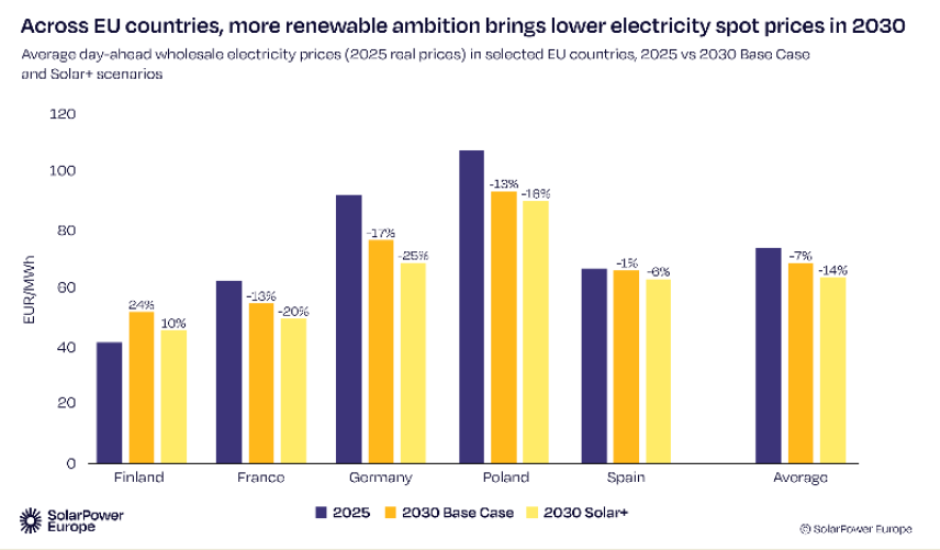
A new report from SolarPower Europe highlights a transformative shift in Europe’s energy economics, showing that large-scale deployment of solar power combined with battery storage could reduce EU power system operating costs by up to 50 percent by 2030. The findings reinforce the growing role of renewables in delivering not only decarbonisation but also price stability and energy security across the region.
European Union is rapidly scaling solar photovoltaic (PV) capacity, with projections indicating cumulative installations could reach 718 GW by 2030. Annual additions are expected to remain strong, approaching nearly 66.8 GW, reflecting sustained policy support and declining technology costs. This expansion is critical as solar already contributes a rising share of electricity generation, accounting for 13.2 percent of EU power supply in 2025.
The economic case for solar and storage is increasingly compelling. SolarPower Europe’s analysis shows that integrating battery storage with solar generation enables better grid flexibility, reduces reliance on expensive fossil fuel peaker plants, and minimizes system balancing costs. By 2030, these efficiencies could cut overall operating costs of the EU electricity system in half compared to fossil-heavy scenarios.
A key driver of these savings is the avoidance of fuel costs. Solar energy has zero marginal fuel cost, unlike gas or coal, making it highly resilient to price volatility. Recent data shows solar power already delivers significant cost benefits. For example, during early 2026, solar generation helped the EU avoid €111.7 million per day in fossil fuel import costs, with total savings reaching €3.77 billion in March alone. Over the 2026–2030 period, solar deployment could avoid up to €170 billion in gas import costs, averaging €34 billion in annual savings.
Investment in battery storage plays a central role in unlocking these benefits. Europe’s battery capacity has been expanding rapidly, reaching over 61.1 GWh, with continued growth expected as solar penetration increases. Storage systems enable excess solar energy generated during the day to be stored and used during peak demand periods, reducing curtailment and improving system efficiency. This combination enhances grid reliability while lowering operational expenses.
The report also emphasizes the broader economic and social impact of solar expansion. The sector is expected to support nearly 916,986 full-time jobs by 2029, highlighting its contribution to industrial growth and employment across Europe. In parallel, reducing dependence on imported fossil fuels strengthens energy security, a critical priority amid geopolitical uncertainties and volatile global energy markets.
Despite these benefits, achieving the projected cost reductions will require continued policy alignment, faster permitting processes, and significant investments in grid infrastructure and storage technologies. The EU’s renewable energy targets, including achieving at least 42.5 percent of energy from renewables by 2030, further underline the urgency of accelerating deployment.
The SolarPower Europe report concludes that solar-plus-storage is no longer just an environmental solution but a core economic strategy. By combining scalability, low operating costs, and energy independence, this model offers a clear pathway for Europe to achieve affordability, resilience, and sustainability in its power system by the end of the decade.
BABURAJAN KIZHAKEDATH