


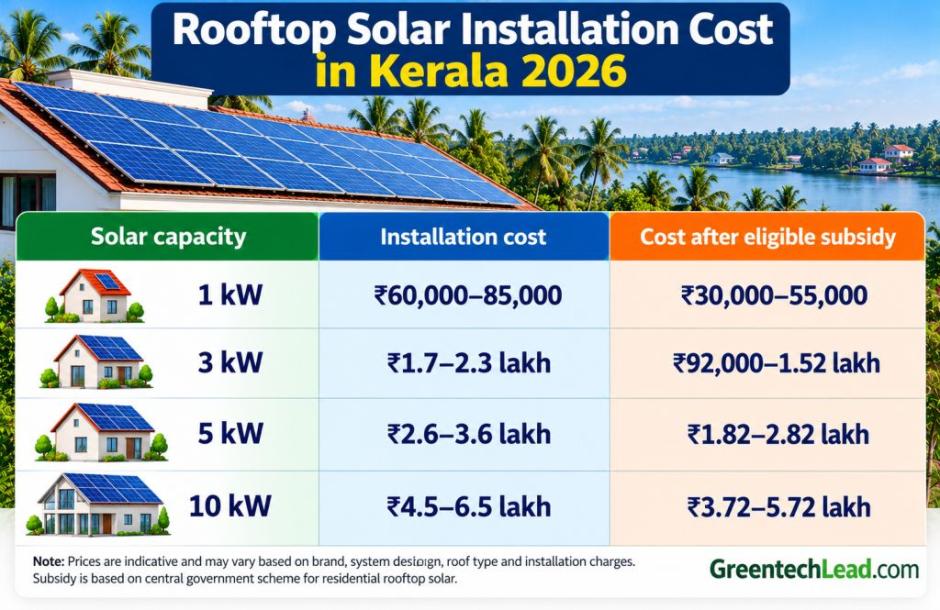
Rooftop solar installation in Kerala in 2026 can cost approximately ₹1.7–2.3 lakh for a 3 kW system, ₹2.6–3.6 lakh for 5 kW and ₹4.5–6.5 lakh for 10 kW before subsidy. Eligible residential consumers can receive up to ₹78,000 in central assistance under PM Surya Ghar: Muft Bijli Yojana.
For Kerala households facing rising electricity consumption from air conditioners, refrigerators, water pumps and other appliances, rooftop solar can reduce dependence on KSEB electricity purchases.
However, the financial return depends on installation cost, solar generation, self-consumption, export settlement rules and maintenance. Kerala’s monsoon conditions and KSEB’s regulatory requirements also influence project economics.
Rooftop Solar Installation Cost in Kerala 2026
The following indicative prices cover residential grid-connected rooftop solar systems without battery storage.
Prices are indicative planning estimates. Post-subsidy costs assume full eligibility and receipt of the applicable central subsidy.
A complete rooftop solar installation generally includes panels, inverter, mounting structures, electrical cables, protection systems, earthing, installation and commissioning.
Additional costs may arise from roof reinforcement, waterproofing, long cable routes, electrical upgrades and metering work.
For example, a 5 kW solar installation on a structurally sound concrete roof may cost less than an equivalent project requiring roof repairs or specialised mounting structures.
Homeowners should obtain itemised quotations from multiple installers before making a purchase.
PM Surya Ghar Subsidy in Kerala: How Much Can You Get?
The central government’s PM Surya Ghar: Muft Bijli Yojana provides financial assistance for eligible residential rooftop solar installations.
Under the standard subsidy structure:
| Rooftop solar capacity | Central subsidy |
| 1 kW | ₹30,000 |
| 2 kW | ₹60,000 |
| 3 kW | ₹78,000 |
| 5 kW | ₹78,000 |
| 10 kW | ₹78,000 |
The maximum standard central subsidy is ₹78,000 for eligible installations of 3 kW or more.
For example, a 3 kW rooftop solar system costing ₹1.8 lakh would require an effective investment of ₹1.02 lakh after receiving the full subsidy.
A 5 kW system costing ₹3 lakh would require ₹2.22 lakh after the same subsidy.
Homeowners must satisfy scheme requirements, including eligible equipment, vendor selection, installation verification and applicable utility procedures.
The subsidy is not automatically available merely because solar panels are installed.
KSEB Rooftop Solar Rules 2026: Approval and Net Metering
Kerala homeowners must follow applicable KSEB procedures before connecting a rooftop solar installation to the electricity grid.
The official KSEB e-Kiran portal provides rooftop solar application facilities and related information.
The process generally involves application submission, technical feasibility assessment, installation, inspection, metering and commissioning.
Permissible solar capacity depends on the current regulatory framework, consumer connection details and applicable technical conditions.
Homeowners should confirm requirements before purchasing equipment rather than relying on outdated online information.
How KSEB Net Metering Works
A grid-connected rooftop solar system first supplies electricity to household appliances.
When generation exceeds immediate consumption, surplus electricity may be exported to the grid under the applicable arrangement.
When solar production is insufficient, the household imports electricity from KSEB.
The financial value of exports depends on the operative metering and settlement regulations. Exported electricity should not automatically be valued at the same rate as electricity consumed directly.
The KSEB rooftop solar FAQs provide official guidance on technical requirements, metering and commissioning.
How Much Electricity Can Rooftop Solar Generate in Kerala?
Solar generation in Kerala depends on sunshine, rainfall, roof orientation, shading and system performance.
KSEB’s published guidance indicates that suitably positioned solar installations may generate approximately four to six units per installed kW per day under favourable conditions.
| Solar capacity | Indicative daily generation | Indicative 30-day generation |
| 1 kW | 4–6 units | 120–180 units |
| 3 kW | 12–18 units | 360–540 units |
| 5 kW | 20–30 units | 600–900 units |
| 10 kW | 40–60 units | 1,200–1,800 units |
These are indicative favourable-condition estimates, not guaranteed output every day or month.
During the southwest monsoon, cloud cover and rainfall can reduce electricity generation.
For example, a 3 kW rooftop solar system may generate 450 units during a favourable month but substantially less during prolonged cloudy weather.
A credible installer should provide a location-specific annual generation estimate that accounts for seasonal variations.
How Much Can Rooftop Solar Reduce a KSEB Electricity Bill?
Solar electricity savings depend on how much generation replaces electricity that the household would otherwise purchase from KSEB.
Consider a 3 kW system generating 360 units during a month.
Assume 70 percent of production is consumed directly by household appliances.
Direct consumption would reach 252 units.
At an illustrative avoided electricity charge of ₹6 per unit, monthly direct-use savings would equal ₹1,512.
Annualising this monthly example produces approximately ₹18,144, assuming equivalent generation and consumption throughout the year.
The ₹6 tariff is illustrative, not a universal KSEB rate. Actual savings depend on the household’s applicable tariff, billing structure and export settlement.
Fixed charges and certain other electricity bill components may remain payable.
Rooftop Solar Payback Period in Kerala
Payback measures how long electricity savings take to recover the initial investment.
Consider a 3 kW residential rooftop solar project with the following assumptions:
| Financial indicator | Value |
| Installation cost | ₹1.8 lakh |
| Eligible central subsidy | ₹78,000 |
| Net investment | ₹1.02 lakh |
| Illustrative annual direct-use savings | ₹18,144 |
| Simple payback | 5.6 years |
The estimate excludes export credits, financing, maintenance and equipment replacement.
If export compensation increases total savings, payback may improve. Lower generation, higher installation costs or reduced self-consumption can extend the recovery period.
Homeowners should compare 20–25-year cash flows rather than relying solely on advertised payback periods.
3 kW vs 5 kW vs 10 kW Solar: Which Is Better for Kerala Homes?
A 3 kW system may suit households with moderate electricity consumption and sufficient daytime demand.
A 5 kW system may be worth evaluating for larger homes using multiple air conditioners, pumps and other electricity-intensive appliances.
A 10 kW system requires substantially greater investment and roof space, making it more appropriate for households with consistently high consumption and suitable electrical connections.
However, larger solar capacity does not automatically deliver better financial returns.
For example, a household consuming relatively little electricity during daylight hours may export much of the additional generation from an oversized system.
The resulting financial benefit depends on the applicable settlement rules.
Homeowners should analyse at least 12 months of electricity bills and estimate daytime consumption before selecting capacity.
On-Grid vs Hybrid Solar: Do Kerala Homes Need Batteries?
On-grid solar systems are generally the lower-cost option for households primarily seeking electricity bill reductions.
However, conventional grid-tied inverters shut down during electricity outages and do not provide backup power.
Hybrid systems combine solar generation with compatible battery storage and can supply selected appliances during outages when properly configured.
For example, a household requiring backup for lighting, fans, refrigeration and internet equipment may benefit from a hybrid inverter and appropriately sized battery.
Battery storage increases initial investment and introduces replacement costs.
Off-grid systems may suit remote properties without reliable grid access, but require sufficient storage for nighttime and cloudy conditions.
Homeowners should confirm subsidy eligibility for their proposed system configuration before investing.
Important Installation Factors in Kerala
Kerala’s rainfall, humidity and coastal conditions make roof suitability and electrical safety especially important.
Homeowners should evaluate roof waterproofing, structural strength, wind resistance, corrosion protection, earthing and surge protection.
Shading from coconut trees, neighbouring buildings and rooftop structures can reduce solar generation.
An installer should provide a roof survey, generation forecast, equipment specifications, warranties and maintenance commitments.
The Ministry of New and Renewable Energy provides official information on national renewable energy programmes and relevant policy developments.
Final Verdict: Is Rooftop Solar Worth Installing in Kerala in 2026?
Rooftop solar can be a financially attractive investment for Kerala households with suitable roofs, meaningful electricity consumption and access to eligible subsidies.
A 3 kW installation costing ₹1.8 lakh could require a net investment of ₹1.02 lakh after the full ₹78,000 central subsidy. Under the illustrative savings assumptions, simple payback is approximately 5.6 years.
However, actual returns depend on KSEB tariffs, solar generation, electricity consumption, export settlement and maintenance.
The best rooftop solar system is not necessarily the largest installation, but the one that matches household electricity demand and delivers reliable lifetime savings.
Before investing, homeowners should verify current KSEB rules, confirm subsidy eligibility, compare installation quotations and obtain a realistic annual generation forecast.
SHAFANA FAZAL