


JinkoSolar, LONGi, Trina Solar and JA Solar remain at the center of the global solar manufacturing race in 2026, but shipment volume alone no longer determines leadership. The competition is increasingly about module efficiency, TOPCon versus back-contact (BC) technology, manufacturing economics, overseas exposure, energy storage and the ability to generate acceptable margins in an oversupplied market.
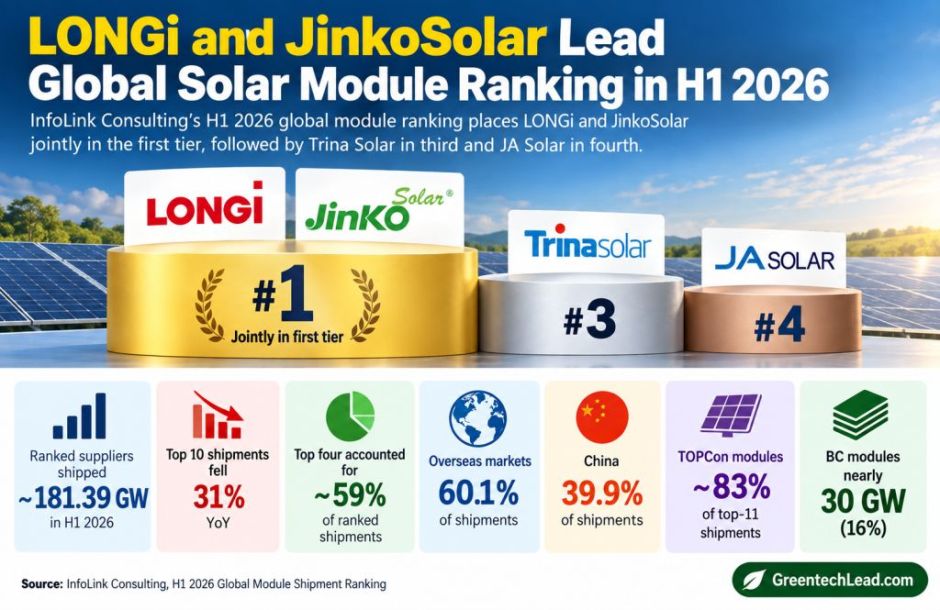
InfoLink Consulting’s H1 2026 global module ranking places LONGi and JinkoSolar jointly in the first tier, followed by Trina Solar in third and JA Solar in fourth. Suppliers included in the ranking shipped about 181.39 GW during the first six months of 2026. More importantly, shipments by the top 10 suppliers dropped 31 percent year over year, highlighting the difficult conditions facing even the largest manufacturers.
The four leaders nevertheless accounted for around 59 percent of shipments among the companies in InfoLink’s ranking. Their strategies are diverging: JinkoSolar is scaling TOPCon, LONGi is betting heavily on BC technology, Trina Solar is combining high-power PV with energy storage, while JA Solar remains a major vertically integrated global supplier.
JinkoSolar and LONGi Lead 2026 Solar Module Shipments
The shipment battle is extremely close.
LONGi reported 29.93 GW of module shipments during H1 2026, while JinkoSolar reported 29.6 GW. InfoLink therefore places both companies in the first tier rather than identifying a clear shipment winner. Trina Solar ranks third and JA Solar fourth.
The comparison also illustrates how sharply the market has changed. InfoLink reported that the leading group shipped substantially less in H1 2026 as weak demand in China, oversupply and capacity rationalization affected the industry. China represented only 39.9 percent of shipments among the top 11 suppliers, while overseas markets accounted for 60.1 percent. The overseas share increased about 18 percentage points from H1 2025.
This shift makes international manufacturing, distribution and project relationships increasingly important competitive assets.
JinkoSolar has one of the industry’s largest installed bases. Cumulative module shipments exceeded 420 GW by the end of June 2026, including more than 250 GW of Tiger Neo modules. Around 70 percent of its H1 shipments went to overseas markets, supported by a network covering nearly 200 countries and regions.
LONGi, meanwhile, shipped 48.91 GW of wafers, including 18.98 GW of external wafer sales, in addition to its 29.93 GW of modules. Overseas module shipments increased more than 26 percent, and overseas markets generated more than 65 percent of module revenue.
The numbers reinforce a broader shift in the global solar market: scale still matters, but geographic diversification and higher-value products are becoming equally important.
TOPCon vs BC Becomes the Critical Technology Battle
The biggest technological difference between JinkoSolar and LONGi is emerging around TOPCon versus back-contact solar cells.
TOPCon remains overwhelmingly dominant among the largest suppliers. InfoLink estimates that TOPCon accounted for around 83 percent of H1 2026 shipments from the top 11 manufacturers. BC modules accounted for nearly 30 GW, or approximately 16 percent.
JinkoSolar has built its position around industrial-scale TOPCon commercialization. Its Tiger Neo family surpassed 250 GW in cumulative shipments, and the new Tiger Neo 5.0 offers output exceeding 700 W with module efficiency of up to 25.91 percent. JinkoSolar also expects more than 40 GW of TOPCon 3.0 production capacity by the end of 2026.
LONGi is taking a different route.
Its BC module sales reached 19.55 GW in H1 2026, jumping 125 percent year over year and representing more than 65 percent of its total module shipments. LONGi also secured more than 10 GW of BC module awards in Chinese utility-scale procurement tenders.
That makes LONGi one of the strongest commercial advocates of BC technology at scale.
The battle is not simply about which architecture achieves the highest efficiency. Manufacturers need to combine efficiency with manufacturing yield, silver consumption, reliability, degradation, cost per watt and energy generation over a project’s operating life.
Why 700 W or 760 W Does Not Automatically Mean Better Economics
The industry’s race toward higher-wattage modules can obscure the metrics that matter to solar developers.
JinkoSolar’s Tiger Neo 5.0 exceeds 700 W, while Trina Solar has been pushing its Vertex family into still higher power classes. But headline wattage alone cannot determine which module delivers the best economics.
A utility-scale developer must consider module efficiency, dimensions, power density, bifacial performance, temperature coefficient, degradation, tracker compatibility and installation requirements.
Higher-wattage modules can reduce the number of panels, connectors, cables and mounting components required for a project. Higher efficiency can generate more electricity from limited land. Lower degradation can preserve production for decades.
The better metric is therefore lifetime value per watt, rather than nameplate wattage.
This transition from scale toward project economics is becoming increasingly important as solar module prices and manufacturing costs remain under intense pressure.
Solar Oversupply Turns Manufacturing Scale Into a Financial Test
For years, rapidly expanding manufacturing capacity was considered a sign of competitive strength. In 2026, unused or low-margin capacity can instead become a financial burden.
JinkoSolar expects annual integrated production capacity of around 100 GW by the end of 2026, including approximately 14 GW overseas. But its Q2 results demonstrate the financial pressure facing manufacturers.
Revenue fell 31.3 percent year over year to RMB12.36 billion, while gross profit was RMB513.1 million. Gross margin was only 4.2 percent, although that was above 2.9 percent a year earlier. JinkoSolar recorded a RMB697.3 million net loss attributable to ordinary shareholders.
JinkoSolar consequently reduced its full-year module shipment guidance to 60–70 GW, while saying high-efficiency products should represent more than 60 percent of shipments.
LONGi also faces industry-wide profitability pressure. Its H1 revenue was RMB27.045 billion. The company said supply-demand imbalance, capacity utilization and high silver prices affected profitability, although gross margin improved by more than two percentage points year over year.
The strategic message is clear: 100 GW of manufacturing capacity is valuable only if manufacturers can sell the output at economically sustainable prices.
InfoLink’s comparison with 2025 makes the change especially striking. Ranked global suppliers shipped around 536 GW in 2025, with JinkoSolar and LONGi jointly occupying the leading tier and Trina Solar and JA Solar in the next tier. In 2026, the focus is shifting from capacity expansion toward profitability and differentiation.
Trina Solar Builds a Solar-Plus-Storage Advantage
Trina Solar’s differentiation increasingly comes from combining PV modules with battery energy storage.
This is strategically important because utility-scale renewable projects are increasingly being designed around solar-plus-storage rather than standalone PV. Batteries can shift solar electricity into higher-value periods, reduce curtailment and provide grid-support services.
JinkoSolar is also expanding its ESS operations. Its first-quarter 2026 storage shipments reached approximately 1.42 GWh on a proof-of-delivery basis, with most shipments going overseas. The company expects its energy-storage business to grow as its power-conversion and energy-management capabilities expand.
LONGi is moving in the same direction. Signed energy-storage orders exceeded 3 GWh during H1 2026, complementing its growing BC module business.
The expansion of solar manufacturers into batteries suggests that the next competitive battleground will extend well beyond the module factory. Companies able to combine modules, storage, power electronics and energy-management software could capture a larger portion of renewable project spending.
That trend is also reshaping the broader renewable energy investment market.
Global Manufacturing Footprint Becomes More Valuable
Trade policy is adding another dimension to competition.
InfoLink’s H1 ranking includes U.S. production associated with all four leaders: Jinko Solar (U.S.) Industries, Illuminate USA for LONGi, T1 Energy for Trina Solar and American Panel Solutions for JA Solar.
Localization can reduce logistics risks and help manufacturers respond to tariffs, domestic-content requirements and procurement rules.
LONGi’s international numbers illustrate the opportunity. H1 module shipments increased more than 36 percent in the Americas, more than 34 percent in Europe and more than 20 percent in Asia-Pacific.
For JinkoSolar, around 70 percent of H1 module shipments already came from overseas markets.
The solar manufacturing race is consequently becoming a competition between global supply chains, not simply Chinese factories.
Who Is Winning: JinkoSolar, LONGi, Trina Solar or JA Solar?
There is no single winner because each company has developed a different competitive advantage.
JinkoSolar leads in TOPCon scale. Its cumulative module shipments exceed 420 GW, Tiger Neo shipments exceed 250 GW and Tiger Neo 5.0 reaches efficiency of up to 25.91 percent.
LONGi leads the BC commercialization push. Its BC sales reached 19.55 GW in H1 2026, growing 125 percent, and BC represented more than 65 percent of module shipments.
Trina Solar has a strong solar-plus-storage proposition, positioning the company to capture opportunities beyond conventional PV modules.
JA Solar remains a major vertically integrated global supplier, ranking fourth in InfoLink’s H1 module shipment table and maintaining a substantial international manufacturing and sales footprint.
In pure module shipments, however, JinkoSolar and LONGi remain the two companies to beat, jointly occupying InfoLink’s first tier.
Solar Leadership in 2026 Is About Value, Not Just Gigawatts
The most important development in 2026 is that solar leadership is moving beyond the number of gigawatts leaving factories.
Manufacturers must turn efficiency into greater electricity generation, high wattage into lower balance-of-system costs, manufacturing scale into sustainable margins and overseas production into supply-chain resilience.
JinkoSolar’s TOPCon scale, LONGi’s BC expansion, Trina Solar’s solar-plus-storage strategy and JA Solar’s integrated manufacturing model give each company a different route through the industry’s consolidation cycle.
But falling shipments among the largest manufacturers show that scale alone offers no protection. The top 10 suppliers recorded a 31 percent year-over-year shipment decline in H1 2026, even as technological competition intensified.
The company that ultimately wins the solar race will therefore not necessarily be the one shipping the most panels. It will be the manufacturer that can deliver more lifetime energy, stronger reliability and lower project costs while protecting margins.
In 2026, the decisive metric is increasingly not gigawatts shipped — but value created from every watt.
SHAFANA FAZAL