


India’s solar manufacturing industry is entering a new phase in which factory utilisation, technology, vertical integration and cost competitiveness are becoming more important than headline capacity additions.
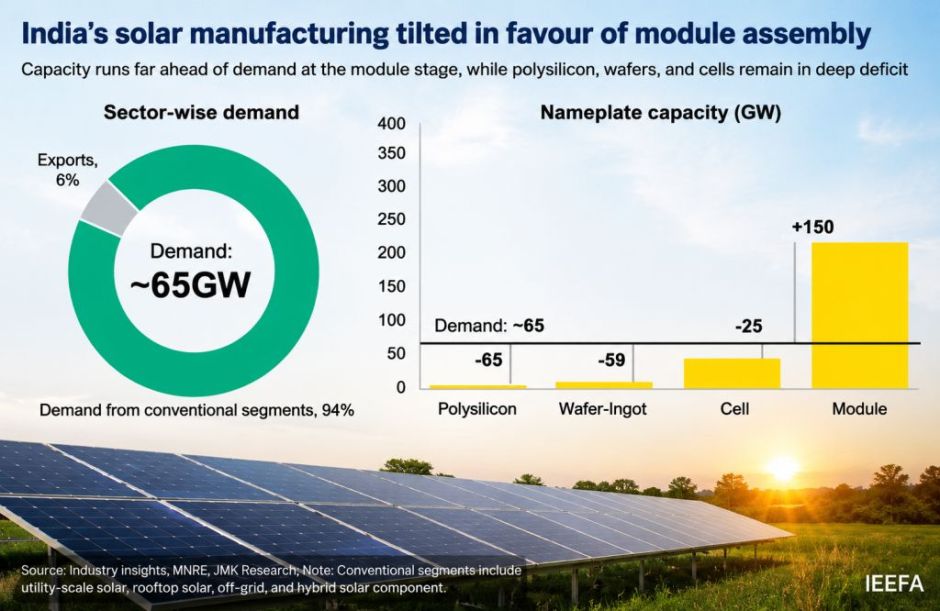
India had approximately 233 GW of solar PV module manufacturing capacity by June 2026, but plants were operating at only around 35-40 percent utilisation, according to an IEEFA and JMK Research assessment. This is materially below the estimated 50-65 percent utilisation required for sustainable manufacturing economics.
The pressure could intensify because another 135 GW of solar PV module manufacturing capacity is backed by firm investment commitments or projects considered highly likely to be commissioned.
The IEEFA assessment of overcapacity risk in India’s solar PV manufacturing market therefore signals an important change in the industry. India’s challenge is no longer simply to build factories and reduce dependence on imports. Manufacturers must now operate those factories efficiently, secure sufficient orders, invest in competitive technologies and generate acceptable returns on capital.
If manufacturing supply continues expanding faster than solar installations and exports, competition for orders could pressure module prices, margins, working capital and investment returns.
India’s 233 GW Solar Module Capacity Creates Utilisation Challenge
India’s manufacturing expansion has created a heavily downstream-focused supply chain. Module manufacturing has expanded much faster than domestic cell, wafer and ingot production because module assembly is comparatively easier and faster to establish.
However, nameplate capacity does not automatically translate into competitive production.
Factories operating at 35-40 percent utilisation continue carrying depreciation, financing, labour, maintenance and other fixed costs. Lower output means those expenses are spread across fewer modules, increasing effective production costs.
The contrast with the estimated 50-65 percent sustainable utilisation level is therefore critical. Adding another 135 GW before demand catches up could increase price competition as manufacturers seek orders simply to keep factories running.
Investors will increasingly need to distinguish between announced capacity, commissioned capacity and factories actually operating at commercially viable utilisation.
The government’s approved list of models and manufacturers for solar PV modules has supported domestic manufacturing, but the industry’s next challenge is turning policy-driven capacity creation into internationally competitive production.
Waaree Energies Invests ₹10,100 Crore in Upstream Solar Manufacturing
Waaree Energies is pursuing one of the industry’s broadest vertical-integration strategies.
The company has started construction of a 10 GW integrated ingot and wafer manufacturing facility in Nagpur, involving approximately ₹6,200 crore of investment. It has also commissioned another 3 GW of module manufacturing capacity at Samakhiali in Gujarat.
Waaree is extending integration into critical raw materials. It has taken a strategic stake in United Solar Holding in Oman to improve access to a traceable polysilicon supply chain and approved approximately ₹3,900 crore for a solar-glass manufacturing facility capable of producing 2,500 tonnes per day.
The company produced approximately 12.6 GW of modules in FY2026, including 4.2 GW during the fourth quarter. FY2026 EBITDA reached approximately ₹6,616.79 crore, according to the Waaree Energies FY2026 production and financial performance update.
Its strategy demonstrates how large manufacturers are shifting from module assembly toward integrated solar manufacturing. But returns will ultimately depend on whether new plants achieve sufficient utilisation as industry capacity expands.
Tata Power Uses Captive Solar Demand to Support Manufacturing
Tata Power has an important advantage in an oversupplied manufacturing market because its cell and module factories are connected to a large downstream renewable-energy business.
Its solar manufacturing operations produced approximately 3,825 MW of modules and 3,759 MW of cells during FY2026, generating around ₹6,968 crore in revenue and ₹857 crore in PAT.
The company has approved approximately ₹6,500 crore for a 10 GW photovoltaic ingot and wafer facility, planned in two phases of 5 GW each.
Tata Power’s downstream operations provide additional demand visibility. Its rooftop solar business has exceeded 4.8 GWp of cumulative installed capacity, including approximately 1.7 GWp added during FY2026, across more than 3.7 lakh installations. Its renewable portfolio has reached approximately 11.6 GW, including projects under construction.
The Tata Power FY2026 performance highlights how manufacturing combined with renewable development and rooftop installations can potentially provide greater protection against external module-demand volatility.
Vikram Solar and Premier Energies Bet on Higher-Efficiency Technology
Technology is becoming another dividing line between competitive manufacturing capacity and capacity vulnerable to obsolescence.
Vikram Solar’s Gangaikondan facility produces N-type TOPCon modules rated at approximately 615-640 Wp, with efficiency reaching 23.69 percent.
The company plans 9 GW of cell manufacturing capacity by FY2027, followed by another 3 GW by FY2028 and 12 GW of wafer and ingot capacity by FY2029-30.
Premier Energies has approximately 10.6 GW of annual solar cell manufacturing capacity and 11.1 GW of module capacity. Its TOPCon cells achieve efficiency of up to 25.2 percent, alongside its Mono PERC capabilities.
These investments demonstrate why India’s overcapacity problem cannot be measured only in gigawatts. A newer factory producing higher-efficiency TOPCon products at strong utilisation could have substantially better economics than an older PERC facility struggling to secure orders.
Jakson Commits More Than ₹8,000 Crore to Integrated Solar Manufacturing
Jakson Engineers is investing more than ₹8,000 crore in an integrated solar manufacturing complex in Madhya Pradesh covering modules, cells and wafers.
Vertical integration can improve supply security, increase domestic value addition and reduce dependence on imported intermediate products. However, upstream plants require significantly more capital than module assembly operations.
That creates additional risk if factories operate below economically sustainable utilisation levels. Companies making large investments will need sufficient demand to absorb depreciation, financing costs and working-capital requirements.
India’s manufacturing winners may therefore not necessarily be those announcing the largest factories, but those converting capital expenditure into highly utilised, technologically competitive production.
ReNew Links Solar Manufacturing With Renewable Projects
ReNew is following an integrated manufacturing-and-generation strategy.
British International Investment has committed US$100 million to support its manufacturing expansion, including a planned 4 GW TOPCon cell facility in Dholera, Gujarat.
ReNew is also pursuing a 6.5 GW ingot-wafer manufacturing facility in Andhra Pradesh, involving approximately ₹4,200 crore.
Its planned ₹22,000 crore hybrid renewable project in Andhra Pradesh provides another source of potential captive demand. The first phase includes approximately 587 MWp of solar, 250 MW of wind and 415 MWh of battery energy storage, with Made-in-India modules from ReNew’s manufacturing operations expected to be used.
Connecting manufacturing directly with renewable development could become increasingly valuable if industry-wide module oversupply makes external orders more competitive.
Adani Green and JSW Energy Show Underlying Renewable Demand Remains Strong
Manufacturing overcapacity does not mean India’s renewable-energy market is weakening.
Adani Green Energy added 5,051 MW of renewable capacity during FY2026, including 3,409 MW of solar, 686 MW of wind and 956 MW of wind-solar hybrid capacity. Its operational renewable portfolio consequently reached approximately 19.3 GW.
JSW Energy is targeting 30 GW of generation capacity and 40 GWh of energy storage by FY2030, supported by approximately ₹1.3 trillion of cumulative capital expenditure.
Storage could indirectly strengthen future solar demand because batteries allow renewable electricity to meet more flexible and round-the-clock power requirements.
The manufacturing problem is therefore one of relative growth: solar demand can expand rapidly while manufacturing capacity grows even faster, leaving factories underutilised.
Green Hydrogen, Data Centres and Exports Could Add 17-22 GW of Annual Demand
New sources of electricity demand could partially absorb India’s expanding solar manufacturing output.
IEEFA estimates that green hydrogen, data centres and exports could collectively create approximately 17-22 GW of additional annual module demand through 2030, beyond conventional solar deployment.
Green hydrogen requires large quantities of renewable electricity, while India’s expanding data-centre industry is increasingly seeking dependable low-carbon power. Both sectors could support additional utility-scale solar and hybrid renewable projects.
Exports represent another potential pressure valve. Europe, the Middle East, Africa and other markets could help manufacturers diversify beyond domestic customers.
However, exports expose Indian manufacturers to direct competition with Chinese suppliers that benefit from enormous scale, mature supply chains and integration across polysilicon, ingots, wafers, cells and modules.
TOPCon Transition Adds Technology Obsolescence Risk
Overcapacity becomes more problematic when existing factories are based on technologies losing market share.
The industry’s transition from PERC toward N-type TOPCon illustrates this risk. Manufacturers operating older lines may need additional capital for upgrades or could be forced to accept lower prices as customers move toward higher-efficiency products.
Manufacturing capacity should therefore be evaluated by technology, age and upgradeability, not just gigawatts.
Vikram Solar’s 23.69 percent module efficiency and Premier Energies’ 25.2 percent TOPCon cell efficiency illustrate the technological competition emerging alongside the capacity race.
India Solar Manufacturing Policy Must Shift Toward Competitiveness
India’s industrial policies have succeeded in creating a huge domestic manufacturing base. The next phase needs to focus more strongly on actual production, utilisation, upstream integration, R&D, technology upgrades and exports.
Transmission expansion is equally important because solar manufacturing demand ultimately depends on renewable projects receiving grid connectivity and reaching commissioning.
Repowering older solar projects with higher-efficiency modules could provide another source of demand while improving generation from existing land and transmission infrastructure.
Through 2030, investors should increasingly monitor utilisation rates, actual production, manufacturing cost per watt, cell and module efficiency, TOPCon capacity, upstream integration, order visibility, selling prices, working capital, debt, export exposure, captive demand and returns on invested capital.
India’s Solar Manufacturing Race Shifts From Capacity to Returns
India has created approximately 233 GW of module manufacturing capacity, establishing the foundation for one of the world’s largest solar manufacturing industries. But 35-40 percent utilisation, compared with the estimated 50-65 percent sustainable range, combined with another 135 GW of prospective capacity, creates a significant overcapacity test.
Waaree Energies is responding through large-scale upstream integration and solar glass; Tata Power combines manufacturing with renewable generation and rooftop demand; Vikram Solar and Premier Energies are investing in advanced TOPCon technology; Jakson is developing an integrated module-cell-wafer platform; and ReNew is connecting manufacturing capacity directly with renewable projects.
Meanwhile, Adani Green Energy’s 5,051 MW FY2026 capacity addition and JSW Energy’s 30 GW generation and 40 GWh storage targets demonstrate that renewable demand itself remains substantial.
The critical question is whether manufacturing supply is expanding faster than that demand.
India’s next solar manufacturing race will therefore not be about which company announces the most gigawatts. The competitive advantage will increasingly belong to manufacturers capable of achieving higher utilisation, lower production costs, deeper vertical integration, advanced technology and stronger returns on capital.
SHAFANA FAZAL