


Canadian Solar reported first-quarter 2026 revenue of $1.1 billion, supported by strong growth in battery energy storage shipments, expanding U.S. manufacturing operations, and a strategic transition toward higher-margin, value-driven business execution.
The company exceeded guidance across key operational metrics during Q1 2026, shipping 2.5 GW of solar modules and 2.1 GWh of battery energy storage systems. Solar module shipments surpassed the company’s guidance range of 2.2 GW to 2.4 GW, while energy storage shipments exceeded expectations of 1.7 GWh to 1.9 GWh.
Canadian Solar generated gross profit of $271 million in the quarter, compared with $124 million in Q4 2025 and $140 million in Q1 2025. Gross margin improved sharply to 25.1 percent from 10.2 percent in the previous quarter and 11.7 percent a year earlier, mainly due to a $93 million tariff refund benefit linked to IEEPA tariffs.
Despite pricing and supply chain pressures, Canadian Solar reduced its net loss to $32 million, or $0.71 per share, compared with a loss of $86 million in Q4 2025. Canadian Solar ended the quarter with a cash position of $1.9 billion.
Energy Storage Business Strengthens Revenue Mix
The company’s energy storage segment emerged as a major growth driver during the quarter. Battery energy storage shipments reached 2.1 GWh, increasing 5 percent sequentially and surging 142 percent year-over-year.
Canadian Solar said higher battery storage sales partially offset weaker solar module revenue during the quarter. The company also indicated that storage deployment volumes are expected to reach record levels in the second half of 2026.
Its e-STORAGE division reported a contracted backlog of $3.5 billion as of May 8, 2026, including long-term service agreements. The backlog represents binding customer commitments that provide multi-year earnings visibility.
CEO Colin Parkin said the company maintained disciplined shipment management strategies to protect profitability amid elevated feedstock costs, including rising silver prices, while leveraging higher-margin U.S. manufacturing operations.
Solar Module Shipments Decline Amid Value-Focused Strategy
Total solar module shipments recognized as revenue reached 2.5 GW during Q1 2026, declining 42 percent quarter-over-quarter and 64 percent year-over-year.
Canadian Solar attributed the decline to its strategic shift away from aggressive volume expansion toward higher-value and margin-focused business operations. The company said it intentionally managed shipment volumes in response to upstream cost pressures.
The company shipped solar modules and system kits to more than 60 countries and regions during the quarter.
While Canadian Solar did not disclose module ASP figures, management highlighted optimized shipment mix and improved U.S. domestic production margins as important profitability contributors.
U.S. Manufacturing Expansion Accelerates
Canadian Solar is significantly expanding its U.S. manufacturing footprint as part of its reshoring strategy and long-term supply chain localization plans.
Canadian Solar operates a 5 GWp solar module factory in Mesquite, Texas, and plans to double the facility’s nameplate capacity to 10 GWp during the second half of 2026.
In Indiana, Canadian Solar commenced trial production at its flagship heterojunction technology (HJT) solar cell manufacturing facility in Jeffersonville in April 2026.
Phase I of the Jeffersonville facility includes 2.1 GWp of solar cell production capacity and is expected to begin commercial operations in July 2026, becoming one of the first commercial-scale HJT solar cell plants in the United States.
Phase II is expected to start trial production in early 2027 and will add another 4.2 GWp of capacity, expanding Canadian Solar’s total U.S. solar cell production capacity to 6.3 GWp.
The company said additional production lines are being installed and commissioned throughout 2026 in response to strong customer demand.
Business Divisions Reorganized Around Manufacturing and Recurrent Energy
Canadian Solar reorganized its operations into two major business segments following the formation of CS PowerTech, a joint venture created to oversee U.S.-based manufacturing and sales operations.
The Manufacturing segment includes CS PowerTech and CSI Solar, focusing on solar products, battery energy storage systems, and power technology products across U.S. and international markets.
The Recurrent Energy segment focuses on solar and storage project development, electricity generation revenue, power services, and asset sales.
Recurrent Energy CEO Ismael Guerrero said Q1 revenue improvements were driven by the sale of the Fort Duncan project and the absence of pipeline impairment charges seen in previous quarters.
The company continues to monetize operating and under-construction assets to reduce debt and recycle capital into future growth projects.
Project Pipeline and Development Portfolio Expand
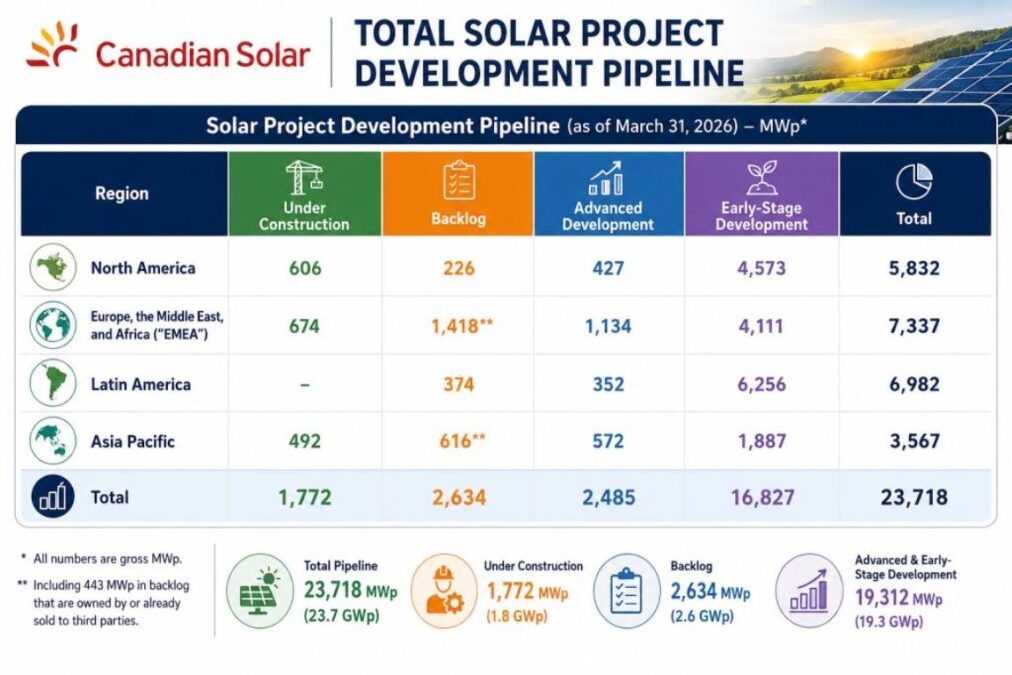
As of March 31, 2026, Canadian Solar’s global solar project development pipeline stood at approximately 23.7 GWp.
This includes:
1.8 GWp under construction
2.6 GWp of backlog projects
19.3 GWp in advanced and early-stage development
The company’s battery energy storage development pipeline reached 81 GWh globally.
Canadian Solar also operates a long-term power services business with 15 GW of contracted operations and maintenance (O&M) projects, generating recurring revenue streams.
The company’s strategy focuses on three primary growth pillars:
Electricity revenue from operating assets
Asset sales to improve cash flow and reduce leverage
Long-term O&M contracts for stable recurring income
Leadership Transition Supports Technology and Growth Strategy
Canadian Solar announced a leadership transition effective May 14, 2026, appointing Colin Parkin as Chief Executive Officer.
Founder Dr. Shawn Qu transitioned from Chairman and CEO to Executive Chairman and Chief Technology Officer, focusing on technology development and long-term innovation strategy.
BABURAJAN KIZHAKEDATH